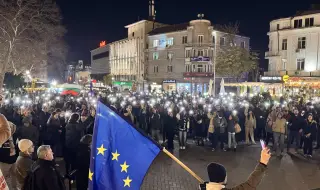
Tens of thousands of people filled the streets of the Bulgarian capital and other major cities on Thursday, calling for fair elections and an independent judiciary capable of effectively fighting mass corruption, writes AP.
The demonstrations in Sofia and other cities followed last week's protests, which were sparked by the government's plans to introduce higher taxes and increase state spending.
The government later withdrew the controversial 2026 budget and eventually gave in to the people's demands and resigned, recalls the American agency, quoted by BTA.
The latest events leave the EU member state without a budget for next year and without a regular government, just before Bulgaria joins the eurozone. President Rumen Radev is now expected to appoint an interim government and set the date for the next snap elections - the eighth in 2021, AP also writes.
People demanded fair and free elections that would not be compromised by vote-buying and falsification of results, as in the previous campaign, the agency adds.
At the heart of the protesters' dissatisfaction is the role of Bulgarian politician and oligarch Delyan Peevski, who is sanctioned by both the United States and the United Kingdom, and whose party "DPS - New Beginning" supported the coalition government in resignation, led by the GERB party of former Prime Minister Boyko Borisov, AP notes.
"Reuters" also points out that the main calls of the participants in tonight's protests were aimed at organizing fair elections and carrying out judicial reform to solve the problem of corruption.
The protesters held Bulgarian and European flags. One poster read: "This is not a farce", the British news agency reports.
President Rumen Radev is holding consultations with the parties represented in parliament, but if they refuse or fail to form a government, he will appoint a caretaker cabinet and schedule early elections, Reuters notes. Bulgaria, a NATO member, has held seven parliamentary votes in the past four years, the agency adds.
After mass protests earlier this month, the government withdrew its 2026 budget, which was the first to be drawn up in euros. Opposition parties and other groups said they were protesting plans to increase social security contributions and taxes on dividends to finance higher government spending, Reuters also reported.