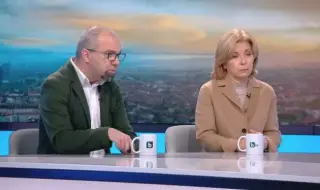
It is too early for exact numbers, but one thing is clear - Rumen Radev's possible entry into active politics could lead to serious shifts in parliament. The biggest resource for the new project are those who have not voted so far, and not the direct "drainage" of a single party. This was commented on bTV by sociologists Boryana Dimitrova from “Alpha Research“ and Parvan Simeonov from the “Myara“ agency, days after Rumen Radev's request to leave the presidency and join the political arena.
According to Boryana Dimitrova, it is too early to talk about electoral results. The first period after such an event is always highly emotional - with fascination, but also with disappointment.
“The first wave of emotions must pass in order to measure something more sustainable“, she emphasized, adding that an electoral breakthrough is entirely possible, but this does not automatically mean long-term sustainability.
The sociologist recalled examples from the recent past - NMSV, “There is such a people“, “We continue the change“ - formations with a powerful start, which, however, were faced with serious challenges in governance.
Potential for over 1 million votes?
Parvan Simeonov stated that Radev has the potential to exceed 1 million votes, but everything will depend on how strong the “wave“ will be and to what extent the project will be supported by people and a clear structure.
“One thing is a wave of 600-700 thousand votes, another is the scale of NMSV or GERB in their strongest years“, he commented.
Which parties are most vulnerable?
According to analysts, the biggest resource for Radev's project are the citizens who have not been voting lately. That is where the potential for serious electoral growth lies.
However, losses can also be expected for:
parties with a clearly expressed geopolitical profile, close to Radev's messages;
formations with a protest vote, for which Radev may prove to be the “more effective anti-status option“;
even parties from the status quo, where part of the so-called conformist vote may be redirected to the new “strong player“.
Leadership project with an ambiguous strategy
Boryana Dimitrova expects Radev not to abruptly change his public behavior. According to her, the future project will be strongly leadership, and his current strategy – „and with Europe, but not all the way“, „and here, and there“ – will probably remain.
„This is a successful election tactic, because everyone hears what they want to hear. However, in government, decisions cannot be postponed“, she warned.
Election rules – risk to turnout
Both sociologists expressed serious reservations about the ideas for last-minute changes to electoral legislation, including the introduction of new scanning devices for paper ballots.
According to them, such moves are technologically and organizationally risky and may demotivate some voters, instead of increasing confidence in the electoral process.
Analysts agree that the next parliament will likely be dominated by three large parties, with different weights, and the key question will be:
how high the voter turnout will be;
whether a majority of 160 MPs will gather for constitutional changes;
and whether the new project will show not only a protest charge, but also a clear management vision.
There are predictions that new elections may follow.