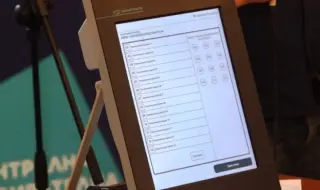
In view of the upcoming elections, the question of the method of voting and the technologies that will be used on election day is once again being raised. In addition to the voting machines familiar to voters, the public is increasingly talking about the so-called scanning devices. Although similar at first glance, the two systems have significant differences, emphasizes dariknews.bg.
How do current voting machines work?
The voting machines used in Bulgaria during the last elections are electronic devices with touchscreen, through which the voter votes directly on the screen.
The process is as follows:
► the voter selects a party or candidate on the screen;
► the machine records the vote in electronic memory;
► after voting, the device prints a receipt;
► the results are counted electronically and retrieved from the machine after the end of election day.
It is important to emphasize that the machines are not connected to the Internet and work offline, and the paper receipt serves as an additional guarantee for transparency.
What are scanning devices?
Scanning devices, also known as optical scanners, work on a different principle. In these, voting remains entirely on a paper ballot, and technology is used only for counting.
The process in this type of device is:
► the voter fills out a paper ballot manually;
► the ballot is placed in a device that scans it and counts the vote;
► the ballot physically falls into a ballot box and is stored;
► the results are automatically summarized by the scanner.
This model is used in a number of countries, as it combines a paper ballot with an automated count.
The main differences in brief
With current machines, voting is on a screen, while with scanning devices it is with a paper ballot.
With the former, the vote is electronically recorded and you receive a receipt for verification, and in the latter, the vote is on paper, but the counting is electronic and the ballot is kept in a ballot box.
In general, with current voting machines there is less human intervention, while the proposed method has a combination of paper and technology.
What are the arguments “for“ and “against“?
Supporters of machine voting point out that it reduces the number of invalid ballots and speeds up the counting of results. Critics, however, express doubts about the transparency and control over the software.
For their part, scanning devices are perceived as a compromise option, since they preserve the paper vote, but at the same time limit counting errors. Opponents of this model point out that the technology could again be subject to distrust or technical problems.
What does this mean for voters?
Regardless of the technology, the basic principle remains the same - the vote must be secret, free and correctly counted. For voters, the most important thing is to be informed about how the system they will vote with works in order to have confidence in the electoral process.
We remind you that on Wednesday (January 14) the scheduled meeting of the parliamentary Committee on Constitutional and Legal Affairs was canceled. The reason was the long-running plenary session.
The first reading was to discuss the Bill on Amendments and Supplements to the EC, submitted by Nadezhda Georgieva Yordanova (PP-DB) and a group of MPs on December 18, 2025. A joint bill of the bills on Amendments and Supplements to the EC, submitted by Kostadin Kostadinov ("Vazrazhdane"), Toshko Yordanov (ITN) and Atanas Zafirov (BSP-OL), adopted on the first vote on January 8, 2025, would have been submitted to the committee for a second vote.
The introduction of fully machine voting is one of the main demands of the opposition parties. They also made a request for this during the consultations with the president, which took place shortly before the Christmas holidays.