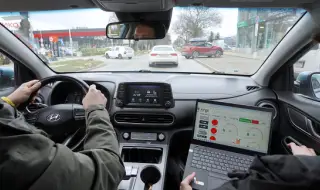
Serious air polluting cars are legally driving on the streets of Sofia, shows the first of its kind in the city, a practical study conducted by a highly qualified international team with specialized equipment at the invitation of the Ecological Association “For the Earth“. The reasons for the problem are related to the examination of the technical condition of the vehicles and the control over them. Pollutants that are significant from the point of view of human health, such as PM and nitrogen oxides, are not at all part of the regulatory checks during the annual technical inspections of cars in Bulgaria. Thus, here some cars are much more harmful to the health of the city's residents than others, without the system taking them into account and often even without the knowledge of their owners. The authorities in the country have serious reason to think in this direction, because the European Commission has already proposed a new directive on the subject, which will probably be adopted in the next few months.
(Un)hidden pollution
The concentration of ultrafine and fine particulate matter (PM) in the air of Sofia is very high, according to the study conducted at various locations in the city between February 24 and 26, 2026. A team including specialists from Germany, Romania and Bulgaria, led by one of the leading European experts in the field, Dr. Axel Friedrich*, is measuring the gases emitted by different types of cars, including ultrafine and fine particulate matter and nitrogen oxides. The cars were checked with various high-precision devices in different scenarios - stationary and moving on the streets. Part of the results were correlated with parallel checks conducted by the equipment used in annual technical inspections in Bulgaria in the conditions of a real GTP checkpoint, with the support of Technotest AD.
1/3 of the cars participating in the study, regardless of the fuel used, failed the ultrafine particulate matter test. At the same time, over 90% of all checked diesel cars (with a standard between Euro 4 and Euro 6) - practically all of them over 7 years old and a standard before Euro 6D - did not meet the required levels of nitrogen oxide emissions in street driving mode. All cars participating in the test had regular documents and successfully passed a technical inspection.
The results show that the contribution of ICE vehicles to poor air quality in the city should not be underestimated at all. What is more worrying is that in this case we are not talking about pollution from cars that have remained under the radar of control in the “second” way, but from those that are completely legal on the streets of the city, including within the Low Emission Zone in Sofia.
Measuring nitrogen oxides from passing cars on a Sofia street. Even relatively new cars sometimes give surprisingly poor results, and polluting and decent cars may be in the same eco category.
Are we measuring what we need to?
Although citizens continue to testify about shortcomings in road traffic control, the problem goes far beyond corrupt practices. When they are put on the market, cars must meet certain standards for particulate matter. To achieve these standards, vehicles are equipped with filters, depending on the type of fuel. A working filter removes up to 99.9% of particles, which ensures that air pollution in the city remains within acceptable limits.
Annual technical inspections should be able to track whether these filters are working normally, whether they are damaged or removed, by measuring particles, as is done during the initial certification of cars. In various European countries, for example, Germany, the Netherlands, Belgium, this is a fact. In Bulgaria, PM is not part of the indicators examined during annual technical inspections, but instead, smoke is measured - an outdated indicator that does not detect the problem. Nitrogen oxides are also not reported during periodic inspections by law, although many years of research by “Za Zemiata“, recognized by international experts and the Sofia Municipality, show that NO2 pollution is widespread in the city and above the norm all year round.
“Our measurements showed that some of the cars in Sofia work fantastically and do not significantly pollute the air. However, many of the others, probably those with damaged or removed filters, pollute dramatically“, says Dr. Axel Friedrich. “We had cars in which we measured 50 ultrafine particles per cubic cm, and in others - over 1 million”, he adds, specifying that it is probably a matter of even more serious pollution, but the device they are using for the initiative in Sofia has a ceiling of 1 million. As for nitrogen oxides, it is probably partly a matter of a problem related to the so-called. “Dieselgate“, experts believe.
1/3 of the cars tested emit harmful levels of ultrafine particulate matter - some even over 1,000,000 per cubic cm.
Rethinking control
The difference in the contribution to pollution of individual cars is a problem that concerns public justice. Measurements show that individual, even newer vehicles, can be major pollutants and control should be refined according to the individual technical condition of the car, and should not be imposed solely on the basis of its year of manufacture.
“Control over highly polluting cars is very key, because in this way one car can ruin the efforts of many“, emphasizes Dr. Friedrich.
“A major reform was made in Bulgaria in the measurement of GTP cars. "However, field data shows that even without cheating, a large number of polluting cars are driving quite legally," adds Ivaylo Popov from "For the Earth". He points out that even the most principled and well-intentioned vehicle owners are deceived in this way, who are simply not aware that their car emits harmful gases and particles and have no way of taking measures about it.
Our country is also distinguished by the lack of subsequent control on the street. "For the Earth" sent an inquiry under the Law on Access to Public Information to the Traffic Police. In response, the institution replied that they do not carry out measurements of potential road violators due to a lack of appropriate equipment.
Very soon, however, the Bulgarian authorities will probably have to rethink their approach, because the European Commission has already proposed a change in the directives that would oblige all EU countries to monitor more pollutants that actually affect human health.
“We call on the Bulgarian government to support this new regulation in Brussels, because the air quality in Sofia is quite bad, it is harmful to the health of people in Sofia and it is the role of the authorities to make sure that this stops“, concluded Dr. Friedrich.
Air pollution remains a leading cause of disease in urban environments, with PM and nitrogen oxides being two of the most important contributors to it in large settlements. Children and people with chronic diseases are particularly at risk. According to data from a recent study presented by the medical organization “Air for Health“, over 3,000 people die prematurely in Sofia every year from diseases caused by these two pollutants, and on average, each resident of the city lives between 11 and 20 months shorter because of them.