On March 15, Kazakhstan - the ninth largest country in the world - will hold a referendum on a new constitution. Sociological surveys show that over 70% of Kazakhstanis will go to the polls, and the percentage of young people who will exercise their right to vote next Sunday is also very high.
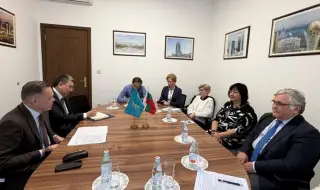
„The launch of our constitutional reform was an initiative of President Kassam-Jomart Tokayev. In his annual address to the people of Kazakhstan in September 2025, he announced the creation of a unicameral parliament. At that time, this was seen as part of a complete reboot of the entire political system of the country“, said the Ambassador of Kazakhstan to Bulgaria Viktor Temirbayev, who hosted a round table dedicated to discussing the large-scale political transformations and the upcoming republican referendum on the adoption of the new Constitution. It was attended by representatives of the expert and scientific-academic community, members of the “Club of Friends of Kazakhstan“ and the Bulgarian media, including a representative of FACT.
“The initiative was formed within the framework of the basic principle currently applied in the country: “Strong president — influential parliament — responsible government“. The focus is on modernizing the entire model of public administration and increasing transparency and accountability in all branches of government“, the ambassador added.
Work on the new text of the constitution began in October last year, when a special group was created for this purpose. It included well-known experts, academics, political scientists and representatives of public organizations and parties. At the same time, proposals from citizens were collected. During the discussions, it became clear that public demand far exceeds the simple reform or reorganization of the parliamentary model.
“In this regard, the president decided to create an expanded constitutional commission. It included 130 members representing various fields: science, education, media and public organizations. Thematic discussions were held, as well as public meetings and expert consultations. In total, over 10,000 proposals were received from Kazakh citizens“, said Temirbayev.
Initially, 40 articles were to be amended. However, in the process of work, it became clear that much more texts would have to be revised. In the end, 77 articles were revised, which is 84% of the entire text. “The focus was on creating an updated constitutional model that reflects modern realities“, said the ambassador.
The key idea of the draft for a new Constitution is the “human-centric“ nature of the state. Individuals, their lives, rights and freedoms are enshrined as the highest values. Nearly 30% of the Constitution is dedicated specifically to the rights and freedoms of citizens. “The text strengthens the guarantees for the protection of individuals, including personal data and the confidentiality of digital communications. In this way, the Constitution adapts the legal system to the era of artificial intelligence and digitalization“, the Ambassador of Kazakhstan specified.
Equal protection for all forms of property is also constitutionally enshrined. This increases the predictability of investments and the stability of the business environment. “All this should increase trust in state institutions and strengthen legal culture“, Temirbayev believes.
In institutional terms, the draft provides for a transition to a unicameral parliament. This model has been widely used, including in Bulgaria, and has proven its effectiveness in terms of the efficiency of the legislative process. Mechanisms for coordinating key appointments with the new people's representative body are also being strengthened.
The institution of the Vice President is being restored as a mechanism for national stability and continuity. “A similar mechanism exists in many constitutional systems in European countries“, the Ambassador recalled.
“The constitutional reform is a conscious step of our country, a sign of constitutional maturity, aimed at strengthening human rights and modernizing the political system. We remain an open, predictable and reliable partner and look forward to developing further cooperation with Bulgaria based on the principles of mutual trust“, concluded Ambassador Temirbayev.
During the discussion, the question of the possibility of online voting arose, in the context of the fact that Kazakhstan is making significant progress in digital technologies. On March 15, voting will be possible only in person. “I believe that with the development of digital technologies, electronic voting will become a reality in the future. We are already testing pilot projects, such as biometric verification. Any electronic voting requires very precise identity verification,“ said the ambassador.