As election day approaches, there is an increase in the desire to vote. This is shown by the data from the new sociological survey of the "Sova Haris" agency, conducted in the period 2-6 April 2026 among 800 Bulgarian citizens.
This is due to the formation of a position among some of the undecided. However, this effect does not radically change the picture for now. The number of voters can be expected to reach 3 million people.
The agency notes that the serious action taken by the Ministry of Interior against vote buying must be taken into account. It is indicated that if the forecast of the activity of about 3 million voters is confirmed, there will be a significant increase in the interest of citizens in the electoral process.
For now, the situation cannot be characterized as a wave, but it can be defined as a serious surge.
There are still 10 days left until the elections - usually the most important in any campaign, when events can occur that affect the final result. Such an effect could have a sharp jump in fuel prices, noted "Sova Harris".
The signing of the cooperation agreement with Ukraine by the caretaker government is also a factor that has the potential to change the behavior of voters.
The results of the study indicate that the topic of high prices and inflation has become a key one for the election campaign. For more than half of the voters, this is the most important issue. This is so, after 69.8% of adult Bulgarians fear that as a result of the crisis, their financial situation may deteriorate to the point that they will have difficulty supporting themselves. Only about 1/4 believe that it will not come to that. This means that most people feel on the edge, which is why they are looking for security and a change in the status quo.
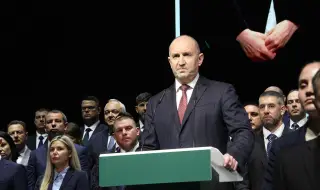
Support for individual political forces shows a relatively stable picture in the last month. The leader is the political project of former President Rumen Radev. An increase in the score of "Progressive Bulgaria" is registered, which shows that their campaign is giving them a positive result with a tendency for development.
Support for GERB-SDF is stable, which suggests a serious battle at the end of the campaign. As a result of the upcoming vote, a new bipolar model is emerging in our political space.
However, the results of the parties that will enter the National Assembly will be crucial for the direction in which events will develop after the elections. It will be important to have the opportunity to form not only a government, but also a qualified majority that will reform the Constitution and elect new leaders of the regulatory bodies, the agency points out.
According to the results obtained, the third political force is the PP-DB coalition, which may be crucial in creating a reformist bloc. The DPS is the fourth political force with chances in a coalition to be able to control the qualified majority and have an influence on changes in the judicial system.
However, the chances of this decrease if a sixth political force enters parliament - then the relative weight of Delyan Peevski's party will decrease. In this regard, the importance of the presence in the National Assembly of the coalition "BSP-United Left" is also evident.
"Vazrazhdane", whose place in the new parliament seems secure, is emerging as a corrector who, as an opposition, can influence a number of important decisions.
It is noted that most voters understand that the problems with inflation and prices depend mainly on foreign policy circumstances. For this reason, the assessment of political forces for military conflicts and Bulgaria's positioning in them turns out to be a fundamental factor in shaping support for individual parties.
The data show a clearly expressed public disapproval of the signing of the agreement with Ukraine by the caretaker government of Andrey Gyurov. The share of negative assessments is dominant, while the high percentage of undecided people suggests insufficient information or complexity of the topic. This is an indicator of a deficit of legitimacy in foreign policy decisions made by official authorities.
The public prefers a moderate and balanced foreign policy line regarding the wars in Ukraine and Iran - most people support a diplomatic approach that takes into account the interests of all parties.
Support for full coordination with the European Commission's line remains limited, which indicates a search for a more autonomous national position. A significant share of those who are undecided shows uncertainty regarding the complex international situation.
There is strong distrust of the consistency of the European Commission - a majority of voters believe that the same criteria are not applied to the conflicts in Ukraine and Iran. This perception can fuel Eurosceptic attitudes and a sense of double standards.
Scepticism prevails about the ability of the elections to produce stable governance. The share of negative assessments exceeds the positive ones, and the significant number of vacillators shows low trust in the political system as a whole. "Sova Harris" points out that this is a typical indicator of chronic political instability.
Public attitudes are rather critical of the caretaker government's ability to guarantee fair elections. Negative assessments outnumber positive ones, but without a clear majority, which speaks of polarization and uncertainty. The share of undecided people remains high, suggesting the sensitivity of the topic to current events.
The assessment of Iliana Yotova's performance as president of the country is positive, but not unambiguous. The share of positive assessments exceeds the negative ones, which indicates a stable public image. Even voters who profess views different from hers accept that her role as an arbiter and balancer in the political space is useful and commands respect.
Expectations for the election result are strongly concentrated around "Progressive Bulgaria" as the leading political force, while the other parties lag significantly behind.
At the same time, nearly 1/3 of people cannot judge, which signals potential dynamics and instability in electoral attitudes. This discrepancy suggests the possibility of surprises in the campaign and, respectively, in the election results.