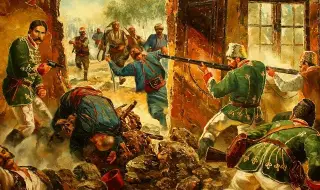
On April 20, 1876 (old style), the April Uprising breaks out in Koprivshtitsa.
This is recalled on "Facebook" by Radoslav Parvanov.
The April Uprising of 1876 is a tragic page in the history of the Bulgarian people, but it shows how strong their longing was to reject the Ottoman yoke and for freedom. Despite the heroism of the rebels, it was suppressed. The cruelty of the enslavers caused a number of intellectuals and diplomats in Western Europe to declare themselves in defense of the Bulgarian people, and the strongest reaction was in Russia. This April Uprising and the dramatic events that followed it led to a strong reaction in Russia, and ultimately to the Russo-Turkish War that led to the Liberation of Bulgaria.
Preparation of the Uprising
Vasil Levski worked most actively in preparing for the uprising. For years, he traveled the country and created revolutionary committees. But after the hanging of the Apostle in 1873, the revolutionary movement in the country fell into a severe crisis. A split occurred in it and two wings were formed - moderate and revolutionary. The revolutionary wing was headed by Hristo Botev. A Bulgarian Revolutionary Committee was created, which set itself the task of preparing our people for an uprising. At that time, the Ottoman Empire fell into a severe crisis and was declared bankrupt. Uprisings broke out in Bosnia and Herzegovina.
In September 1875, an uprising broke out in Stara Zagora, but it was poorly organized and quickly suppressed. After the failure of the Stara Zagora Uprising, Hristo Botev resigned as head of the Bulgarian Revolutionary Committee, which dissolved itself shortly after.
At the end of the year, young revolutionary figures created the Gjurgovski Revolutionary Committee and, in view of the deep crisis in the Ottoman Empire, decided to begin preparing an armed uprising in the spring of the following year.
They divided the country into 5 revolutionary districts – Tarnovo, Sliven, Vratsa, Plovdiv and Sofia.
Chief apostles were appointed to lead and coordinate the activities in preparing the uprising. However, real actions were carried out in the First Revolutionary District - Tarnovo and Plovdiv Districts.
In the Fourth Revolutionary District - Plovdiv, Panayot Volov was appointed as the chief apostle, but he later ceded leadership to Georgi Benkovski. Panagyurishte became the center for preparing the uprising, where an insurgent militia was created.
On April 14, 1876, in the area of \u200b\u200b“Oborishte”, near Panagyurishte, a general meeting was convened, which lasted until April 16. The meeting decided that the uprising would break out on May 1. Among the participants was a traitor, this was Neno Terziyski, who betrayed the decisions made to the Turkish authorities. They reacted immediately and sent mounted units to Panagyurishte and Koprivshtitsa to arrest the leaders of the rebels.
Outbreak of the April Uprising
The April Uprising broke out on April 20 in Koprivshtitsa. A mounted police group led by Nezhdeb Aga arrived here the day before. The officers attempted to arrest Todor Kableshkov, who was the head of the local revolutionary committee. The attempt to detain him was unsuccessful. Realizing that he was being betrayed, the next day, April 20, Todor Kableshkov declared the uprising. The rebels headed for the local inn and took it over. The church bells rang solemnly, the guns thundered, and from all the streets of Koprivshtitsa, rebels dressed in uniforms came.
Immediately after the beginning of the uprising, Todor Kableshkov wrote a letter informing the apostles in Panagyurishte about the events in Koprivshtitsa. This letter became known as the “Bloody Letter”, as it was symbolically signed with the blood of one of the murdered prisoners. The letter was carried to Panagyurishte by 19-year-old Georgi Salchev, who covered the distance between the two cities in a record two hours. His horse was so exhausted that he died before reaching the city.
Upon receiving the news of the declaration of the uprising, Georgi Benkovski acted immediately and Panagyurishte revolted. The power in the city was seized by the rebels and a Military Council headed by Pavel Bobekov was established. Ivan Parpulov, known as Orcho Voivoda, was sent to help the rebels in Strelcha.
On April 22, the rebel flag, made by the teacher Raina Popgeorgieva Futekova, better known among our people as Raina Knyaginya, was solemnly consecrated in Panagyurishte.
After the declaration of the uprising, Panayot Volov and Georgi Ikonomov headed for the northeastern regions of the district, and Georgi Benkovski, who in the meantime organized his horse Hvarkovata Cheta, headed for the village of Petrich to help the local residents who had risen against the tyrant.
Suppression of the April Uprising
The Turkish authorities took quick measures to suppress the uprising of the Bulgarian people. A regular army was sent against the rebel forces. The strongest reaction was against the center of the uprising in the Srednogorie. To attack Panagyurishte, Hafiz Pasha gathered 10,000 regular troops. The city was subjected to a cruel pogrom. Many peaceful residents were killed, their houses were looted and burned.
The fate of the Srednogorie village of Petrich was also tragic. Here, on April 24, the first victory of Georgi Benkovski's Hvarkovata detachment over the Turks was achieved. The next day, the village was attacked again. In the fighting, the Bulgarians achieved a second victory, with the attackers suffering a significant number of casualties, including their leader.
These were the only two victories of the Bulgarians in the uprising against the centuries-old enslaver. But Georgi Benkovski with his Hvarkovata cheta left for Mount Eledzhik to help the rebels who had occupied the peak.
On April 28, a regular Turkish army headed for Petrich under the leadership of Hafez Pasha, Bashibazouks and Circassians. The people of Petrich left their homes and took refuge in Sredna Gora, and the village was subjected to devastation and defeat, which lasted several days.
In the pogrom, 172 people of Petrich died, including 12 women and 25 children. The village was burned down. Only 27 houses survived. The attackers took with them everything of value - household utensils, livestock, clothes, food.
The rebels on Mount Eledzhik were attacked by the Sofia division led by Hasan Pasha. The defenders and the civilian population there were massacred.
Batak became a symbol of the tragic events of the April Uprising. Over 3,000 people were killed or burned alive here.
All this happened after the village leaders decided to voluntarily surrender their weapons to the leader of the Turkish bashibozuk Ahmet Aga in exchange for a pardon. The most cruel and massive massacre was the massacre in the local church "St. Nedelya". Here, for three days, mothers and children seeking salvation were surrounded. On May 3, the church was attacked and a mass massacre occurred.
About 30,000 people died in the blood-drenched April Uprising. About 200 villages with a total population of more than 75,000 people were destroyed.
April Uprising 1876 - reasons for the failure
There are numerous reasons for the failure of the April Uprising. Above all, it is a reflection of the long-standing slavery on the national spirit. The Bulgarian nation did not prove to be ready as a whole to reject Ottoman rule. In the Srednogorie, the uprising was massively supported, but in Northeastern and Northwestern Bulgaria it did not find any response.
At the same time, the organizers of the uprising made significant organizational mistakes. It was prepared in a very short time and no external support was sought.
In its design and implementation, it deviated from Levski's ideas. According to him, the Bulgarian revolution could succeed if it was nationwide, if it was prepared in an organized manner and had the strength to destroy the military power of the Empire. All this required serious and long-term preparation.
The preliminary announcement of the uprising also played a negative role. The Turkish authorities organized mass preventive arrests of committee activists throughout the country, which also showed betrayal in the ranks of the insurgents.
April Uprising - assessment
The uprising was brutally suppressed, but the assessment of the dramatic April Uprising was positive for its role and significance for the longed-for freedom. The atrocities against the Bulgarian people received a strong international response. As a result of this strong reaction of the international community, the Constantinople Conference was held. At this conference, the first international recognition of the right of the Bulgarian people to have their own state within their ethnic borders was obtained.
Thus, the unsuccessful April Uprising led to the greatest political success of the Bulgarian nation to that point. Later, the refusal of the Ottoman government to implement the decisions of the conference led to the decision of Russia to declare another Russo-Turkish war, which led to the Liberation of Bulgaria on March 3, 1878.