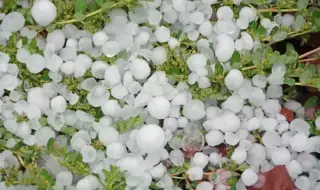
May and June are traditionally the most critical months for farmers in the Sliven region due to the risk of devastating hail. In recent days, powerful cumulonimbus clouds have passed over the region, putting the protection system under strain.
The hail season began actively in mid-April, but the real test came after the first 10 days of May. Over the territory of Sliven and part of Yambol region, for which the Regional Directorate for Combating Hail in Staro Selo is responsible, cells developed, which imposed a massive impact.
Regional Director Daniela Mushkova commented on the actions to deal with the element:
"These cloud masses were processed by our missile sites in volleys, so that we could saturate the cloud as much as possible with the active ingredient – this is silver iodide, and so that we could change the structure and the ratio between water and hail, in order to reduce the size of the hail and, accordingly, the force with which they strike the production on the ground. For Zhelyo Voivoda and Galabintsi – these are settlements, we do not have the right to shoot over the settlements themselves. Our goal is to preserve the agricultural production, which is subjected to a very long period of the impacts of – especially in our case, it is a hail-prone region – of the impacts of hail".
The changing climate is also reflected in the fight against hail. It is no longer about ordinary clouds, but about supercells that reach enormous heights and carry the so-called "dry hail".
"However, in recent years, the frequency of powerful cumulonimbus clouds has increased, reaching almost the upper limit of the atmosphere. Such processes used to be rare - once every few years, while since 2019 I have personally witnessed five such processes, which in five consecutive years caused enormous damage. They cannot be stopped for now by any means that people can use".
"We must have one thing in mind about our attitude towards nature and the way we treat what surrounds us", Mushkova was categorical.
The new realities due to climate change also require the search for new ways to deal with the icy element.
"For now, our directorate from the north, east and south has no neighboring directorates. If complete coverage of the country is achieved, then things will look different. We will not accept ready-made cells in our defense that cause such damage. As for the methods for improving the fight against hail, I am convinced that this is where we are heading – towards the use of new, safer methods. I hope that in the future things will improve and we will witness new methods with which to fight against such extreme phenomena".
The command post of the Regional Directorate for Combating Hail in Staro Selo coordinates the work of dozens of missile sites in the region. Decisions are made in seconds based on radar data.
"In May, we usually carry out between 7 and 9 active impacts. In June, they reach 15, since then the air humidity is also high, and as time progresses, the temperatures become much higher and conditions are created for the clouds to rise to such a height that suggests the formation of hail. Any rise of a cloud above the zero line suggests the formation of ice and there is no way to prevent this".
The forecast for the coming weeks remains uncertain, and the teams in Staro Selo are on 24-hour alert. For the farmers of the Sliven Plain, there remains hope that technology will be able to mitigate the blows of nature during this difficult season.