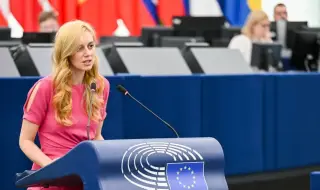
The debate on the introduction of the digital euro is entering a crucial phase in the European Parliament, with a vote on the report expected soon. While the European Commission and the European Central Bank present the project as a modernization of the payment system, critics warn of serious risks related to personal freedom, the privacy of personal data and the possibility of greater control over financial transactions. What can be expected... MEP Rada Lajkova from “Vazrazhdane“ speaks to FACTI.
- Ms. Lajkova, debates on the introduction of the digital euro continue in the EP. At what stage is everything?
- The vote on the report in the plenary hall is approaching. Although they have not yet officially put it on the agenda, we suspect that they will push it through quickly. The rapporteur for the report, Mr Navarrete, has been putting in a lot of pressure to get this report through the EP as quickly as possible. And it should be borne in mind that he was initially more critical of the digital euro.
When I asked the key question about the guarantees that the digital euro and digital identity would never be linked, the main rapporteur abruptly ended the meeting.
I never got an answer to this question. In the meantime, some central banks are working together to implement the key parts of the IT system and to check whether this is done properly. The key parts of the system are in-house, while the non-key parts are outsourced to external companies and suppliers.
The Austrian Central Bank is one of the few involved in the implementation process, and it does not check how the technical implementation is carried out, although this is precisely one of its tasks. It no longer requires its employees to check how the implementation of the key components for the digital euro is being carried out. Their task is to check whether everything is happening according to the agreement. The question - why the Austrians suddenly do not send their experts to check - is worth asking.
- You have repeatedly warned about the risks of the introduction of the digital euro. What is the biggest risk for Bulgarian citizens if this project is implemented?
- At first, there will be no difference, since Bulgarians will not be able to buy many things due to the strong inflation during the transition from lev to euro. Our statistical institute claims that inflation is low. However, the sharp jump in prices is obvious to everyone in Bulgaria, even tourism is down, since everything is now significantly more expensive. At first, the digital euro will only be used to highlight the special advantages of its use and to encourage its spread, so that it successfully penetrates the payment methods and people get used to it.
The problem is that this is a completely new monetary system that shares only the name euro. The creation of money, as well as the ability to program its use, are fundamentally different from familiar monetary systems and allow for greater control, even if they are not used at the beginning.
The possibilities are there. I have serious concerns that it is only a matter of time until digital identity and digital euro are merged, i.e. the wallet is linked to digital identity - the dream of Brussels. Monetary systems have always been about control, just as money controls behavior and incentives.
- You claim that the digital euro can lead to greater control over people's personal finances. What specific control mechanisms do you see in the proposals of the European institutions?
- At first glance, everything looks good, but a better understanding of how the current system allows control over people, countries, institutions, etc. is really needed. The new system with the digital euro includes components built into its very design: the programmability of transactions, the possibility of a difference in money creation and the potential to withdraw it from circulation in a more efficient and direct way than at present - all of which potentially allows for greater control of the central bank and governments over people, as well as a harsher redistribution of wealth.
The problem I see is the potential built into the design itself. At first glance, it seems harmless, but technology really allows this. The possibility of emergencies and threat analysis oblige me to be cautious as a legislator.
- More and more MEPs are talking about so-called programmable payments. What does this term mean and why do you think it poses a threat to citizens' financial freedom?
- This is a huge threat, which is at the very heart of the problem, if combined with digital identification. We see how the EU and the ECB first try to create a blurring of the issue, stating that the digital euro is not programmable - which is true - but the transaction itself is, as is everything else that can be done with money. Brussels' behavior does not inspire much confidence. Remember that the Lisbon Treaty was supposed to give more powers to member states. Critics pointed out that exactly the opposite would happen, and of course it did.
If transactions can be "conditionalized" through so-called "smart contracts", all kinds of manipulations can be created. If this is related to YOUR PORTFOLIO and you only have one single wallet tied to YOUR DIGITAL ID, you are essentially dependent on the will of Brussels.
This way, money can be created, let disappear if not used, or condition purchases on any aspect, such as CO2 emissions or whatever the Commission comes up with.
- Supporters of the digital euro claim that it will facilitate payments and reduce Europe's dependence on international payment systems. Is that true?
- Yes, but that is practically the only argument in its favor. There is no other. Even rapporteur Navarrete, who was initially critical of the digital euro, scoffed at this argument and rightly pointed out that the costs and dangers far outweigh the benefits.
The problem with this argument for a payment solution is that it is disproportionate to the costs.
It also raises the question of why other European options for other payment solutions have failed over the past decade. This is not just an application, this is a new monetary system and we, from “Vazrazhdane”, do not believe that it will benefit the people.
- Do you think that the introduction of the digital euro could lead to a gradual restriction of cash payments and how will this happen?
- We are increasingly seeing how the EU places citizens under general suspicion, for example, that they can launder money or finance terrorists, as more and more laws and lower and lower thresholds are being introduced (despite inflation), to see how we can make anonymous cash payments at all, but without the state having to monitor everything, supposedly to show that the money is being used legally. This same EU is directing over 100 billion euros to Ukraine and prohibiting any audits by the European Court of Auditors of these cash flows. The EU has presented us with the Regulation on “Cash in circulation as legal tender”, which aims to allay any concerns that cash could be displaced – although this is already increasingly happening – by electronic payment solutions. While the EP compromise on the regulation is certainly an improvement on what the Commission initially presented, it is still not strict enough, missing important requirements for cash acceptance for certain sectors and potentially creating loopholes.
I am currently investigating the case of the Austrian “Oberbank”, which has stopped all cash withdrawals for its customers and is directing them to grocery stores to receive cash. Absurd, since banks create money, literally (through debt), so they should provide cash, not grocery stores.
But Oberbank's actions are in conflict with another EU regulation from 2014, which actually requires banks to provide their customers with the ability to withdraw cash. I asked the Commission about this - you can see in my parliamentary questions. Commissioner Dombrovskis de facto agreed with my assessment, but then added vague comments that in this case the Commission should probably talk to the Austrian national authority. Usually, when the EU sees its laws being violated, it takes a tougher approach to resolving the problem - but here they pretend they have nothing to say and that they should talk to the Austrians, and in a vague way. (this can be read in Dombrovskis's answer) In any case, I asked a follow-up question whether after almost a year they really talked to the Austrians. In my opinion, this whole case will show whether the EU's commitment to protecting cash is real or whether the current regulation is only symbolic for show and a “paper tiger“.
- As a member of the Committee on Economic and Monetary Affairs in the European Parliament, how do you assess the readiness of the European institutions to guarantee the protection of personal data and the privacy of citizens when using the digital euro?
- I think the data would be fairly well protected from third parties, but this is not compatible with the digital identity approach, as the purpose of tying digital identity to the digital euro would be to put conditions on YOUR PAYMENTS. I am more concerned about the servers in the event of a complete failure. Few people know that the TARGET2 servers suffered a major incident two years ago, which completely blocked their operation for all transactions (within the EU and between banks) for many hours. Two components failed - the main component and the backup component, although they are intentionally completely separated. No clear explanation has been given as to why this once-in-a-billion event happened.
- How does the digital euro fit into the broader debate about national sovereignty and the right of countries to determine their own financial policies?
- Everyone who joined the euro has given up all sovereignty. All aspects of monetary policy have been transferred to the EU and the ECB. But the argument in favour of a digital euro is based on the use of Article 133 TFEU. Our minority opinion on the digital euro report is as follows:
„We voted against this report not only for the well-known political reasons that underlie our opposition to a digital euro. Furthermore, we consider that several elements of the proposed regulation raise serious doubts as to whether Article 133 TFEU alone provides a sufficient legal basis. While Article 133 TFEU allows for measures necessary for the use of the euro as a single currency, the regulation increasingly goes beyond traditional monetary measures. The cumulative effect of the provisions affecting the payment market and banking structures, centralised infrastructures, access mechanisms and commercial conditions between payment service providers raises concerns about competence and proportionality. We believe that the proposed regulation is based on an interpretation of Article 133 TFEU that would extend the scope of the Union's monetary competence beyond the limits established by the Treaties. These concerns were not adequately addressed during the legislative process. For these reasons, we cannot support the report in its current form.“
Our minority opinion also stresses that, given the many changes that the digital euro introduces, it is likely to be more than just a “new payment solution“ but a new monetary system. That is why the rapporteur, Mr Navarrete, has probably been subjected to “undue” influence that has suddenly transformed him from a critic of the digital euro into a zealous and tireless supporter.
- Is the digital euro project on the way to final adoption?
- It will happen. It is being forced on the European Parliament. The procedure for its technical implementation, as well as the way it is being discussed here in the European Parliament, should make people extremely cautious about this issue. I recommend that people not use it, so that its penetration into payment habits fails, regardless of the incentives they are trying to create for its use.
- “Vazrazhdane“ is part of the “Europe of Sovereign Nations“ group in the European Parliament. What depends on you, can you do something?
- We are trying to explain to people what we see here. We are analysing the possibilities. We cannot change much. Make no mistake, the right-wing parties do not have a majority here in the EP. The "cartel" parties push through every document here in the style of "backstage democracy" - there is generally no open discussion. This is "democratic inaction". Sometimes we manage to achieve success by including something important in a report, but with less than 30 MEPs we cannot change much if our votes are not really needed. In the legal tender regulation, we managed to add something crucial: Member States' assessments of how cash is used and supplied, potential problems with cash acceptance, etc., which have to be reported by Member States, have to be published together with the statistical methods, which have to be explained in detail, as well as the sources of the data. This allows independent researchers to analyse and verify these reports, so that Member States cannot create misleading reports that gradually support a 'race to the bottom' in cash availability based on the data and models they use. I published a press release a few weeks ago, before the Belgian Prime Minister blocked the use of the Russian assets. It clearly stated that the whole thing was a sham - they never planned to use the Russian assets, it was always planned to use Member States' money. This was just a distraction and attention for the Belgian Prime Minister. We reveal such things based on events and questions in the EP.