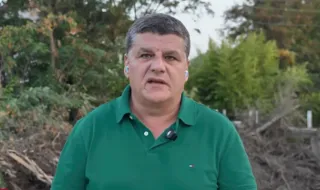
The cleanup after the severe flood in the Strumyani municipality continues with the help of heavy equipment, volunteers and teams of various institutions. The electricity and water supply in a large part of the affected area have already been restored, announced the mayor of the municipality Emil Iliev in the “Interview in NOVA News“.
According to him, during the day, sufficient machines, volunteers and representatives of various institutions worked in the field, coordinated by the municipal administration and emergency services. The main efforts were aimed at restoring the upper part of the riverbed, which in places has practically disappeared.
The state of emergency in the municipality will be extended after coordination with the regional governor. Iliev stressed that volunteers are still needed and welcome in the affected area.
“The riverbed is actually at the level of the first houses“, Iliev explained. Water supply has been restored, as has power to almost all homes. Three houses remain without power due to uprooted voltage regulating equipment.
The mayor pointed to a combination of factors that he believes contributed to the scale of the disaster - the large fires in the past two years, intense rainfall, logging and uncleaned clearings.
Iliyev recalled that in the past two years the area has been affected by two serious forest fires. One was in the Maleshevska Planina and lasted more than 20 days, and the other occurred last year in the area under Pirin.
According to him, the region from the Kresna Gorge to the south, encompassing the municipalities of Kresna, Strumyani, Sandanski and Petrich, is already facing a different climatic reality.
“Increasingly higher temperatures of the order of 41-42 degrees, increasingly rare but heavy rainfall create a completely different situation and prerequisites for such floods with high tidal waves“, the mayor pointed out.
He specified that the riverbed was corrected about eight years ago, and its complete cleaning was carried out two years ago. According to him, however, the problem is also related to the torrential floods that were expected after the big fire last year.
The scale of the processes high in the mountains became visible in the first hours after the disaster. The water carried huge trees, some of which were between 10 and 15 meters long and about a meter in diameter. According to Iliev, these are tree species that grow at an altitude of between 900 and 1300 meters. “There are gaps in all directions, including in logging and in uncleaned clearings“, said the mayor.
Specialists from the Institute of Hydrology have also visited the affected area. Together with the director of the General Directorate “Fire Safety and Population Protection“ Chief Commissioner Alexander Dzhartov local authorities have identified the location where the water blockage probably occurred.
According to Iliev, it is located significantly ahead of the bridge facilities, which were initially suspected to have contributed to the problem due to their insufficient throughput capacity.
The mayor also drew attention to the condition of part of the infrastructure. Some of the facilities were built in the 1960s and 1970s and no longer meet the new climatic conditions. “We now have to think about completely new engineering solutions – "both in terms of bridge facilities and riverbeds," Iliev is categorical.
When asked whether there should be sanctions for the shortcomings made over the years, he replied that everyone along the chain must bear their responsibility - both the local authorities and the state institutions and structures related to forest management.
After the visit of Prime Minister Rumen Radev, a working meeting was held with the Minister of Environment and Water Rositsa Karamfilova. The most urgent measures were identified that should limit the risk of a recurrence of such a disaster.
According to the mayor, the danger will not disappear with the completion of the current restoration. “A burned forest is not restored in a year or two. "In the next 10-15 years, such tests may be ahead for the population," Iliev warned.
In the meantime, the description of the damage continues. The most seriously affected are about 33-34 houses, with more than one family living in some of them. The inventory of the homes has been completed, but the final amount of damage has not yet been calculated.
The water supply has been restored, but the water is not yet drinkable. Additional tests are due in the coming days. Local authorities are also checking whether the flood has damaged the sewage infrastructure. "We need to be clear about what will happen from now on and what we need so that we don't have to work piecemeal," the mayor said.
After the removal of the large trees and other large debris, the cleaning of the accumulated sediment has already begun. The company's heavy equipment, which works on the bypass of the "Struma" highway, as well as machines from local companies, is also involved in the cleaning.
“From now on, we need to be more careful and really think two steps ahead about the consequences of climate change,“ concluded Emil Iliev.