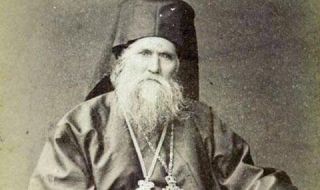
On December 1, 1816, Antim I was born. He was the first Bulgarian Exarch (since 1872), a prominent politician and public figure, who remained in history primarily as a fighter for the independence of the Bulgarian Church and for strengthening its role as a unifier of the people. His words are: "I will be blessed if with my sacrifice Bulgaria is resurrected for a new free life!"
Born in 1816 in Lozengrad, Eastern Thrace (today in Turkey) with the secular name Atanas Chalakov.
In 1837 he accepted monasticism at the Hilendar Monastery.
In 1843-1844 he studied at the most renowned secular school in the Ottoman Empire - the Great Greek Public School in the Kuruchesme quarter of Constantinople.
In 1848 he graduated with the first class from the theological school of the Great Church of Christ in Halki, Greece. From the preserved diploma, written in ancient Greek on parchment in 1848, it is clear that the future exarch graduated from the school with honors, that his teacher of sacred theology and philosophy was the rector Konstantin Tipald, and among the signatures is that of Neophyte Hieromonk Rilsky - professor of Slavic philology.
He entered the Odessa Theological Seminary with a scholarship provided by the Russian consul in Izmir. He continued his education at the Moscow Theological Academy, which he graduated in 1856 with a master's degree in theology. Because of his outstanding qualities, he was ordained to the hieromonk rank personally by Metropolitan Filaret of Moscow.
From Russia, the future exarch returned to Constantinople and the Patriarchate honored him with the dignity of archimandrite. For some time he was a teacher and rector of the theological school of Fr. Halki.
In 1861, Archimandrite Antim was ordained as the Metropolitan of Varna-Preslav, and in 1868 - as the Metropolitan of Vidin. The same year, he rejected the church's subordination to the Patriarchate of Constantinople and led the struggle for an independent Bulgarian Church.
On February 20, 1870, a sultan's decree was issued establishing the Bulgarian Exarchate. In March 1871, Metropolitan Antim was elected a member of the Provisional Synod of the Bulgarian Exarchate and participated in the Church-People's Council of 1871.
On February 16, 1872, Metropolitan Antim was elected by the Church-People's Council as the Bulgarian Exarch. The active and enlightened exarch played a significant role in the fight against Uniate propaganda, in the building of the Exarchate and in the cultural and educational upliftment of the Bulgarian people.
Exarch Antim I morally and materially supported the liberation movement for liberation from the Turkish yoke. In the exarchate's house in Constantinople he met with Hristo Botev (autumn 1875) and other revolutionaries, gave them money for the preparation of the April Uprising and blessed them with the words:
"Be blessed, you Bulgarian children. When you return to your comrades in Wallachia, tell them that from the high Exarchate throne, on which you have placed us, as worthy children of Bulgaria, I will not cease to be the bearer of the spirit of my people and with the most vigilant gaze and firm perseverance I will walk towards achieving its great national task (liberation)."
After its cruel suppression and the Batak massacres in 1876, on the initiative of Exarch Antim I, evidence of Turkish atrocities in Perushtitsa and Batak was collected. Exarch Antim I summarized them in a report sent to the ambassadors of the great powers in Constantinople. He also informed their governments about the Turkish atrocities, sending Marko Balabanov and Dragan Tsankov to Western Europe at his own expense, and himself headed a delegation to the Turkish government in defense of the Bulgarian people.
The activities of Exarch Antim I led to the convening of the Constantinople Envoys' Conference in December 1976. Despite pressure from the Turkish Foreign Minister, he refused to send a thank-you address from the Bulgarian people to the Sultan and the conference, with the words "We cannot thank a government that stabs, hangs and oppresses the people!"
In January 1877, Antim I thwarted a specially convened "Great National Assembly" in Constantinople by deliberately "slipping" in the Constantinople Baths. The sole purpose of the meeting was for Exarch Antim to publicly deny the Turkish massacres.
On April 14, 1877, by order of the Vizier, Exarch Antim I was deposed from the Exarchate throne. After a short trial, Midhat Pasha sentenced him to death for treason. After a recent coup in the Ottoman Empire, the sentence was commuted to exile.
On June 17, 1877, Exarch Antim I was sent into exile in Ankara, Asia Minor.
In a letter to the Russian Emperor Alexander II, Exarch Antim I described the plight of the Bulgarian people and asked the Tsar to intercede for Bulgaria. Reading it, Alexander II shed tears and wrote on it "Let Bulgaria be liberated!".
In March 1878, after the liberation from Turkish slavery, as a result of a general amnesty, Exarch Antim again took up his exarchical post and took an active part in the construction of the new Bulgarian state.
From February 14 to April 16, 1879, Exarch Antim I presided over the Constituent National Assembly, which elected the draft constitution he also supported.
From April 17 to June 26, 1879, he presided over the First Great National Assembly in Tarnovo, which elected Prince Battenberg as the first Bulgarian prince. Exarch Antim was also elected chairman of the First Ordinary National Assembly, but he refused.
In 1878-1879, Exarch Antim I was actively involved in the "Unity" committees, supported and provided great material assistance to the Kresna-Razlog Uprising.
On Shtipka, Exarch Antim laid the foundation stone for the erection of a monument to the heroes who fell for the freedom of Bulgaria and, by the unanimous decision of the National Assembly, headed a delegation to Russia, which thanked the Russian people and the Tsar-Liberator Alexander II for the Liberation of Bulgaria.
Exarch Antim returned to Vidin and took over the leadership of the Vidin Metropolis as a metropolitan, as he had been before being elected exarch. He bequeathed his entire fortune for the construction of the "St. Dimitar", for the construction of a community center and for the development of educational work in Vidin and built a large two-story junior high school (which today bears his name).
After the Berlin Congress in the summer of 1879, Antim I organized a mass collection of signatures in the Vidin and Vratsa dioceses against the decision to dismember San Stefano Bulgaria.
Unlike most Russophile politicians and priests, Antim I invariably defended Bulgarian national interests. When he realized that Russian imperialist interests threatened them, he supported the liberals in the person of Stefan Stambolov and Petko Karavelov, with whom he was also a long-time friend. "You liberated us from the Turks, I wonder who will liberate us from you?", Antim I asked Prince Dondukov in 1879, at a banquet on the occasion of his departure to Tarnovo.
Antim I declared himself sharply against the coup that overthrew Prince Alexander Batemberg on July 9, 1886, and supported Stambolov and the Regency.
On November 14, 1885, during the Serbo-Bulgarian War, Antim I refused to leave the besieged Vidin with the words "The body of a shepherd must be where the people and the army fall."
In 1887, he was a deputy in the Third Great National Assembly, which elected Ferdinand as Bulgarian Prince and publicly called on him to observe The Tarnovo Constitution.
On December 1, 1888, Exarch Antim I passed away in the city of Vidin.