


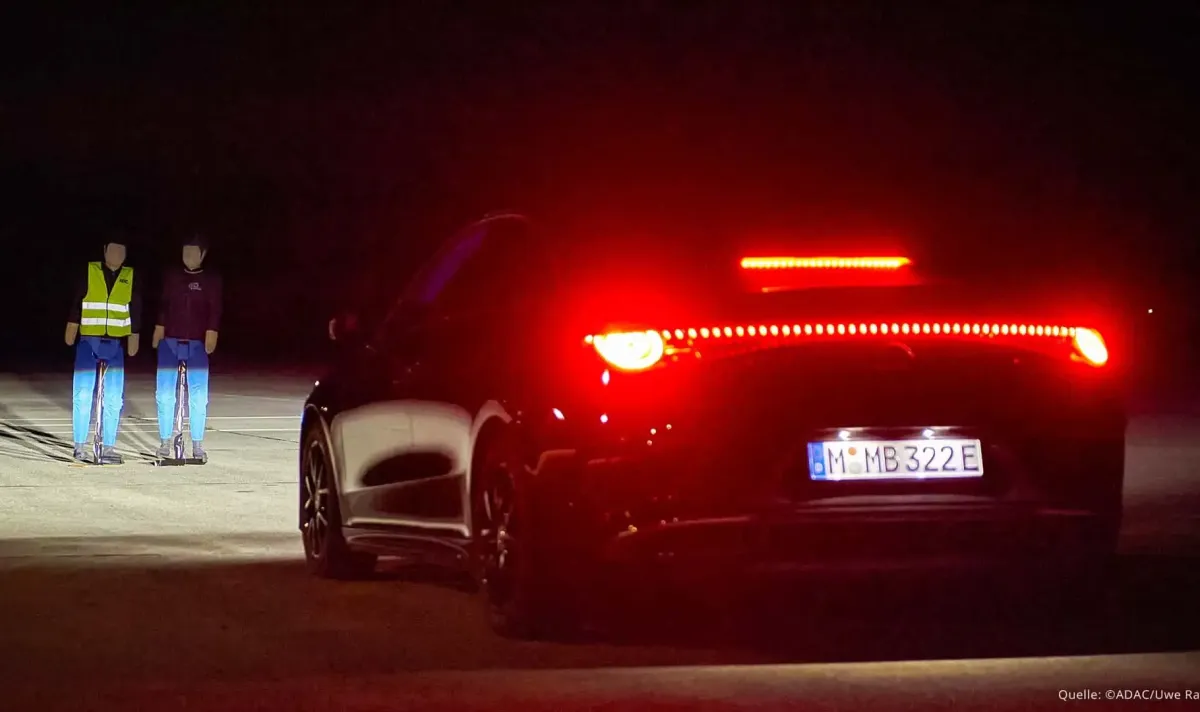

The emergency braking assistants of six modern cars show serious shortcomings in recognizing pedestrians in reflective clothing at night. Almost all the tested systems reacted too late or did not recognize an adult in standard work clothes, such as those used by construction workers, rescue workers, police officers and traffic police.
Even more problematic is the result with a child in reflective clothing and a school backpack. Although all the cars recognized a child in dark clothing, almost every system failed with reflective elements. The only exception was the Mercedes CLA, which was able to recognize a child who had stepped out from behind a parked car on the road.
Six cars in the night test
The ADAC study included the Mercedes CLA, Tesla Model Y, BYD Seal, Hyundai Tucson, Dacia Duster and Opel Astra. For each car, an individual speed was first determined at which the system could still prevent a collision with a dummy without warning clothing. This speed was used as a basis for the other scenarios.
With an adult dummy wearing a simple warning vest, all cars recognized the pedestrian and avoided the impact. The results changed when standardized workwear with reflective elements was used. Almost all systems detected the person too late or were unable to brake in time.
ADAC specifies that the results should not be used to directly rank the cars, as a different reference speed was applied for each model. The methodology is similar to Euro NCAP's night tests, but the recognition of pedestrians wearing reflective clothing is not a mandatory requirement either by law or in the approved assessment protocols.
Software fixes are possible
According to ADAC, the problem seems to be less related to the sensors and more to the way the software classifies road users. Therefore, the organization believes that in many cars, improvements can be achieved through software updates and called on manufacturers to react quickly.
The organization emphasizes that the driver retains responsibility for controlling the vehicle and must monitor the road in order to be able to intervene in case of danger. At the same time, ADAC recommends that pedestrians and children continue to wear high-visibility warning clothing during the dark part of the day. According to the organization's assessment, the benefit of better visibility for the human driver outweighs the risk that the assistant will react late or not at all.
Sources: de.motor1.com