


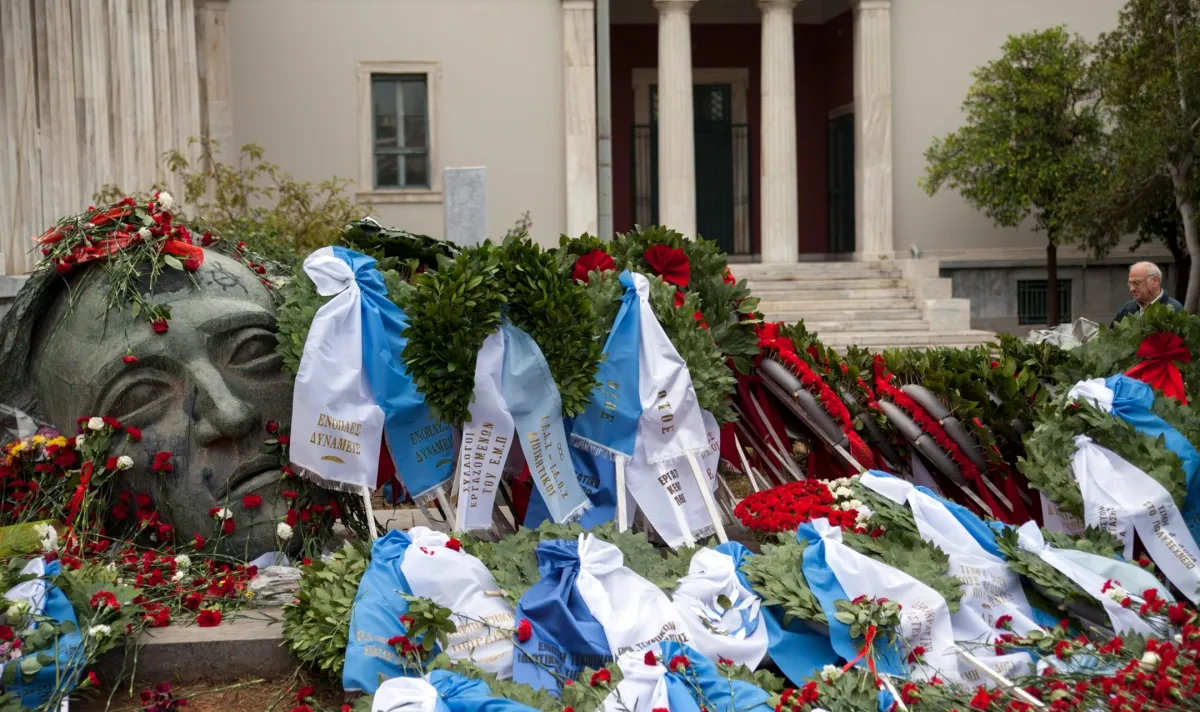

Shortly before dawn on November 17, 1973, a tank crashed through the gates of the Athens Polytechnic. Behind them were the students who, three days earlier, had turned the university into the center of an uprising against the military junta. Military and police units stormed the area, and the protest was dispersed by force.
The occupation began on November 14. Students from the National Technical University of Athens gathered with demands for democracy and an end to the dictatorship established after the coup of April 21, 1967. The slogans “Bread, education, freedom” were raised above the building, directed against the regime of Georgios Papadopoulos.
Radio Broadcasts from the Occupied Building
The students organized a radio broadcast that reached the residents of the capital. Appeals for support were made from the building, while thousands of citizens gathered around the Polytechnic. The protest gradually spread beyond the university and became the largest public demonstration against the junta up to that point.
On November 16, tensions escalated. Police forces were deployed on the streets around the Polytechnic, and gunfire was used against the demonstrators. According to the chronology of the University of Athens, the decision to deploy the army was taken late that evening by Papadopoulos. Tanks, infantry units, paratroopers and security forces were sent toward central Athens.
The Assault and the Victims
In the early hours of November 17, a tank broke through the main gate. The footage became one of the most recognizable images of the Greek resistance to dictatorship. After the army entered, the students were escorted out of the building, while many of them were detained, beaten and taken to police stations and investigative services.
Figures for the number of victims vary depending on the source. The preliminary prosecutorial investigation in 1974 cited 34 deaths, including 16 people whose identities had not been established. During the 1975 trial of those responsible, 24 deaths were proven. The number of injured people registered in hospitals was 1,103, while historical studies suggest that the total number of injured may have been around 2,000, as some people did not seek medical assistance for fear of reprisals.
From Papadopoulos’s Fall to the End of the Junta
The suppression of the uprising did not bring the military regime to an immediate end, but it deepened its crisis. On November 25, 1973, Brigadier General Dimitrios Ioannidis carried out a coup against Papadopoulos and established an even harder line.
The junta fell on July 24, 1974, following the failure of the Greek coup in Cyprus and the subsequent war with Turkey. The restoration of democracy turned November 17 into an official day of remembrance for the victims and a lasting symbol of resistance to dictatorship.
Sources: ertnews.gr, news247.gr, theguardian.com