


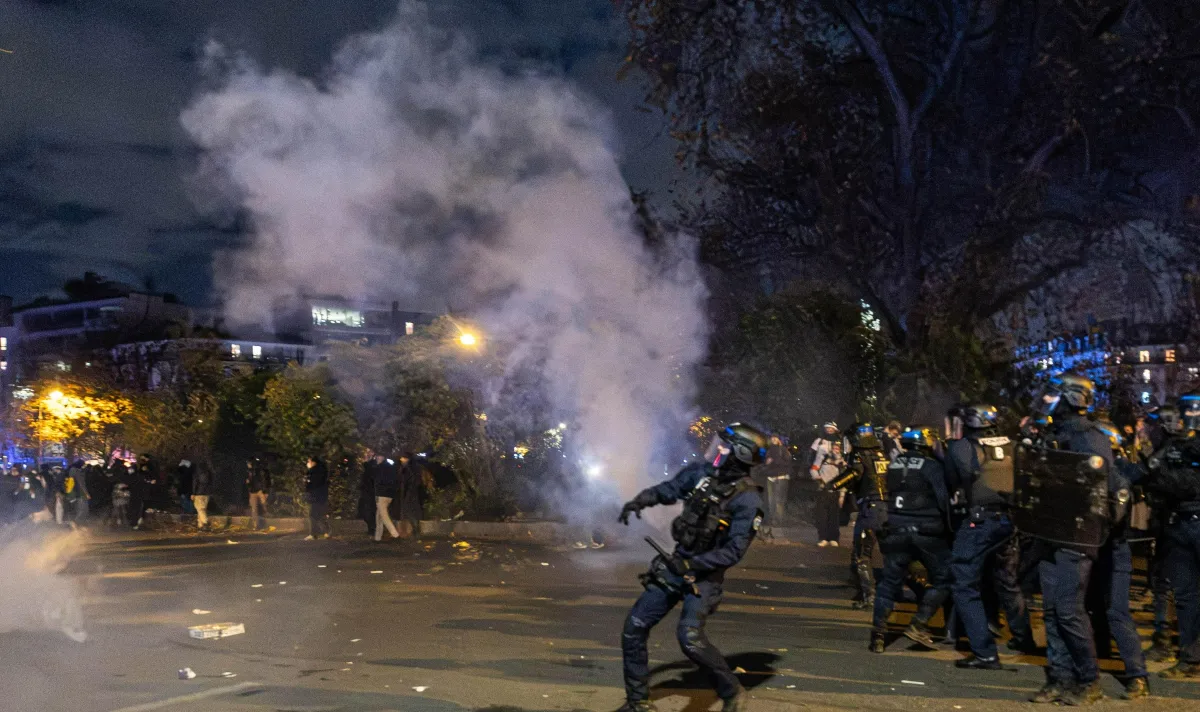

Europe is increasingly witnessing scenes that until recently seemed unimaginable on the civilized continent – streets on fire, shattered shop windows, attacked police officers and fans beaten in broad daylight. The question is no longer whether there is a problem, but whether there is anyone who can stop it.
“Student” protests that were not student protests
The so-called student protests in France were presented by some media outlets as a spontaneous expression of youth discontent. The reality on the ground, however, was completely different.
Instead of peaceful marches, we saw organized groups setting rubbish bins on fire, smashing bus stops, looting shops, throwing stones and firecrackers at police officers, and blocking entire neighborhoods. These were not student demands for better education. They were acts of vandalism committed by hooligans who seize every opportunity to sow chaos.
What is most alarming is the impunity. When a riot becomes routine and the state responds weakly with politically correct explanations, the message to those who follow is clear – you can destroy property and nothing will happen to you.
Marseille – Levski: When football became a battlefield
The same atmosphere of lawlessness spilled onto the football field during the clash between Olympique Marseille and Levski Sofia.
Instead of a football celebration, Bulgarian fans became the target of an organized attack by some Marseille supporters. The scenes of aggression, pursuit and assaults on visiting fans had nothing to do with sport or with rivalry in the stands.
This was not “football passion.” It was deliberate violence that endangered the lives and health of people who had come to support their team in a foreign country.
Where were the preventive measures? Where were security personnel, the police and the organizers? And most importantly – will there be real punishment for the perpetrators, or will everything once again end with a statement of regret and yet another “investigation” that produces no results?
A double standard that destroys trust
The problem is not limited to France. It is a problem across Europe, where anarchy is increasingly tolerated if it comes under the right slogan, while order is portrayed as extremism.
When a vandal smashes and sets things on fire, he is a “protester.” When an ordinary citizen demands security, he is “intolerant.” When football hooligans attack visiting fans, it is reduced to an “incident.” This discrepancy is destroying people’s trust in institutions.
Europe has a choice – either it will restore the rule of law, order and accountability for everyone, without exceptions and double standards, or it will continue watching as streets and stadiums turn into territories of impunity.
The question “is there anyone who can stop the anarchy” is no longer rhetorical. The answer must come from governments, UEFA and the courts – through swift, strict and visible punishments. Otherwise, next time it will be worse.
Additional real examples from the past 2-3 years
1. France, June-July 2023 – riots following the death of Nahel Merzouk
Following the death of 17-year-old Nahel Merzouk during a police check in Nanterre, France was engulfed by 8 days of unrest. According to official estimates, the damage amounted to 650 million euros, more than 1,000 buildings were damaged and 5,662 vehicles were burned. This was no longer a protest, but systematic arson, looting and attacks on public buildings, libraries, shops and transport.
2. United Kingdom, July 30 – August 5, 2024 – unrest following the Southport tragedy
Following the murder of three children at a dance studio in Southport on July 29, 2024, six days of protests broke out in England and Northern Ireland, escalating into riots, vandalism, looting and arson. In Southport itself, more than 50 police officers were injured, walls were smashed so that the bricks could be used as projectiles, and cars, a mosque and shops were set on fire. In other cities, hotels believed to be housing asylum seekers and police cars were attacked.
3. Amsterdam, November 6-7, 2024 – hunt for people following Ajax – Maccabi Tel Aviv
Before and after the Europa League match between Ajax and Maccabi Tel Aviv, tensions surrounding the war in Gaza escalated into street violence. Seven people, including five Israelis, were taken to hospital, while 20-30 people suffered minor injuries. After the match, Maccabi fans were ambushed and attacked in groups organized through social media, while Amsterdam police arrested 62 people.
4. Marseille – Levski, November 2025 – not an isolated incident
The violence at the „Vélodrome“ was not an isolated incident that evening. Clashes also took place that same night during the Beşiktaş – Hapoel Be'er Sheva match in Georgia, as well as an incursion by Polish fans into Sunderland – Jagiellonia's home section.
Regarding the Marseille – Levski match itself, the Marseille prosecutor's office has opened two investigations after six Bulgarian supporters were taken to hospital, one of them with a cerebral hemorrhage and a skull fracture. Reuters photographs show masked and bloodied fans with improvised weapons and metal pipes during the melee.
5. Aston Villa – Young Boys, November 27, 2025
Even in England, where security is considered the strictest, the Europa League match at „Villa Park“ led to a temporary stoppage of play, attacks on police officers, numerous arrests and a conviction for one visiting fan.
The conclusion
What all these cases have in common is not nationality, religion or a football club. What they have in common is the pattern:
A protest becomes an excuse for arson and looting. A football match becomes an excuse for an organized ambush. And the state and sports authorities respond slowly, with statements instead of swift arrests, stadium bans and real convictions.
That is why the question remains the same, but now with many more examples behind it: if lawlessness is becoming the norm in Paris, London, Amsterdam and Marseille, who will stop it before it becomes the norm everywhere?