



Nikolay Marchenko,
international affairs journalist (Sofia, Bulgaria)
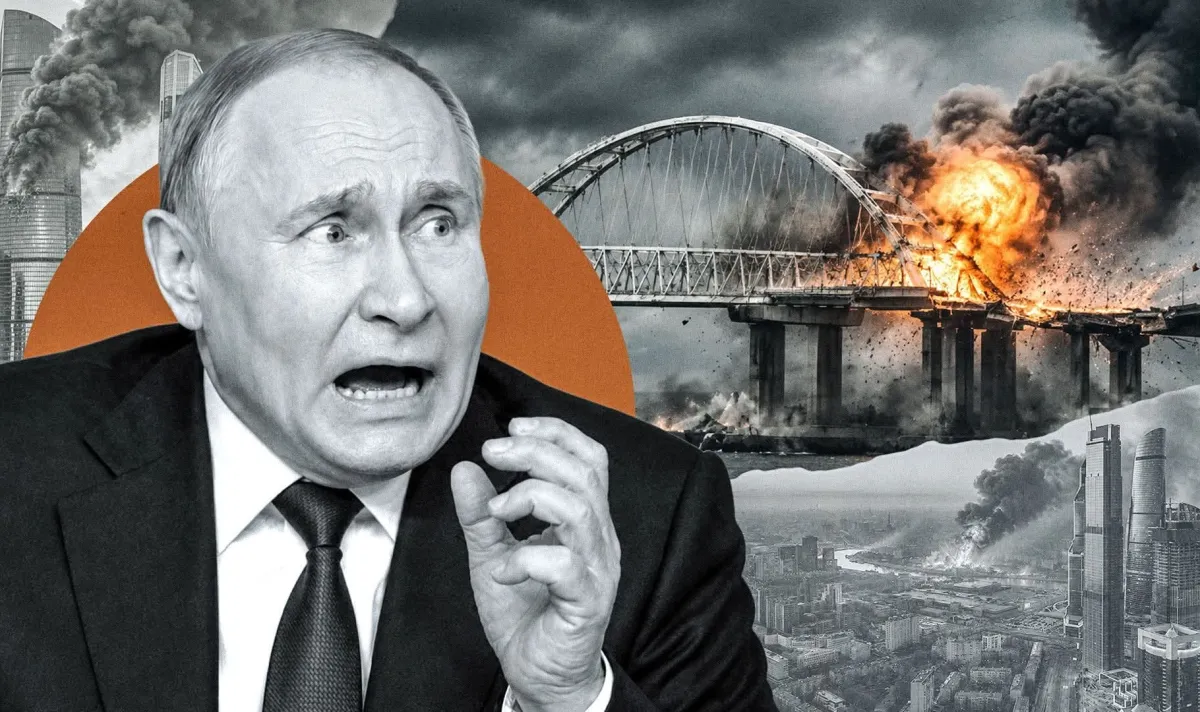
A study of coverage on Russian television and radio broadcasts, conducted by the international media-monitoring platform infosonar.com, found a sharp change in tone following the successful operation by the Armed Forces of Ukraine (AFU) to destroy the Kerch (Crimean) Bridge, built between 2016 and 2019, in response to Russian attacks on bridges in Kyiv. The main megalomaniacal infrastructure project of Kremlin autocrat Vladimir Putin collapsed following an operation by Ukrainian troops—on November 17, 2026, they destroyed the road section of the bridge and one of its arches. During the night of November 18–19, the strikes hit the railway section. From November 19 onward, the share of propagandistic statements in Russian media tripled, while calls for retaliatory action became the main topic, as Putin’s claim that the facility had a civilian purpose became part of the Kremlin’s political argumentation. Putin threatened retaliatory action, after which he would not “negotiate” peace with Ukraine. Kremlin-affiliated analysts, meanwhile, let slip on state television that the investments in the bridge would never pay off; it had been built merely as an expensive symbol of Putin’s Russia’s occupation of Crimea in 2014.
Russian television and radio significantly changed the nature of their coverage of the Crimean Bridge after reports of the AFU’s most successful operation to destroy it, carried out on November 19, 2026. While in the previous three months the main focus had been on the transport link to the Russian-occupied Crimean Peninsula, the state of the infrastructure and ensuring its security during the summer tourist season, in the four days following the attack on the bridge the information agenda visibly shifted toward military rhetoric, threats of retaliation and political statements.
The share of statements classified by researchers as propagandistic rose from 15.6% to 44.8%. Calls for retaliatory action began appearing more than four times as often—in 44.8% of broadcasts, compared with 10.5% during the preceding period. At the same time, the number of reports describing the bridge as an “exclusively civilian facility” rose sharply, while the damage to it was used as an argument to justify further escalation of the full-scale war against Ukraine. These are the main findings of the monitoring of Russian television and radio for the period from August 18 to November 22. The study covers 34 television and radio stations in the earlier period and 29 media operators after November 19. The total sample includes 2,682 broadcasts and 1,224 unique stories.
The results make it possible to trace not only the change in the tone of Russian media after the news of the AFU’s successful strikes, but also the mechanism by which the information agenda is formed: how reports about transport restrictions and infrastructure damage coexisted with political statements, how the emphasis in the presentation of the facility changed, and how the topic was incorporated into the broader context of the war and negotiations.
Not an infrastructure facility, but a Kremlin symbol
Until November 19, the Crimean Bridge was presented on Russian television and radio primarily as a transport artery linking Crimea. Transport and logistics appeared in 68% of mentions: electronic media reported on the movement of cars and trains, queues for inspections, crossing rules and security-related restrictions.
An illustrative example is a report by Radio Rossiya on August 21: “As for the situation on the Crimean Bridge, there are no queues before the manual-inspection checkpoint on the Taman side, while on the queue for manual inspection on the Kerch side there are about 600 vehicles. The waiting time is slightly more than two hours.”
This presentation corresponded to the logic used in covering the infrastructure facility: its importance was determined by its practical functions, the condition of the transport link and the consequences of traffic disruptions for the peninsula’s residents and economy.
The bridge, however, also had another dimension. In Russian media, it was regularly presented as a symbol of Russia’s annexation of Crimea and of the peninsula’s political connection with the country’s mainland. Its symbolic significance was noted in 8.6% of mentions, while its political significance and sovereignty were mentioned in 9.7%.
In August, the scandalous phrase was heard on Rossiya-1 television: “When will the Crimean Bridge pay for itself? Well, it will never pay for itself, but this is an infrastructure investment by the state that provides the very rationale for Crimea’s existence together with Russia.” This wording is telling: the bridge was described less as an economic or transport asset than as the infrastructure foundation of Putin’s political project for developing the occupied peninsula and as a symbol of his power over it.
At the same time, the airwaves claimed that the bridge was well protected and resistant to attacks. Security measures were a topic in 16.3% of broadcasts, while claims of its invulnerability appeared in 1.6%. The facility’s vulnerability was acknowledged in only 7.2% of mentions.
Thus, even before November 19, different perceptions of the bridge coexisted in Russia’s information space: a transport facility, strategic infrastructure and a structure whose security had repeatedly been the subject of discussion. But also a symbol of state prestige for the Putin regime.
A pretext for escalation on the eve of peace talks
One of the study’s most important conclusions is that the change in rhetoric did not begin immediately after the report of the attack on November 19. During the final three days of the preceding period, from November 16 to 18, the number of mentions rose sharply. During those three days, 936 of the total 1,406 broadcasts for the period from August 18 to November 18, 2026, were recorded—66.6% of the entire volume of the earlier period.
It was precisely then that new emphases appeared in the airwaves, later becoming central to the coverage of the events. The topic of the possible failure of the peace talks was particularly pronounced. All 129 broadcasts from the early period containing this narrative were concentrated in the days from November 16 to 18: 13.8% of mentions during the three days before November 19.
On November 16, Zvezda television and Komsomolskaya Pravda radio promoted the claim that the attacks on the bridge had supposedly been “aimed at derailing” Kyiv’s “negotiating process” launched by the administration of US President Donald Trump. Thus, the politicized interpretation of the events was formed even before the report of the AFU’s successful attack on November 19. The subsequent coverage did not create this line from scratch, but turned it into a large-scale and intensive information campaign.
Another element was the presentation of the facility’s rapid restoration and normal operation: on November 16–18, the narrative appeared in 56% of broadcasts—more than the average for the entire preceding period. This is important for understanding the subsequent dynamic: after November 19, Kremlin media intensified two seemingly contradictory lines—reports of serious damage and the occupying state’s ability to quickly restore the infrastructure.
November 19: rising intensity and a change in tone
The scale of information coverage after November 19 significantly exceeded the figures for the preceding months. For the period from August 18 to November 18, monitoring recorded 1,406 broadcasts over 93 days—an average of 15.1 mentions per day. During the following four days, from November 19 to 22, 1,276 broadcasts were recorded, or an average of 319 per day—the daily intensity of mentions increased more than 21-fold.
At the same time, the number of unique stories after November 19 was 515, compared with 735 during the preceding 93-day period. This indicates significantly more concentrated coverage of the event, in which the same topics were reproduced across different channels and at different times. In the first hours of November 19, the media mainly reported on the suspension of traffic and assessments of the consequences. Radio Sputnik quoted the so-called “head” of the Russian-occupied republic, Sergey Aksyonov, who said that “traffic on the Crimean Bridge has been suspended following another AFU attack.” And that “all responsible services are at their workplaces”: “Let me remind you that this is the third attack on the Crimean Bridge in one week.”
Kommersant FM radio, owned by Russian oligarch Alisher Usmanov, broadcast a statement by the Russian Ministry of Transport on the suspension of rail traffic and the assessment of the damage. The morning broadcast included factual information, but over the course of the day the coverage took on an increasingly pronounced political dimension. The key turning point came after public statements by the Russian president, which received extensive coverage.
The share of propagandistic statements rose from 15.6% before November 19 to 44.8% afterward, while the share of informational reports fell from 54.4% to 32.8%. The difference reflects not merely an increase in the number of items about the attack—it testifies to a substantial change in the nature of the presentation: politicized assessments, accusations, threats and statements about retaliatory action occupied a larger place in the coverage of the event.
Putin’s “response” as a political narrative
The most tangible change concerned calls for retaliatory action. Before November 19, such statements appeared in 147 broadcasts, or 10.5% of all broadcasts. After that date, their number reached 572—44.8% of all broadcasts during the four days. Thus, the topic promoted by the Kremlin dictator became a central line of meaning in the coverage of the Crimean Bridge.
In particular, on November 19 Rossiya-1 television broadcast a statement according to which Moscow had no intention of continuing negotiations with Ukraine after the attack and would carry out retaliatory strikes. Later that day, Business FM aired a more detailed statement by Putin: “I had given a direct order: the Crimean Bridge must not be used either to transport military equipment or to transport ammunition.”
The dictator claimed—obviously addressing an international audience—that the Russians “had not transported even oil or petroleum products across the bridge”: “This is an exclusively civilian facility.” Putin then moved on to threats concerning the Washington–Moscow–Kyiv peace process: “But following the strikes on the Crimean Bridge, we will not negotiate; we will respond to these strikes.” “And I want everyone to know this. I believe that the retaliatory measures will be much more painful than what the Kyiv regime did to the bridge,” the Russian president complained. And for the domestic audience of Russian propaganda he added:
“And, of course, we will rebuild the bridge.”
The context preceding his statement about the “response” is particularly interesting. According to the Russian news agency Interfax, Putin said that he had discussed with members of the Security Council of the Russian Federation some “possibility of arrangements to stop strikes on certain facilities”—energy and maritime infrastructure. He had asked “his colleagues to consider this issue further.” He then linked the change in his position to the AFU attack on the bridge. This shows how painful the event was for him—and how correct the operation was from Kyiv’s perspective: Putin is issuing threats out of helplessness in the face of strikes he failed and can no longer prevent.
Three elements of meaning clearly stand out in Putin’s quote concerning retaliation against Kyiv over the bridge: the claim that the infrastructure was civilian in purpose, the refusal to negotiate and the promise of a more painful retaliatory strike. This combination became a characteristic feature of the new stage of media coverage.
The study shows that retaliatory action was discussed not only on the most radical pro-war media platforms. The topic also became central to the federal state media: they accounted for 266 of the 572 items containing the relevant narrative. Among private pro-war media, the line also ranked first: 77 of a total of 165 broadcasts. In particular, Vladimir Solovyov’s Solovyov Live platform, belonging to Putin’s chief propagandist and biographer, featured 60 such statements out of 105.
But it is impossible to speak of complete uniformity in the Kremlin’s media space. Pro-government economic media in the occupied territories more often emphasized the restoration and normal operation of the bridge. The overall information picture after November 19, however, was far more politicized.
Putin’s “civilian facility” justifying retaliatory measures
Another important finding of the study is the sharp increase in the message that the Crimean Bridge was merely a “civilian facility”—propaganda adopted the Russian head of state’s argument.
Before November 19, this characterization appeared in 3.3% of broadcasts. After that date, the figure rose to 21.9%. The number of relevant mentions increased from 47 to 279. Russian broadcasters repeatedly emphasized that the bridge had supposedly not been used to transport military equipment, ammunition or petroleum products. The claims were conveyed with reference to statements by Russian officials, beginning with Putin himself, who lied about the bridge’s “peaceful purpose” against the backdrop of Ukrainian intelligence data documenting the transport of military equipment and weapons.
In the context of the study, what matters is not how accurately each claim describes the actual use of the infrastructure, but what function it performs in the Kremlin’s media message. Presenting the bridge as an exclusively civilian facility allows for a consistent political argument: the attack was supposedly a strike on civilian infrastructure, followed by justification for retaliatory action and the termination of negotiations with Ukraine.
At the same time, the study shows that the bridge’s military purpose was mentioned increasingly rarely: the share of mentions fell from 2.6% to 1.3%. After November 19, the promotion of the thesis that the bridge was civilian intensified, as censorship simply “shrinks” references to its military functions during the period of full-scale aggression against Ukraine.
Acknowledging the damage under strict state control
A substantial change also occurred in descriptions of the consequences of the attacks. Before November 19, Russian media used vague formulations suggesting that the damage was insignificant—the downplaying of the damage appeared in 7.4% of broadcasts. After November 19, its share fell to 1.3%, while reports directly acknowledging the seriousness of the damage rose from 7.1% to 24.8%. The change reflects a transition from vague reports to a more specific description of the damage.
Thus, on November 19 Business FM reported that “the road section was seriously damaged and closed for an extended repair, while the railway lines had so far been closed temporarily”: “Cargo deliveries, although interrupted, continue. The attacks on the Crimean Bridge have so far not affected supplies to the peninsula.”
Acknowledgment of the damage, however, was not accompanied by the abandonment of another persistent line—the demonstration of the authorities’ ability to control the situation and quickly restore the infrastructure. The narrative of the bridge’s restoration and normal operation was the most widespread one even after November 19. Its share rose from 38.3% to 52.4%: the number of such broadcasts was 668, compared with 538 during the preceding period.
The Kremlin has instructed propaganda outlets to reassure residents of the occupied and front-line regions so as to prevent the kind of panic seen on social media. Footage of frightened and outraged motorists is actively shown in the broadcasts of Russian opposition media in exile—for example, by Dozhd television.
It is telling that reports of serious damage and statements about restoring the rail link could exist in the same information space. The distinction between the road and railway sections of the bridge made it possible simultaneously to acknowledge the damage and emphasize the partial resumption of its transport function. Thus, instead of emphasizing the facility’s invulnerability, another model emerged: the damage is acknowledged, but the consequences are presented as controllable and restoration as inevitable. All in the spirit of Putin’s statements.
Kremlin television and radio: nuances of media hysteria
The study found significant differences between the Russian television and radio airwaves. Before November 19, the share of propagandistic statements was identical on television and radio—15.6% each. After that date, the difference reached 20.7 percentage points. On television, 55.2% of broadcasts were propagandistic, while on radio their share was 34.5%. The share of informational reports was 24.6% and 40.9%, respectively.
Television was much more active with the narrative of retaliatory action: it appeared in 346 of 638 broadcasts, while on radio the corresponding figure was only about one-third—226 of 638. The television agenda performs a more pronounced mobilizing and political function, while radio retains its informational component to a greater extent—reports on train movements, transport restrictions and the progress of restoration work.
Differences were also observed among individual media channels. Solovyov Live led in the number of propagandistic broadcasts both before and after November 19—their number reached 69. It was followed by NTS (Sevastopol, Crimea) with 48 broadcasts, Komsomolskaya Pravda radio with 45 and Vesti FM with 42.
At the same time, the private Kommersant FM retained its restrained informational approach: 48 of the 70 broadcasts after November 19 were informational. A similar trend was observed on Moskva FM, where the figure was 34 out of 49.
This difference is important for understanding Russia’s media space. Even within a common political framework, different media performed different functions: some transmitted politicized assessments, while others continued to focus on the practical consequences for traffic around the bridge. Hysteria in Russian media varies in intensity—the private media of Russia’s biggest oligarchs are trying to sit on two chairs in case Putin leaves and his regime is replaced with a more democratic one.
Aggressive rhetoric and appeals to authority
The change in content was accompanied by a transformation in tone. The share of aggressive statements rose from 5.4% to 30.5%: their number increased from 76 to 389. Meanwhile, the share of calm presentations of information fell from 64.7% to 48.6%. There was an increase in arguments based on appeals to authority—from 8.6% to 36.8%.
The technique involves strengthening claims by referring to a high-ranking official, as happened with Putin’s reasoning and Aksyonov’s promises. It also applies to experts’ statements—instead of presenting evidence independently.
Another trick is the repetition of the same theses in different broadcasts and media outlets. The mechanism increases the presence of specific formulations in the information space and links reports about damage to the facility with the broader political interpretation of the conflict between Moscow and Kyiv. What is the propaganda message? Putin had supposedly been preparing for negotiations, but Ukrainian President Volodymyr Zelensky suddenly struck the greatest infrastructure achievement of his Russian counterpart—right at the heart of the dictator’s pride. Thus Kyiv is accused of derailing nonexistent negotiations through its attack on the Crimean Bridge.
Information panic and its limits
Despite the rise in politicized rhetoric, the transport and logistics component did not disappear entirely from the coverage. After November 19, transport and logistics remained the most frequently mentioned characteristic of the bridge—appearing in 52.9% of broadcasts. Its technical condition and damage were mentioned in 33.1%, while the civilian nature of the facility appeared in 22.3%. Reports about the consequences for Crimea increased from 12.4% to 17.1%. But only those who follow Russian media in exile and the social media accounts of Russian users can see the dissonance—panic has gripped Russians in the areas near the front. In Kremlin media, however, they assure audiences that the situation is under the authorities’ control.
The Kremlin’s reliance on propaganda is clearly producing no results. On social media, Russians use obscene language to discuss the problems caused by strikes on the main transport artery between Rostov-on-Don and Crimea—the Novorossiya federal expressway. People are reporting from their smartphones about fuel shortages on the peninsula and in Russia’s southern regions. But the Ukrainian strikes on Novorossiya are not discussed in the federal media—the panic among the population is obvious, but in the Kremlin-controlled media space it does not exist.
Only the suspension of trains, restrictions on automobile traffic, the operation of ferries and the use of overland routes are discussed on the federal airwaves.
Reports about supplies to the peninsula appeared alongside reports about congestion on alternative transport routes. Thus, on November 19 Radio Sputnik reported: “That same Novorossiya is currently overloaded, with numerous passenger cars traveling along it that cannot cross the Crimean Bridge.” Not a word about Ukrainian drones and missiles, nor about the accounts of Russians on social media—that there is no fuel, no electricity, nowhere to charge their smartphones and no heating in their cars. Many are driving at maximum speed, while others are cancelling their trips altogether because of the immediate danger of shelling.
This is an example of how two different assessments can coexist in Russia’s media space: the alternative route and the logistical difficulties arising from the change in the transport scheme. The third assessment—that the roads were being shelled by the AFU—remained on social media and in independent Russian media abroad.
The war has come to Russia, but Kremlin media do not notice it
The conclusion of the monitoring is that after November 19, the Russian propaganda system changed its presentation of the Crimean Bridge case. Beforehand, the infrastructure agenda prevailed: the bridge and its transport function, its security and its symbolic significance. After the attack, the focus shifted to the political consequences for Putin’s propaganda symbol, claims about its supposedly civilian purpose and threats of retaliatory action.
But the information strategy does not have a single line—it combines acknowledgment of the damage, the promised restoration, supplies to Crimea and aggressive rhetoric toward Ukraine. The chronological aspect is also important: the narrative about failed negotiations with Kyiv appeared on November 16–18, but with the new attack on November 19 it became more widespread alongside “retaliatory action.”
The monitoring does not draw conclusions about how the Russian audience perceived the case or about the influence of propaganda on public opinion. This would require a study of publications on social media and in opposition Russian democratic media in exile, such as The Insider, Dozhd television, Mediazona or Meduza.
The study does, however, trace how the Kremlin’s media agenda and political messages changed in coverage of the transport crisis after the successful operation by Ukrainian troops. The Crimean Bridge is not simply a transport facility around which a media wave on the scale of mass hysteria arose. The bridge case is a platform on which Russian media united their messages around security, state symbolism, military rhetoric and the negotiating process.
And this transition—from reports about the transport artery to using the damage to it as an argument to politically justify further escalation—is the study’s most significant finding.
Russians posting videos from Crimea and the Novorossiya road on their social media are worried: how are the authorities organizing logistics, why is there no fuel and who will protect them from Ukrainian drones and missiles that might accidentally hit their cars? Videos of burning cars on the roads dominate their social media feeds.
And the information on Russians’ social media, with its amateur coverage, is significantly more extensive than in the media of Putin’s “journalists.” The media avoid footage of missile strikes, fires and destruction, fuel shortages and the transport collapse in southern Russia. Meanwhile, in the streams from Russians’ smartphones, the message is clear: the war is moving through their country and the occupied territories with full force—territories that Putin has been forcibly “biting off” from Ukraine since 2014.
The article was prepared on the basis of a study by the international media-monitoring platform infosonar.com concerning Russian radio and television coverage of the destruction of the Crimean Bridge.