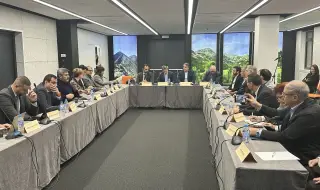
"We need to start a real discussion on how Bulgaria can become a rich and developed country, because this is the only way for people to want to return, stay in Bulgaria, start families and live here". This was stated by the chairman of “Continuing the Change“ Assen Vassilev yesterday at a discussion on the topic “Competitive Business“ within the series of public discussions on important topics for the future of Bulgaria under the motto “Strong Bulgaria in a Strong Europe“, quoted by the party's press center.
According to Assen Vassilev, the idea of the discussion is to look further into the horizon – not within 1-2-3 years, but where we see the Bulgarian economy and Bulgarian business in 10-15 years. Because this will determine the trajectory of the next 1-2-3 years. “No matter what we say, all the funds that the state has at its disposal come from business in one form or another – they must be created. So here we should rather think about how we see the Bulgarian economy and from there on.“ The second task of this discussion is to formulate how the state should not hinder, but help business, he pointed out.
The moderator of the discussion, Ivaylo Shotev, a member of the Executive Council of “Continuing Change“, explained that the party has adopted a new approach to forming its policies. According to him, the goal is not to come to business and tell it what we intend to do, but to have an honest discussion about what really needs to be done.
“The European Union is changing, the world is changing. The pace is extremely fast, to some extent we are on the verge of a new industrial revolution in view of the advent of robots in industrial production, with artificial intelligence, which is already entering both beyond personal use and into business“, Shotev said. According to him, that is why we need to discuss how we should change in politics and in business.
Representatives of business, employer organizations, economists and financiers joined the discussion. It was broadcast live on the “Continuing the Change“ channels on YouTube and Facebook. Economic data were presented on each of the discussion topics, on which the debate could be based.
The first topic of the discussion was “We are moving towards a global market – from a small town to a global brand“. Assen Vassilev raised the question of how Bulgaria can stop being a symbol of cheap labor, create a Bulgarian brand and whose responsibility it is for this – the state or business. The participants in the meeting united around the idea that a long-term national growth strategy for Bulgaria should be developed, in which sectors with high growth potential should be identified. Our country must preserve its industrial production, but also develop sectors with high added value, create its own brands and attract large global companies. Business raised the question of the need for better quality education. At the European level, the issue of reformatting the Green Deal was raised so that EU countries do not lose competitiveness.
The second discussion was on the topic of “The State in the Market“. It was dedicated to the role of state-owned enterprises, hospitals and educational institutions in the development of the economy. The participants in the discussion united around the idea that state-owned enterprises need to rely more on concessions for activities in which the state is not a good manager. For key activities where the state has a natural monopoly, better control is needed. Education should remain the concern of the state, but with a change in quality. Also, consumers need to understand that control largely depends on them.
“Where the market stops and solidarity begins“ was the third topic of the discussion. It was dedicated to how the state takes and redistributes resources from taxes and social security contributions and where it is invested. Should the tax system and the percentage of redistribution by the state be changed? Can we have a social state without stifling private initiative, and how can we stimulate business without creating inequality? The majority of participants believe that there can be a social state without increasing taxes and the percentage of redistribution. On the issue of inequality, business believes that social programs should be more targeted in order to have an effect. “The problem is that if the aid is targeted, those who have paid their taxes are excluded from the system. We believe that justice should come first and then solidarity“, said Assen Vassilev. According to him, a change in the structure of the pension system should also be discussed, because there is currently a generation that has earned its pensions and does not receive even the minimum of the poverty line.
The fourth panel was on the topic of “Time as the most expensive resource of business“ and was dedicated to the administrative obstacles, procedures, control and regulations by the state that create difficulties for business. It was discussed how the digitalization of administrative services would reduce time and make it easier for entrepreneurs. All participants united around the opinion that the administrative burden on business takes time and money and creates opportunities for corruption. Digitalization and the introduction of electronic services are among the processes that would reduce this burden.
Link to main version
Feb 7, 2026 12:10 281
Assen Vassilev: We need to start a real discussion on how Bulgaria can become a rich and developed country
"This is the only way for people to want to return, stay in Bulgaria, start families and live here", the leader of the PP also commented
Снимка: ПП