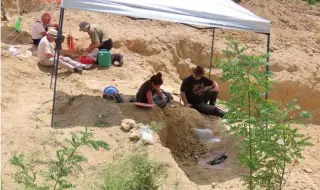
The most ancient bipedal hominids lived in the Balkans, not in Africa. This was established by scientists after discovering a bipedal hominid that lived in Bulgaria 7.2 million years ago.
The team consisting of Prof. Nikolay Spasov, Prof. Dionysios Youlatos, Prof. Madeleine Boehme, Ralitsa Bogdanova, Assoc. Prof. Latinka Hristova, Prof. David Biegun published their discovery in the journal Palaeobiodiversity and Palaeoenvironments under the title “Early form of terrestrial bipedalism in a hominid from the Late Miocene of Bulgaria“.
The article describes a fossil femur from the Late Miocene deposit Azmaka, Chirpansko (Bulgaria), with an age of 7.2 million years, which is presumably attributed to the Balkan hominid called Graecopithecus. The conclusions reached by the authors of this study are quite unexpected and could change a number of ideas about the earliest evolution of humanity. They will undoubtedly provoke a discussion in anthropological circles, reports the National Museum of Natural History at the Bulgarian Academy of Sciences.
“This epochal discovery is such because we, Bulgarian scientists, overturn a long-standing theory that upright standing and movement in hominids occurred for the first time in Africa“, said Prof. Pavel Stoev, Director of the NPM-BAS. According to him, the results show that the place where this development first occurred is the Balkans.
„This discovery can be called largely Bulgarian, because out of the six authors, three are Bulgarians and museum employees, including the first author“, the director also said.
He explained that the study used the most modern methods of analysis, such as computer demography and the most modern statistical methods.
„The arguments presented are strong enough not to be easily refuted“, concluded Prof. Stoev.
Signs indicating bipedalism
According to the team, there are various signs indicating bipedalism. According to them, bipedalism has long been considered a major acquisition in the early evolution of hominins (the evolutionary line that includes humans and their direct ancestors) and one of the most important basic characteristics of this group. Until recently, the first hominin (pre-human) capable of walking upright was considered Sahelanthropus from Chad, but recent studies have cast doubt on its motor abilities.
“Another African hominin - Orrorin - shows quite convincing signs of bipedalism, according to most researchers, but this Kenyan pre-human is more than 1 million years later than the Azmaka hominin“ - says Prof. Nikolay Spasov from the National Museum of Natural History at the Bulgarian Academy of Sciences, head of the excavations and first author of the publication.
He points out that the quantitative and qualitative analysis of the marks on the femur from Azmaka convincingly shows a unique combination of signs of terrestrial locomotion on all fours with those indicating possibilities for upright walking. A number of morphological features of the found femur show similarity to bipedal fossil hominins and humans and are distinguished from arboreal apes. Such are, for example, the elongated neck of the femur, the position of the gluteal tuberosity (protrusion), the disappearance of the intertrochanteric crest in the direction of the lesser trochanter, the presence of an intertrochanteric line, the low values of the angle between the body and the neck of the femur, the straight body of the bone and other features. The Azmaka hominid is also distinguished from the arboreal apes by the asymmetrical development of the cortex of the femoral neck, established by computed tomography, the scientist explains.
Another feature is the multivariate statistical analysis, which distinguishes the Azmaka femur from those of the European Middle and Late Miocene hominids, who lived about 12-9.5 million years ago - Danuvius, Dryopithecus, Hispanopithecus, and places the Azmaka femur relatively close to African apes, but especially close to bipedal hominins such as ororhinus, modern humans, paranthropus and Australopithecus, notes Prof. Dionysios Iulatos from the Aristotle University of Thessaloniki.
„These transitional motor capabilities and especially the strong arguments showing possibilities for "bipedal locomotion makes the Azmaka hominid the most likely earliest ancestor of humans," notes Prof. Spasov.
What did the Azmaka hominid, called Diva, look like?
According to the comparative analysis, the found femur belonged to a hominid (i.e. a representative of the human family, the higher apes and their direct ancestors). This is a female creature weighing only about 24 kg, which corresponds approximately to an 8-year-old girl. Therefore, the found creature was named Diva by the researchers (from wild woman by analogy with the mermaids from the legends).
The fossil femur was found during excavations 9 years ago together with remains of the Mesopithecus monkey (Mesopithecus), gazelles, other antelopes, hipparions, giraffes and rhinoceroses, typical of the Balkan fauna of that time, explain Ralitsa Bogdanova and Assoc. Prof. Latinka Hristova from the National Museum of Natural History at the Bulgarian Academy of Sciences (NPM-BAS). This natural setting shows a savannah landscape that was characteristic of the late Miocene of the Balkans and of the nature of the Balkan-Iranian paleozoogeographic province of that time.
Where were the first steps of humanity taken?
For a hundred years, Africa has been considered the cradle of humanity, and the evidence for this is numerous and convincing. So convincing that it was difficult to admit any other possibility. There is indeed no doubt that the vast majority of humanity's evolutionary path passed on the African continent. But it seems that the first steps were taken in the Balkans, say the authors of the study.
The Balkans and Asia Minor are particularly important for the evolution and migrations of species because they are a crossroads between three continents. There is growing evidence that today's African savanna fauna is largely related in origin to Eurasia, they point out.
Our analyses from a previous study indicate that the period between approximately 8 - 7.5 and 5.5 million years ago was a time of mass migrations of a number of mammal species from the Balkan-Iranian-Afghan region to Africa, but there is no evidence of the reverse process at that time - migrations from the African continent to Eurasia, explains Prof. Madeleine Böhme from the University of Tübingen. These migrations were caused by climate changes associated with the development of the Arabian Desert, which became a barrier to this faunal exchange between Eurasia and Africa about 5.3 million years ago. One of the migrants could be the aforementioned Balkan hominin.
There is no longer any doubt that during the late Miocene, when the Balkans and the Near East were inhabited by Graecopithecus and its probable direct predecessors - Ouranopithecus from Northern Greece and Anadoluvius from Asian Turkey, a savanna with a look and fauna similar to those of present-day Africa stretched across a vast territory from Southeast Europe to Iran and Afghanistan (the so-called Balkan-Iranian paleozoogeographic province). There is increasing evidence that with the discovery of similar spaces in Africa, many of the Eurasian savannah inhabitants migrated to the African continent. There is growing evidence that the present-day savanna fauna of Africa is largely related to Eurasia, scientists say.
“Modern data show that the diversity of great apes in the late Miocene of the Eastern Mediterranean was much greater than previously thought, and that many hominids bearing the characteristics of today's African great apes existed here long before their appearance in Africa was documented.
The new data and analyses that have accumulated lead to the conclusion that African great apes appeared in Europe and that the Balkan-Anatolian region, where at least three genera of this group lived from 9.6 to 7.2 million years ago, is most likely the place of origin of today's African great apes,“ says Professor David Biegun of the University of Toronto, Canada.
The probable first pre-human (hominin) - the bipedal creature discovered in the Azmaka paleontological site (Bulgaria) - also seems to have migrated south to the African continent, like many other mammals (giraffes, rhinoceroses, hyenas, antelopes, etc.). As a result, subsequent human evolution continued there, he specified.