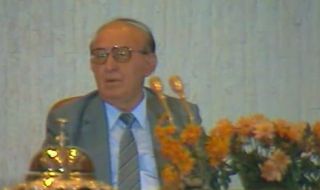
Folk wisdom says better a terrible end than a horror without end. At its meeting on November 10, 1989, the Central Committee of the Bulgarian Communist Party in Boyana dismissed Todor Zhivkov from the highest position of General Secretary in the party (and de facto in the state), which he had held for 35 years.
The date is perceived as the beginning of Bulgaria's transition to democracy and a market economy, although the one-party system of the Bulgarian Communist Party, which continued to be the only leading factor in the state, was abolished only the following year, and the first real economic reforms were undertaken 15 months after the plenum.
The November 10 plenum was defined by authorities such as Zhelyu Zhelev as a coup, or as a “constitutional change“ of the state leadership, and together with the subsequent events is also called the “quiet revolution“.
With the coming to power of Mikhail Gorbachev in the Soviet Union, a process of perestroika began. This also had an impact on the other socialist countries that were members of the Warsaw Pact and the Council for Mutual Economic Assistance. Bulgaria, not without reason referred to as one of the most loyal satellites of the USSR at that time, also announced a course towards restructuring the socio-political and economic system existing in the country.
In Bulgaria, Todor Zhivkov stated in various statements that the current system failed to meet the needs for change in the then society and a framework for a new social order was being drawn up - a democratic beginning of the state. The economic framework also changed from state planning to elements of a private economy.
Under Gorbachev and the course he took for the independence of the allies, for the first time since Zhivkov was at the helm, differences emerged between him and a Soviet leader.
On November 9, 1989, at a meeting of the Politburo, Todor Zhivkov resigned as General Secretary of the Bulgarian Communist Party after pressure organized by the Soviet embassy, as well as from his closest associates Yordan Yotov, Dobri Dzhurov, Dimitar Stanishev, as well as Stanko Todorov, Grisha Filipov and Georgi Atanasov.
The request for resignation was organized by Politburo member Petar Mladenov and candidate member Andrey Lukanov. Some of the Central Committee members such as Milko Balev and Dimitar Stoyanov were not informed in advance. Zhivkov did not resign from the post of Chairman of the State Council of the People's Republic of Bulgaria (the highest position in the state), the proposal for this was made on behalf of the Politburo.
The agenda of the November plenum included two items. The first was a report by Todor Zhivkov on the current situation in the country and the need to restructure the economy "in the direction of the market mechanism, combined with a planned beginning", and the second was the resignation of the General Secretary of the Central Committee of the Bulgarian Communist Party. Zhivkov delivered the opening speech, after which the Central Committee approved his report.
At the afternoon session of the plenum, the members of the Central Committee accepted Zhivkov's resignation, without giving him the opportunity for closing remarks, and confirmed Petar Mladenov as General Secretary of the Central Committee of the Bulgarian Communist Party. The plenum proposed to the National Assembly to relieve Zhivkov of the post of Chairman of the State Council of the People's Republic of Bulgaria.
On November 17, at a session of the National Assembly broadcast live on television, Petar Mladenov was elected Chairman of the State Council. The very next day - November 18, the first free rally was held, organized by the so-called informal organizations, led by the CT "Podkrepa" and "Ekoglasnost", on the square in front of the temple-monument "St. Alexander Nevsky".
30 years since November 10, 1989, Bulgaria continues to be divided by hatred. How will we build a modern state if we are divided? Our national slogan is: I love to hate most....