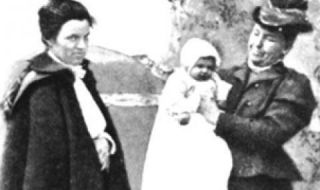
On September 3, 1901, partisans of Yane Sandanski and Hristo Chernopeev kidnapped the Protestant missionary Miss Ellen Stone and the pregnant Katerina Tsilka for a ransom of 100,000 US dollars.
Ellen Stone was born in Roxbury, USA, on July 24, 1846. She arrived in Bulgaria in 1878 to work at the American Girls' School in Samokov. She later moved to Plovdiv to teach hygiene, reading and Protestantism to women in homes. In 1898 she was sent to Thessaloniki by the American Council for Foreign Missions for evangelical missionary work among women.
In the summer of 1901, Miss Stone went to Bansko to lead a short course for the training of Bulgarian teachers for the early Protestant schools and for women from the Bible Society together with her assistant, the Bulgarian Katerina Tsilka.
At that time, one of the main problems facing the IMORO was the lack of funds for armaments. That is why Gotse Delchev made two unsuccessful attempts to kidnap wealthy Turks and Greeks. Later, a plan was developed to kidnap the son of Ivan Evstatiev Geshov, Nikola, which also failed.
The financial crisis was the main problem discussed at the meeting of the IMORO leadership in Kyustendil in the summer of 1901, which was attended by Delchev, Sandanski and Chernopeev. At this meeting, Delchev stated that petty robberies only damaged the reputation of the organization and did not help solve the financial problem. Sandanski proposed the kidnapping of Prince Ferdinand I during his visit to the Rila Monastery, but this radical plan was opposed by Delchev, who believed that the kidnapping should take place on Ottoman territory. Delchev also proposed that instead the voivodes conduct fundraising operations within the borders of Bulgaria. This created a dilemma for the leadership and the voivodes, since it was precisely the help from Bulgaria that was unacceptable, petty robberies were undesirable, and large-scale operations were dangerous for the organization and the liberation cause, but still the financial situation required urgent action.
Chernopeev and Sandanski discussed the kidnapping of a wealthy Turk near Simitli, but the plan failed. In 1901, around Petrovden, Yane Sandanski, Hristo Chernopeev and Sava Mihaylov prepared a plan to kidnap Suleiman Bey, the son of a Gorno-Dzhumayski pasha, but due to Suleiman Bey's illness, this operation also failed. Then Sandanski turned to the idea of kidnapping a Protestant missionary from Bansko, with the first target being the head of the mission in Thessaloniki - Dr. John House.
Yane Sandanski, Hristo Chernopeev and Krastyo Asenov did not expect the operation to become complicated and its duration of 6 months surprised them. The main problem was keeping the hostages in a safe place, which was Sandanski's duty. The operation was threatened by the Ottoman troops in Pirin, and in addition, the actions of the Bulgarian forces in the border areas, which made staying on Bulgarian territory impossible. Because of all these dangers, the kidnappers have to move constantly, but this becomes very difficult because of the kidnapped women - Miss Stone is 55 years old, and Katerina Tsilka is five months pregnant at the time of the kidnapping.
Yane Sandanski decides to seek refuge where Tsilka can give birth. However, on the way, she experiences pre-natal pains and the detachment settles in Sarbinovo. Sandanski calls two midwives to help with the birth. On December 22, Tsilka gives birth to a girl, who is named Elena (after Miss Ellen Stone). Meanwhile, a Turkish army arrives in Sarbinovo, forcing the detachment to leave the village on the third day after the birth. Since Tsilka is unable to walk or ride, she travels in a specially made chest pulled by a horse.
After lengthy negotiations in Sofia and Samokov, the ransom - 14,000 golden Turkish liras - was received on January 18, 1902 in Bansko. The captured women were released on February 2.
The action contributed to the popularization of the IMORO far beyond the borders of the Ottoman Empire, which was also helped by Miss Stone herself with her talks in the United States, where she returned after her release.
Ellen Stone died on December 13, 1927 in Chelsea, USA.