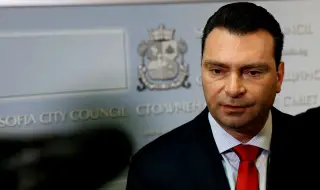
Kaloyan Pargov – chairman of the Strategic Institute for National Policies and Ideas (SINPI), four consecutive terms as a municipal councilor and chairman of the group “ BSP for Bulgaria“ in an interview for the audiocast of “ Focus“ “ This is Bulgaria“.
What did we see during these 9 months and 3 weeks? The three weeks turned out to be the most fatal, almost like in that movie “ Eight Weeks and half“ – so here the three weeks are the most fatal.
Yes, we can apply movie plots, such as weddings and funerals – there was a very good movie, with Hugh Grant, etc. But what happened during these little more than 9 months – it happened that two irreconcilable poles, and I don't mean as political poles, left-right, but rather as two different concepts that were presented to us for the development of Bulgaria, which for a long time clashed and threw the country into early elections, finally embraced each other with disgust and disgust and each with their own internal party and personal interests as a pledge to participate in such a non-coalition assembly. One – with the desire to continue to be a factor in politics, respectively GERB and DPS, against the background of the fact that only a year and a half ago – two of them were… no one could have thought or imagined that they would continue to play any role in Bulgarian political life, given the sentiments against them. The others were rather poorly prepared, but very ambitious young people, graduates of prestigious universities, with the promise of change and never again the previous over 10-year-old model of "GERB". In practice, what happened was that the first ones achieved their goal. They are on the crest of the wave, they have an advantage for the upcoming elections, looking at the sociological surveys, and those who arrested them and who had claims for the new beginning of Bulgaria, it is obvious that they will have a lot of image problems that they themselves have inflicted – sometimes intentionally, sometimes unintentionally, sometimes out of stupidity, over the last little more than 9 months. What is more worrying – and I am saying this already on behalf of SINPI, since SINPI is outside of political analyses, this is not its function, rather its function is expert in various fields – we do not observe, who knows what development of the economy, although some colleagues economists, macroeconomists, financiers may say the opposite – purely with a propaganda character in view of the approaching elections. That is, our huge concern is that the state is not in a good and stable state from the point of view of the economic process, no matter that the numbers may tell us otherwise, but behind these numbers stand thousands of people, thousands of businesses, thousands of human destinies. And it is no coincidence that we at SINPI evaluate the last year as zero for the development of Bulgaria, for the economy of Bulgaria, because almost nothing significant, apart from scandals in various sectors and upheavals, has happened and has not been felt as something significant that has given any progress in economic life, and from there – and in public life, I mean at the individual level of each person.
Where are the biggest failures? Where do you see them in SINPI?
If we start with the topic from the back, with the topic "Agriculture", the state was no different from the trend throughout Europe. And what the regular government currently leaves to the caretaker government, regardless of the fact that it has to hold fair early elections as its main task in two months, will also have to work for the state, to perform other functions, besides organizing elections. So, in the field of agriculture, the signed agreement is not financially secured. There is about 190-200 million in the hole, for which I do not know how these funds will be found. Because what we hear from the Ministry of Finance is that we have enough money in the state, and that the big problem over the last year, including at the beginning of this year with this new budget, is that this money is not visible, not felt. The second topic after agriculture is local self-government. It is also zero for local self-government in the last year, not only because there were local elections, which imply a cessation of greater activity and concentration on pre-election issues of local authorities, but rather because local authorities are closest to the people and they need the care of the state, because a huge part of the municipalities, with a few exceptions, but they are also included in this list, without money from the state and without direct subsidies, there is no way to fully fulfill their functions related to the well-being and the environment in which we live in Bulgarian cities and villages. But there is a problem there too. The mayors were indignant, and rightly so. If we start from the beginning of last year, get to this point and look at the budget reports of the various municipalities, we will see that we have a very low implementation of the capital program. That is, these are direct investments, a significant part of which comes from the state, in the majority of municipalities. Including in Sofia there is a certain percentage, because Sofia is the largest city, and here the state also has a participation, but not as decisive as it is for some other municipalities. Third topic - I said, I'm going backwards - the third topic is the topic of the priorities of this government. Schengen - we are already part of the airspace. I read with affection how an owner of a private plane yesterday started the plane and went to Lecce to drink coffee for two hours and returned in an hour. Well, God forbid more people had such means of transport, but - alas, we are all on land transport, and that is the big problem. That is, this semi-Schengen sounds a bit like Todor Zhivkov's semiconductors to me: "This year semiconductors, next year - targets". This year, half-Schengen, let's see if we will have a full Schengen next year, which, of course, is also a political decision, as we see, taking into account the local conjunctures of the countries that are blocking us, in this case Austria. The Eurozone - no matter how political the decision for the Eurozone is, it is still based on criteria for membership in it. Yes, we are part of this Eurozone in the sense of our currency board, of the Lev's attachment to the Euro, in the sense that in 2007 we agreed to enter the Eurozone, we just did not specify when as the date of accession in this part of the European Union, the European space. The point is that the issue of inflation is again a problem. As we know, in recent years it has been higher than the average in the Eurozone and in Europe as a whole, i.e. we again have an unfulfilled commitment. But it was loudly waved as something that is a great achievement. Now the debates are still going on "for" and "against" the eurozone. There is almost no communication campaign, although various advertisements have started in various media, but there is a need to talk much more about this topic, as the impact of the introduction of the euro still scares the ordinary Bulgarian. And this thing needs to be communicated more widely, so that all the effects, all the sides of the adoption of the euro and the abandonment of the leva can really be seen. Energy: I believe that last year, as a continuation of previous governments, energy, which is key for Bulgaria, has given up positions: as we saw, at the beginning of the year, from a net exporter we began to turn into a net importer, justifying the treacherous attitude against the background of the green commitments that we strive, as always, without thinking about our interests first to accept like everything else in our foreign relations, i.e. we embrace the policy of "Yes, I do", without thinking about how this will affect our local economy. And this is related to the fates of tens of thousands of people still working in these mines, thermal power plants, etc. And of course, the price of emissions, which made an entire industry uncompetitive, i.e. took it out of order, out of the market system with a non-market mechanism. Because these emissions that are imposed are a non-market mechanism and they worsen the market picture. And that's where the problem with the coal sector comes from. And what we are going to do with it, as well as the people working in it, is a very complex and difficult topic that we will have to discuss in the future. That's not the case with Poland, which doesn't care at all. It is a large country in the European Union, although it recently joined in the last 20 years, but as we see, the Poles are holding on to their own. Until 2038-2040, and even until 2042, they will exploit their coal complexes. Even Germany and even Greece have started to return to coal complexes against the backdrop of the energy problems they have experienced in recent years. The topic of the nuclear power plant: well, we will not do “Belene“, we will do the Seventh and Eighth Units of the “Kozloduy” NPP, we will think about a new nuclear power plant. But we have somewhere around 20-25 years to complete this process and switch to new nuclear capacities, since the old ones will enter a period in which they will have to be closed due to their shelf life, generally speaking. And here in the topic “Energy” we did not see any very good solutions. The last one, concerning replenishment of the Energy Security Fund, is related to certain interests of certain sectors, shares in the energy sector, such as photovoltaics, such as combined heat and power production of district heating plants, a large part of which in the country are private. I'll leave the topic of "Toplofikatsiya Sofia" aside, along with its obligations to BEH and "Bulgargaz" and its future. We'll see what happens from now on. The ball is in the court of Mr. Vasil Terziev, the PP and the new Municipal Council. So there are many topics. The topics of the mysterious murders and their influence on politics - something that hadn't happened for a long time. Somehow we had forgotten about such showy murders, and of people who have a key relationship to public and political life to one degree or another. I can list a lot of what happened during these 9-10 months, in a short period - eventful events. What I can say in the end is that some achieved their goal, returned to the game, are now factors again, they are no longer viewed with such reluctance, but on the contrary. Against the backdrop of the incompetence, the bankruptcy of the "new beginning", so to speak, more and more people, unfortunately, look to the well-forgotten and supposedly denied and spat upon old, which is still clearly safer and better for them than what they present as something new and as change. Against this backdrop, we can also talk about the BSP: where it stands in this whole configuration in the upcoming 2-in-1 elections.
Before we get to the BSP, I have a few more questions for you. The political coalitions, which continue to attack and smear each other, expect after the elections to continue the negotiations from where they left off. The final judgment is that of the outgoing Prime Minister Nikolay Denkov. Is this realistic?
Look, the big problem is to what extent a certain degree of morality and ethics can be shown. Because in the last 9 months we have also seen the lack of morality and ethics. We say one thing before elections, and do another after elections. In other words, the joke that after elections and after hunting, people lie the most, has practically become a maxim in our political life, which is very unfortunate. Currently, all parties are in an election campaign, and not since yesterday, but for several weeks, and we are already seeing this rhetoric. First - passing the ball who is to blame for the fact that the so-called "technical rotation", which has nothing constitutional or legal as a basis, i.e. this is a term that was invented in the last 9 months, and the passing of the ball and the playing of ping-pong by both sides, with which the state did not win again, the people did not win, and we watched theater, another one in the last 9 months. Second - why are we going to negotiate from where we left off, after we decided to restart the system? The restart of the system is always an election - whether they are regular or early, these elections always restart the system and the configuration. I.e. Mr. Denkov, who is an intelligent person, but obviously with little political experience, apparently does not realize that when restarting the system, you cannot start from where you left off, since elections are not just a technical process in which you stop for a while one or other processes that have been started and are unfinished, and continue after the elections. After the elections, there will be a completely new political picture. Usually, elections cause image and all sorts of other harm, damage, which from the point of view of thoughtless speech, attacks, pre-election campaign, pre-election attacks, is sometimes very difficult to swallow just like that, because I say again, there must be some level of morality and ethics. Because we cannot spit like carters for two months and at one point hug, kiss and smile at all of Bulgaria. Somehow I personally do not imagine this little thing for myself, but if for them this is the norm of behavior, so much the worse for the system and for Bulgaria.
How will it end?
Well, how will it end - it will end so that there will be attempts at arguments again, i.e. where they ended. I.e. apparently the PP imagines that they will start arguing about the cabinet and who will be the minister, who will manage the regulators. I see that this started in their election campaign, in which Kiril Petkov and Asen Vassilev explained that they were for fair elections, for transparent elections of regulators, of the Judicial Council, of prosecutors, of judges, and you see GERB and MRF, with whom they had been drinking coffee and even cuddling each other in their laps, were for the exact opposite. Did they now understand after 9 months that this is so, for example? I say this because the more experienced players, of course, are GERB and MRF, the more resourceful, the more pragmatic, while the more naive and inexperienced were the colleagues from the PP-DB. And this is evident.
We come to the question: what is happening with the BSP. Last week, Saturday, the "Buzludzha" movement was created as a wing of the party. Now I see a reportage photo from the municipal party conference in Svoge, where the leader Cornelia Ninova is surrounded by about twenty people. About twenty. What are your chances?
Look, the restart of the political process is a chance for every political force. The BSP has been in opposition so far. Usually the BSP is a strong opposition. The problem is that this right was taken away from it in recent years by the so-called "new parties", "saviors", "changers", which is a mistake of the BSP itself that it allowed this initiative to be taken away from it and allowed it to be pushed out. At least because the direct election, the first of its kind in the BSP, in 2020, and the entire purge of dependent people, so-called, in the BSP was aimed at making the BSP both stronger and more acceptable and to set an example to society that the BSP is for operation "Clean Hands" in the state as well. Yes, however, all this did not happen and this analysis should be done by the current leadership of the BSP, since it is obvious that this goal was not only not achieved, but the BSP was also pushed out of the field of a leading opposition force, as we see that "Vazrazhdane" is arguing for its place, as we see that the small, but still quite mobile ITN is also arguing for this. We also see external forces that are making claims for the place in question. In the left space, the BSP is the largest party, no matter whether it is with 9, 10, 8, 7 or 15-20% as it was, which does not allow anything new to develop. This is a postulate in the last 35 years that we have observed. Many people have left the BSP, many people have tried their luck outside the BSP, on the back of the BSP, but they have not succeeded. That is, This is something that everyone who thinks they can create something alternative to the BSP in the left space should know. In this case, of course, what was created as a movement in the NDK is another movement in the BSP, since over the last 35 years of transition and democracy in the BSP there have been quite a few movements: "Open Forum", which was created by Krasimir Premyanov after 1997 based on the events of that time, later Yanaki Stoilov created the "Left Wing in the BSP", the so-called one, which started mostly from the disagreement of a part of the BSP with the adoption of the flat tax under the government of Sergey Stanishev. In more recent times we have "Socialism XXI century", "Socialists bg". "Socialism XXI century" – by Georgi Pirinski, "Socialists bg" – by Petar Mutafchiev. And now we have a new movement, in which many people were present outside the BSP, which... I can't say now, I'm not an organizer, I was invited, I was also present as a guest to see and hear. Let me just say that I do not participate in any of these movements, I have not participated so far and I will not participate, this is my principle. But the Statute gives the socialists the right to make movements within the BSP with one goal or another. For me, the ideological and political conversation in the BSP is important from the point of view of several things. First, if we talk about ideological and political conversation, I am missing two things so far, which the BSP has not done for 35 years. First of all - its assessment of November 10, 1989, since this year it will be exactly 35 years since the events of November 10. Secondly, the BSP is running away and has not given an assessment of the events of 1996-1997, since this is a watershed point and a point of division within the BSP given what happened. Of course, the BSP has periodically given an assessment of these 35 years over the years, but it certainly needs this in order to move forward with new strength. I say it as a kind of condition and my view, since this view is shared not only by me, but also by quite a few people, authorities in the BSP, who do not participate in one or another movement, solely and solely to have such a mindset. From then on, what is coming up on June 9th - it is obvious that everything possible will be done to have 2-in-1 elections due to various considerations. Let's see if Mr. Glavchev will manage to form a government by the end of the week, which he will present to the president and have him issue a decree for it, i.e. by April 9th, so that there will be 2-in-1 on June 9th. Obviously, this will be another chance for the BSP to establish itself as an alternative to the last 9 months. Whether it will succeed is a topic for another conversation, against the background of what is happening in different areas of the country in the BSP. Namely - in Shumen, the early cycle of reporting and elections ended these days, which has been going on since September. That's nearly 6-7 months. The same thing happened the previous Sunday in Sliven. And there was an early cycle there, scheduled back in September last year - it has only just ended. We have one in Blagoevgrad, which has been going on for two months, and one in Sofia, which has been going on for a month. The question is: how will the early cycles be combined, because my concern is that the BSP usually, when it has internal party elections ahead, forgets about everything around it and everything is directed - and all the energy, thought, and attention is directed to the internal party election, regardless of whether it is being held at a low, medium, or highest level. I.e., with this in mind, I express concern whether time will be missed for intra-party battles against the backdrop of the big external battle, which is more important for us - the European one and the one that is parliamentary. Because if they are 2 in 1, this will certainly be good for the BSP, since we know that the red voters underestimate the European choice, it's just that this is a trend not from yesterday, but since there have been European elections since 2007.
Yes, but how will the BSP establish itself as an alternative, given that it is so deeply torn apart at the moment? You told me about the elections in various different structures. I told you at the beginning my impressions of the reportage photo with twenty people. What alternative will this lead to?
The reportage photo with twenty people – yes, we are used to it… There is a difference, just to tell you – not that I am saying it as an excuse for the reportage photo. Mr. Borisov, as he tours the country, since the structure of GERB is like this – they do not have such a structure as the BSP has, it is based on municipal centers. This is the structure of GERB. Usually, when Borisov goes to a region, they gather 100-200 people from several municipal centers to take this mass photo that you are talking about. I assume that there was a conference in Svoge. Now the Svoge organization is not a large organization, it is one of 22 in the Sofia region. This must have been the composition of the municipal conference. I can't say what event took place there, I haven't followed up on it, so there were 20 people. But it's not authoritative.
Yes, a municipal conference. But it really seems small. After all, we have seen BSP events with a fairly serious, impressive attendance.
Again, Svoge is not an example. If it were an entire region, as I was comparing it with GERB and Borisov, things would look different. Yes, at the meeting in Sofia there were about 400-500 people, both standing and people who were not members of the BSP. Now whether that was good or not – I can't say. I see that this element is criticized a lot, but that's what the organizers of this event decided, that's their right.
But this shows that there is a need for talks on the left.
Look, the Sofia organization, since I am one of its long-time leaders, within these 130 years, Ovcharov led it for 11-12 years and I am after him – I have managed this organization for 9-10 years, which puts us in the first two places. I know this organization. This organization has always been critical of the national leadership, even during the time of Todor Zhivkov, and there have always been skirmishes and sparks flying, and it has always been a thorn in the side of every national leadership. Starting from the beginning of the first decade of the 1990s – there the clash of Alexander Marinov, one of my predecessors, now an advisor to the president, the professor, against Zhan Videnov. Subsequently, Rumen Ovcharov with Sergey Stanishev, me - with Kornelia Ninova, and also with Mikhail Mikov and Sergey Stanishev, because I have worked under three BSP chairmen. I have worked with Sergey Stanishev, and with Mikhail Mikov, and with Kornelia Ninova as chair of the City Organization and there have been contradictions, clashes, disagreements and contrary opinions, but the national leadership has always been afraid and has taken into account to a certain extent the City Organization as the bearer of the intellectual potential and elite of the party, understandably, as a capital, since this is also a demographic process, a collective one. In large cities we usually have larger aggregates. So this event at the National Palace of Culture brought together quite a few socialists from Sofia, but there were also from the country. I say again, the assessment of it is contradictory. But Sofia, as an organization that I know, I am sure that it will be able to get out of this difficult situation and whatever is necessary and depends on me, I will do what is necessary to help it, because after all, this is my family. This cycle will be done. I see that there is no understanding from the national leadership, since I have also given such advice - whether it would not be good to stop the cycle for a while, given that it could drag on longer, and to prepare and hold these elections and Sofia gave its contribution to the overall result. As for Sofia's result, Sofia's contribution to the overall result is unfortunately not anything different from what is the average for the country, i.e. in Sofia, no exceptional results can be expected. Usually between 10 and 20% are the votes that Sofia gives in the overall result. The closer they are to 20 percent, the better Sofia's performance as a share. The lower it is, the worse it performed. I say this about the statistics from my empirical observations for years in the capital. But it is important for me that after this cycle Sofia manages to emerge somehow united, just as it helped to happen after my administrative suspension, which I attacked in court and you know, and your listeners, the Supreme Court of Cassation ruled in my favor as reinstatement, which I refused to return at the time, implementing this court decision, since Ivan Takov had already been elected and we would have entered into normative chaos that I cannot blame on my organizations. So I hope that this cycle the BSP will be able to, with intelligence and reason - I am talking about the Sofia organization - to emerge from this obstacle that the national leadership caused us.
How will the national leadership lead the party for the elections in this situation?
Now, given the upcoming early parliamentary elections, it seems to me that there should be a Plenum of the National Council, which should kick off the preparation of the parliamentary elections by starting the nominations of candidates for deputies, since one for MEPs was already done two months ago and it is underway. Because party meetings are currently underway, in Sofia in particular, but also in other cities, and nominations for national deputies must be made, so that, if we accept June 9 as a conditional date for European and parliamentary elections, I say a conditional date, we must have finished with all the lists, with their arrangement and with the preparation for their registration by the end of April, because the elections, i.e. the election campaign, will open on May 9. I am talking about the regulatory deadlines from the Central Election Commission, which must be followed and observed. So right now we need an urgent meeting of the National Council to kick off this campaign so that the structures can start nominating candidates for MPs more actively, since the conferences will have to sort them out. I'm talking about Sofia - the city conference will have to sort the three lists, and then in the regions - the district councils, based on the municipal conferences, sort the district lists. The National Council, in turn, must determine the tasks and places of the coalition partners and the citizen quotas. That is, a very intense intra-party process awaits us. And that is why I am making an address on Radio "Focus" that we urgently need the National Council to start the process.