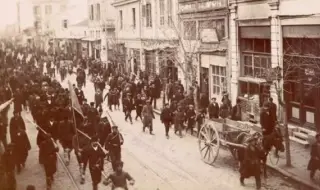
On October 27, 1912, during the Balkan War, the Greek army captured Thessaloniki, where the Seventh Infantry Rila Division also arrived. It was formed in 1904 by Decree No. 88/30 of December 1903 with headquarters in Dupnitsa. Colonel Stefan Toshev was appointed the first commander of the division. This is recalled by "Pleven Press".
While the Bulgarians were clearing the heights around Aivatovo, the commandant of the Thessaloniki garrison, Hasan Tahsin Pasha, surrendered with his troops to the Greek army. The startling cry of "the Bulgarians are coming" forced the Turkish pasha to surrender. Faced with the choice of surrendering to the Greeks or the Bulgarians, the pasha chose the first option. It later became clear that he had been bribed by local Greek bankers, frightened by the prospect of Thessaloniki becoming Bulgarian.
The Greek army, which entered Thessaloniki without a fight, refused to allow Bulgarian units into the city, and only after subsequent negotiations on October 28, between the commander of the VII Rila General Georgi Todorov and the Greek Crown Prince Constantine, was the Greek condition for the entry of two Bulgarian battalions into the newly liberated Thessaloniki accepted. That very evening, not two Bulgarian companies, but one infantry brigade with three batteries and one cavalry squadron entered the city.
The next day, the agreed two companies, in full force and one squadron with a waving flag and music, led by Their Royal Highnesses the Bulgarian Princes Kiril and Boris, the officers attached to them and the headquarters of the 7th Rila Infantry Division, solemnly entered the city with a ceremonial march. In the evening, another Bulgarian regiment arrived, so despite the agreements, more than 10,000 Bulgarian soldiers from the victorious 7th Rila Infantry Division were concentrated in Thessaloniki.
From an emotional point of view, the fate of the Bulgarians in Macedonia is of paramount importance for Bulgaria. For the liberation of the geographical area, the Headquarters of the active army has allocated only the legendary Seventh Infantry Rila Division consisting of the 14th Macedonian, 22nd Thracian, 13th Rila and 26th Pernik, 49th and 50th Infantry Regiments, 7th Artillery Regiment, 7th Pioneer Company, 1st Cavalry Division, 1st Horse Regiment, 7th Division Quartermaster's Office.
When the mobilization was announced on September 17, 1912, the announcement spread with lightning speed and Rila residents flocked to the assembly points. From their formation until the beginning of the Balkan War, the regiments of the division were preparing to win the freedom of the remaining enslaved Bulgarians in Macedonia and Adrianople. An impressive, colorful mass, decorated with flowers - soldiers, citizens, peasants, women, children, grandmothers, old men - slowly filed through the main streets of Dupnitsa, Kyustendil, Samokov and Radomir. Each soldier was surrounded by his loved ones - wife, children, father and mother - the people of Rila were setting out to put an end to the horrors in Macedonia.
During the Balkan War, the division was commanded by Major General Georgi Todorov. In the first stage of the war, the Seventh Division was included in the Second Allied Army, which was commanded by the Serbian General Stepa Stepanovic. From its starting base in the Nevestino-Kocherinovo area, its three brigades deployed in three columns between Struma and Bregalnitsa. The First Brigade formed the right column, the Second - the central one, and the Third - the left. The fighting in the autumn of 1912 developed in the following sequence:
October 5 - The Second Brigade captured Tsarevo Selo, and the Third - Gorna Dzhumaya. The Turkish counterattack near Simitli was repulsed.
October 10 - The Second Brigade captured Pehchevo.
October 11 - The right column of the division defeated the Turkish 16th Nizam's Division near Kochani and entered the city.
October 12 - 13 - In battles around Krupnik, the left column repelled the Struma Corps and on
October 14 - captured the Kresna Gap.
October 22 - 23 - The Rupel Gap was overcome. Third Brigade enters Demir Hisar.
October 25 - The vanguard of the 7th Division enters Kukush together with Serbian cavalry (from the Danube Cavalry Regiment).
October 27 - Battle of Aivatovo. The Third Brigade commanded by General Spas Georgiev breaks the Turkish shelter 12 km north of Thessaloniki. At the same time, Tahsin Pasha surrenders the city to the Greek army.
After leaving a company of the 14th Macedonian Regiment in Thessaloniki, the Seventh Division is transferred by the Greek fleet to Dedeagach and is included in the newly formed Fourth Bulgarian Army. On January 26, 1913, the First and Third Brigades of the division repel the Turkish attack at Bulair and thwart the plan of the Turkish command to advance into the rear of the Bulgarian army. After this battle, a lull occurred on the front in front of Bulair. However, the Seventh Division suffered heavy losses from the cold due to a shortage of fuel and warm clothing. For this reason, 3,000 people were put out of action in early February.
In 1913, the division was demobilized and mobilized again in September 1915, with 11,000 of its personnel coming from the newly annexed Pirin Macedonia.
During World War I (1915 – 1918), the division became part of the 2nd Army.