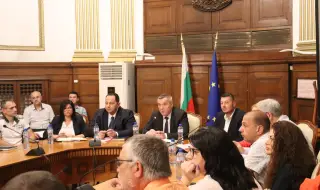
In cases of confirmed animal disease due to an established outbreak of smallpox infection in small ruminants (SHOK), farmers will receive an advance of 200 leva per animal within a week. This was announced by the Minister of Agriculture and Food Dr. Georgi Tahov during the meeting of the Advisory Council on Livestock Breeding. He emphasized that the payment will begin immediately - before the completion of all administrative procedures for receiving the entire compensation.
„Today, at the Advisory Council on Livestock Breeding, we are considering measures to deal with a crisis - not only in livestock breeding, but in all of agriculture. This is a difficult year with many crises and I would like to reach constructive solutions with a reasonable approach. You can count on full cooperation from the administration, as we have always done so far“, emphasized Minister Tahov.
During the Council, a decision was made to implement a measure to control the purchase and transport of raw milk from the affected areas. “An order will be issued for the Plovdiv region today“, said Dr. Svetlozar Patarinski, Executive Director of the Bulgarian Food Safety Authority, who outlined the current epizootic situation.
He recalled that after the first outbreak of sheep pox was detected on the territory of Bulgaria on September 4, 2024 in the Yambol region, as of today there are already 65, together with the newly declared ones. The municipalities currently affected are: Maritsa – the villages of Skutare, Voivodinovo, Yasno Pole, Manole, Rogush, Manolsko Konare, Trilistnik, Kalekovets, Voysil, Graf Ignatievo; Parvomay Municipality – Parvomay Town, Dalbok Izvor Village, Dragoynovo Village; Rakovski Municipality – Rakovski Town, Belozem Village; Sadovo Municipality – Katuntsi Village. 2 more outbreaks have been identified outside the Plovdiv Region – Stara Zagora Municipality (Sheinovo Village) and one outbreak from yesterday in the village of Kapitan Andreevo, Haskovo Region.
The outbreaks were identified based on the intensified inspections in the country and a number of measures have been taken to limit the disease. A 21-day ban on trade, movement and grazing, as well as transport of small ruminants, with the exception of those intended for slaughter, has been imposed for the entire Plovdiv Region since July 15. In addition, letters have been sent to the State Veterinary Service to terminate inspections at facilities with DZH. A letter has also been sent to the Bulgarian Veterinary Union to terminate visits by veterinarians to farms with small ruminants. Visits by milk samplers are also prohibited.
In connection with the prevention of the disease, over 1,200 meetings have been organized with mayors and livestock breeders in 256 municipalities since the beginning of this year. According to a joint plan prepared with the Ministry of Interior, Border Police and the industry, specific measures are already being implemented with a deadline for implementation.
“Intensive meetings on site will begin on Monday, and with the help of the Bulgarian Veterinary Union, our capacity in the field will be strengthened“, Dr. Patarinski also pointed out. He appealed for responsibility so that the outbreak in the Plovdiv region can be localized as quickly as possible, so that the livestock throughout the country is not endangered.
Dr. Iliyan Kostov, Chief Veterinary and Sanitary Inspector of the Republic of Bulgaria, stressed that the most important thing at the moment is to blockade these regions and limit the movement of animals. He appealed to livestock breeders to show understanding and not to buy animals at dumping prices, which they then introduce into the herds. Other important biosecurity measures include: not allowing cars into the affected farms, restricting access to workers who also work in other places, as well as restricting all movements, as otherwise the transmission of the infection cannot be controlled, added Dr. Kostov.
The Ministry of Agriculture and Rural Development has committed to initiating preliminary discussions with the European Commission regarding the measures introduced and the proposal from the industry for animal vaccination.
Regarding the support for the "Livestock" sector under the de minimis state aid scheme, in connection with the drought and difficulties with feeding animals, we have tried to ensure that the rates are as high as possible," emphasized Minister Tahov. This year, a ceiling of EUR 50,000 per farm for a three-year period under state aid is in force. For dairy and beef cows in breeding programs, as well as for endangered breeds and buffaloes, the rate will be BGN 80 per animal. For dairy and beef cows in commodity areas and cattle in mountainous areas, a rate of BGN 60 per animal is proposed. For sheep and goats included in breeding programs, as well as for those from endangered breeds - BGN 16, and for sheep and goats under transitional national aid and in mountainous areas - BGN 12 per animal. For bee colonies, support of BGN 8 per family is provided. It is proposed that there will be no modulation this year in order to facilitate the administration of the support. In order for the support to be provided, a decision of the Management Board of the State Fund “Agriculture“ is required, which will approve the acceptance of applications and the instructions for the implementation of the support.
A proposal was presented and discussed at the meeting to create a new intervention within the Second Pillar, through which the financing of animals raised according to organic production methods would be continued. It is proposed that the new intervention replace the currently existing eco-scheme for supporting organic livestock farming in the First Pillar.