


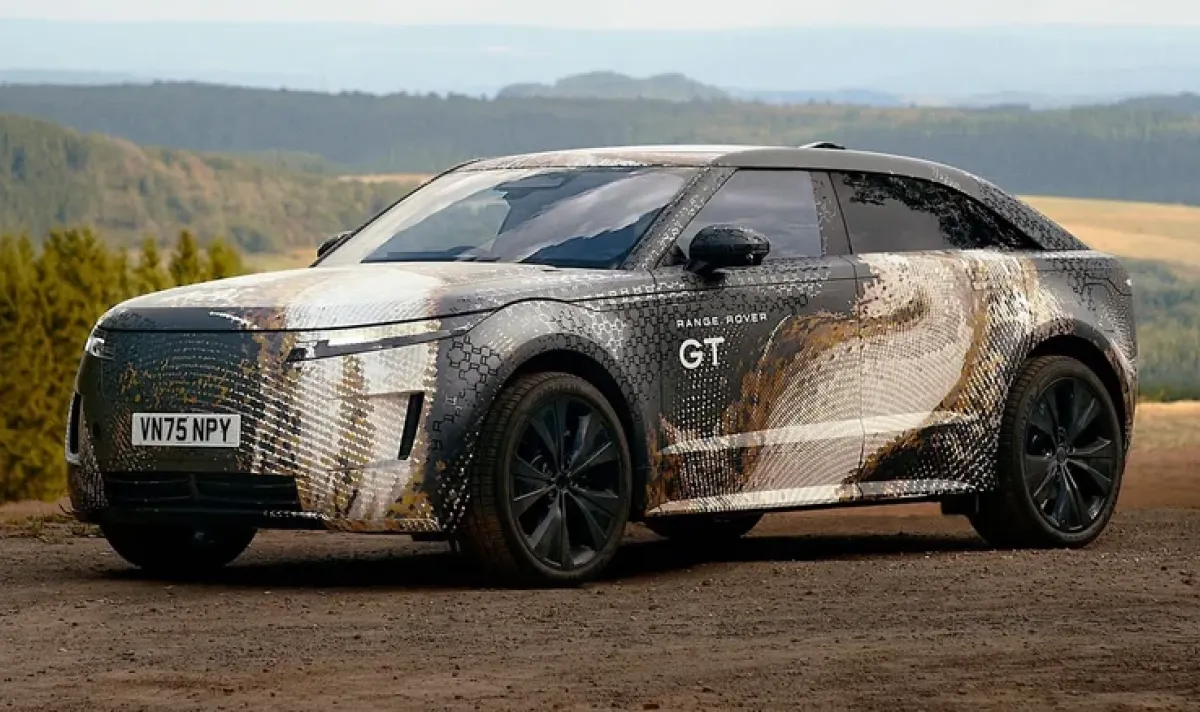

Land Rover introduced the latest model in its range a few weeks ago, but only now has the company revealed a little more about it. Although Jaguar Land Rover insists that we perceive it more like a car, the new Range Rover GT is designed as a grand tourer with a lower body, a more aerodynamic shape and behavior oriented towards long trips. Prototypes have already been tested on a route from the UK through Belgium to Germany, including on the Nurburgring, with the aim of refining the ride and feel behind the wheel. According to the presentation of the GT model, it will have the lowest center of gravity of any Range Rover to date, which should help with stability and comfort when driving on asphalt. Despite the proportions close to those of a coupe or a fastback, the brand does not give up a key characteristic of the Range Rover. Jaguar Land Rover defines the model as “extremely capable off-road“ and “a leader among its direct competitors“ in this area.
The Range Rover GT will use the new Electric Modular Architecture, or EMA. Sales will start with a fully electric version, and a hybrid will be added to the range later. The company has confirmed the platform and electric drive, but some of the technical data remain at the level of assumptions. It is possible that the GT will receive an 850-volt electrical system and a battery with a capacity of 118 kWh, similar to that of the Jaguar Type 01. In such an option, fast charging with direct current could reach 350 kW. A configuration with two electric motors is considered more likely, while Jaguar's three-motor system would be more complex and more expensive.
The cabin will be one of the biggest changes to the new model. It will use solutions familiar from the Jaguar Type 01, including a two-spoke steering wheel, a floating center console and a large central screen for the infotainment system. The Range Rover GT will thus occupy an unusual place in the brand's lineup. It will not be a classic hatchback, but it will not follow the tall and massive design of traditional SUV models. Instead, it will combine a low road stance, electric drive, off-road capabilities and an interior that moves away from the previous Range Rover design.