


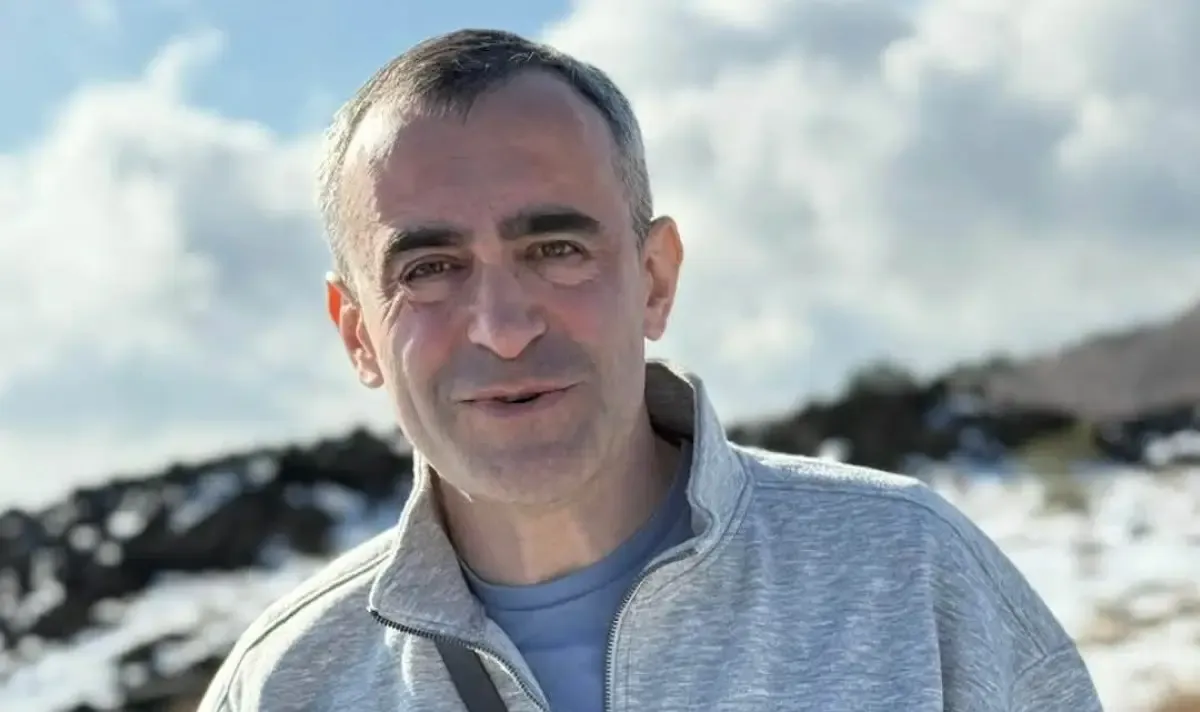

Talks between the United States, Russia and Ukraine have shown no real progress towards ending the war, while the main disagreement remains Moscow’s demand that the unoccupied part of Donetsk region be handed over. Why does Trump continue to put stronger pressure on Kyiv than on Moscow, while Russia is trying to exhaust Ukraine with strikes on energy infrastructure and civilian targets… Israeli military analyst David Sharp speaks to FAKTI.
- Mr Sharp, how do you assess the results of the talks between the United States, Russia and Ukraine in Abu Dhabi? Is there any real movement towards ending the war, or is this another diplomatic attempt against the backdrop of continued hostilities?
- First of all, of course, we do not know some of the details. We do not have all the information about the course of the negotiations. We hear that both the Ukrainian side and the Americans are speaking of some progress and are indeed hinting at the possibility of a cessation of hostilities in the near future.
But I prefer to stick to the facts. It is clear that the participants in the talks know more than we do. The facts, however, are that Russia has so far put forward as its minimum, initial demand that Ukraine hand over the unoccupied part of Donetsk region. That is Russia’s demand.
There are other demands that may not be territorial; we will not list them one by one, but the territorial demand is the main one. Without it, there can be no move on to the other issues. Accordingly, we have heard neither from the results of these talks nor from other statements that Russia has abandoned this demand. There are some hints of flexibility, but you cannot buy bread with hints. Has Ukraine refused to hand over this territory? It has not refused – on the contrary, we clearly hear that it has no such intention at all.
Moreover, Ukraine has not even agreed to what we might call a „creative“ proposal by the United States.
I will remind you that the Americans, through mediator Steve Witkoff, proposed redrawing the borders of Donetsk and Luhansk regions. In other words, the administrative borders of the two regions would be changed so that they coincided with the front line. Russia could then say: „We have already seized the entire Donetsk region and need nothing else.“ But the Ukrainians refused even to take this step. That is why I base my assessment on what I see. There may be progress on some secondary and tertiary issues, although they are also very important – for example, the exchange of prisoners. But as far as a broader agreement and ending the war are concerned, I am not aware of any progress. Accordingly, I do not believe that the talks have achieved any significant success. They may be necessary for both sides to some extent, including to avoid angering Trump. To avoid appearing to be the ones refusing to negotiate and seek rapprochement with the American president. I think this factor also plays a role, and we need to understand the situation in this context.
- Donald Trump has demonstrated a desire to end the war, but in his approach he is putting pressure mainly on Ukraine, including over territorial concessions. Is it possible for the American president to reach an agreement with Putin at the expense of Ukrainian interests?
- Trump undoubtedly has very serious levers of pressure on Russia, but he is hardly using them. There were periods when he, so to speak, activated some of these instruments slightly, but he did not use them seriously.
Trump is putting greater pressure on Ukraine. There were also several episodes in which relations between Trump and Zelensky became strained. Among other things, this led to a temporary suspension of the provision of intelligence. There were also problems with Starlink.
Incidentally, a few days ago President Zelensky said that there were once again speed restrictions on the Starshield system. This is the military system, not Starlink.
- And that is very important for Ukraine…
- Yes. This means that the Americans are once again very dissatisfied – either with Ukraine’s positions in the talks or with the strikes on Russian oil refineries, which Ukraine has resumed and is carrying out on a large scale. This is one example.
The Americans are exerting pressure, but it is limited. Of course, every form of pressure and every element of an embargo is a serious blow to Ukraine.
But so far I see no attempts by Trump to literally force Ukraine into territorial concessions. It has not reached that level. I assume it is unlikely to come to that, because following the political changes in the United States, Trump’s positions on this issue have become less stable.
That is why I would say that Trump is putting pressure on Ukraine, but not very strong pressure, while he is exerting practically no pressure on Russia.
Accordingly, the task of the Ukrainians, as I see it, is to minimise the damage from the problems with the United States. They are making maximum efforts not to anger Washington – both during the talks and through their other actions. At the same time, they are relying on the European countries that support Ukraine.
I do not see how Trump could reach a deal with Putin without Ukraine’s consent, given that Ukraine also relies on the European countries. Ultimately, Ukraine itself will decide whether to make concessions or not. For now, as far as I understand, the answer regarding territorial concessions is negative.
- How do you assess the development of the hostilities? Where does the strategic initiative lie, and what can we expect on the front, as winter is approaching?
- When we talk about the front, I believe we need to look at things more broadly. There is the front directly on the ground – the line of contact, but there is also what has been called since the Iran-Iraq War the „war of the cities“. These are strikes on the rear, civilian targets, military targets and economic targets. In recent weeks and months, Russia has carried out a huge number of strikes, largely without regard for the consequences, against a broad range of civilian targets – including medicine warehouses and supermarkets.
These are literally deliberate actions intended to inflict colossal damage on the Ukrainian economy and create exceptionally harsh living conditions.
Strikes on the energy sector are part of this strategy. In Kyiv, in many places, there is sometimes no electricity for 22 hours a day.
The aim is to inflict enormous damage on the economy and put pressure both on Ukrainian society and on the authorities. This will leave fewer resources for war and defence, and the Ukrainian side may become more inclined to make concessions in the talks. This is also part of the strategic initiative and must be taken into account. The Ukrainians are also carrying out very significant strikes against Russia. Compared with 2024 and 2025, there has been enormous progress. But the damage inflicted by the Ukrainians is still not great enough to force Russia into any sharp concessions. There is no parity.
In my view, Ukraine’s main task should be to achieve a deterrent effect – Russia must suffer such heavy losses that it begins to consider whether continuing the war is worthwhile. The situation on the front is also very difficult.
Russia’s gains in 2026 are significantly smaller. Russia is suffering very heavy losses.
I would not blindly trust the reports issued by the warring parties, but there are many confirmed Russian losses. Russia is experiencing a shortage of personnel without having declared mobilisation. Ukraine has a similar problem, however. There are not enough volunteers, and mobilisation is extremely problematic. Many people leave the front or desert. The exact size of the Ukrainian armed forces is not known, but it is probably not increasing and at times is even declining.
That is why we cannot say that, in terms of personnel, the situation is changing in a positive direction for Ukraine. At the same time, the Russians have suffered very heavy losses in recent months. These losses are probably reducing the number of people Russia is able to bring to the front.
I assume that during the winter Russia will continue its offensive along several operational axes, including the Orikhiv and Dobropillia directions, respectively in Zaporizhzhia and Donetsk regions. It may also open another axis by drawing on certain reserves. I expect heavy and protracted fighting during the winter.
Russia’s main objective remains Donetsk region, while the additional axes are in Zaporizhzhia region. Winter conditions have different effects on military operations. When there are no leaves on the trees, it is harder to camouflage yourself from drone strikes and avoid detection. This makes an offensive more difficult and can lead to greater losses. On the other hand, when there is fog and rain, it is sometimes easier to hide from drones. Under such conditions, drones are not as effective, and traditional methods of warfare once again become more relevant, including attempts to advance with tanks. We are already seeing such attempts by the Russian side.
- If a ceasefire or even a peace agreement is reached, can Europe remain the main guarantor of Ukraine’s security? What would such a guarantee actually mean?
- First of all, in my opinion, the term „security guarantee“ always requires a very clear explanation. What exactly does a security guarantor mean?
If we are talking about obligations like those under NATO and Article 5 of the North Atlantic Treaty, that is one thing. That is the highest level of guarantees and, in my view, the only thing that can be called a genuine security guarantee. But, frankly, at present I do not see a situation in which the European countries, a particular country, the NATO bloc, the Americans or some combination of them would give Ukraine a guarantee of this kind – that if Russia attacks Ukraine again, they will join the war on its side.
So far, no one has been willing to make such a commitment.
Other options are possible – sending troops, instructors and providing other forms of support. All of this is important, but it does not constitute a guarantee that you will enter the war if Ukraine is attacked. What remains, then? Guarantees at a much lower level remain – for example, promises of economic and military aid for Ukraine, the presence of observers or some symbolic forces, in the hope that Russia will not want to attack in order not to kill NATO soldiers and trigger an escalation. All of this is very important, and Europe must unquestionably play a role. But I want to stress that a more serious guarantee is one that would make a potential aggressor think five times before attacking. That is the most important thing. To a large extent, promises of military aid, arms deliveries and similar commitments may prove unreliable. Governments in individual countries change, and these commitments may change with them.
What was promised two years ago may not be implemented four years from now. For example, elections are coming up in France. Candidate Marine Le Pen, as far as I understand, is among the favourites and states quite directly that she will change military aid to Ukraine. This raises the question: if President Macron now gives Ukraine some kind of guarantee, what will happen if Marine Le Pen comes to power? What will happen to these commitments?