


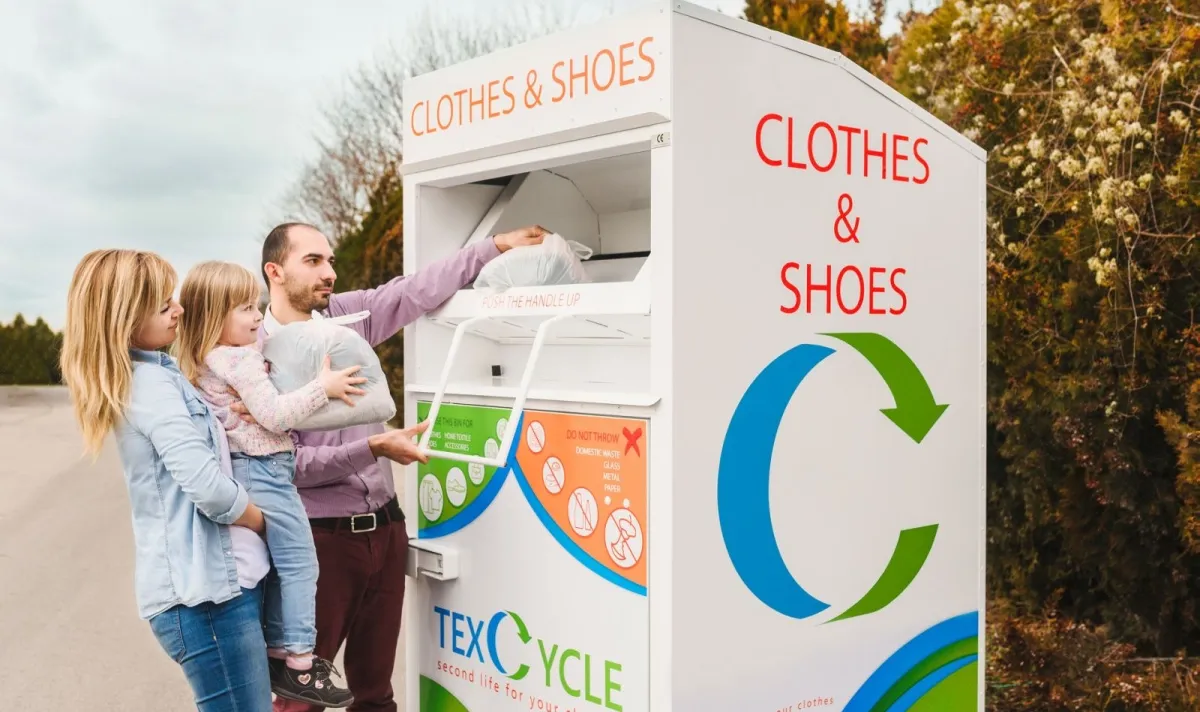

Bulgarians are already making use of separate textile collection options and expect a system that is more accessible, well organized and leads to the effective management of collected textiles. This is shown by a quantitative survey on attitudes toward separate textile collection, conducted by the BluePoint agency at the request of the Bulgarian Circular Textile Association (BCTA).
78.5% of respondents have used a textile collection container at least once, while 34.3% do so regularly. Among regular users, 40.4% say they use the containers more often than they did two years ago.
People are already using the system
The results show that when there is an easy and accessible way to hand over textiles separately, people use it. Most often, unwanted clothes are handed over in textile collection containers – a practice cited by 55% of respondents, while 43.2% identify the containers as the easiest and most convenient way to hand over unwanted textiles.
“The trend is clear: people are looking for better solutions for unwanted textiles and find them when the system provides them. The data show that when there is an accessible and convenient option for separate collection, it becomes the preferred way to take action,” commented Julian Dobrev, manager of BluePoint. “There is definitely room for improvement, and the data clearly show this. Conveniently located containers are the key to this improvement,” Julian Dobrev added.
This is an important message for the development of the future national system: the main problem is not a lack of willingness and readiness among citizens to separate their waste, but rather how accessible and convenient the system is for people. Only 25.8% believe that the containers are currently sufficient in number and conveniently located. 29% know about them but find them insufficiently close or convenient. If the containers are removed, 66.8% expect more textiles to end up in mixed municipal waste containers, while 76.1% say they would be dissatisfied with their removal.
The textile collection container is already perceived as part of urban infrastructure
According to 87.3% of respondents, textile collection containers should be a normal part of the urban environment, while 79.8% want more containers in their area. 88.5% consider their regular servicing important. This means that separate textile collection is no longer perceived merely as a voluntary initiative, but as a service that people expect to be accessible and well organized.
The survey also shows a clear link between access and behaviour: 84.5% would hand over more textiles if the containers were conveniently located, while 86.3% would be more likely to use them if they were clean and regularly serviced.
Regarding who should be responsible for the separate textile collection system, the survey shows clear expectations of municipalities: 45.8% identify the municipality as responsible for placing the containers, while 83.5% agree that it should participate more actively in textile collection.
At the same time, the data show that people also recognize the role of specialized companies. When asked who would be most reliable for maintaining the system, 25.8% identified the municipality, 22.8% – specialized collection and processing companies, and 14.8% – a public-private partnership.
Bulgaria already has experience
The European Union is introducing mandatory extended producer responsibility (EPR) systems for textiles and footwear in all Member States. This means that companies placing these products on the market will participate in financing their overall management after use – from separate collection and sorting to preparation for reuse and recycling. The goal is to build a sustainable system that encourages reuse and recycling and limits textile waste in mixed municipal waste.
The members of the Bulgarian Circular Textile Association (BCTA) have more than 25 years of experience in separate collection, sorting, preparation for reuse and recycling of textiles. Therefore, Bulgaria is not starting to build the system from scratch. Expertise, practical experience and significant capacity for the subsequent management of collected textiles are already in place. The first steps toward separate textile collection began before the European obligation was introduced. Since 2018, BCTA members have been implementing voluntary pilot projects for separate textile collection in partnership with municipalities across the country, with the aim of testing different models and building practical experience and expertise for the development of a national system. During this period, more than 18,500 tonnes of textiles have been collected through the containers installed. Today, BCTA members maintain a network of around 350 containers in more than 43 municipalities – an established foundation on which the future national system can build.
“The survey results show that the system already has its foundation today: people know the containers, use them and perceive them as a necessary part of the urban environment. At the same time, the voluntary model is no longer sufficient. Every container involves real costs – for transport, servicing, human resources, sorting and the subsequent management of collected textiles. Specialized companies cannot continue to finance this system. Due to the lack of clarity and a sustainable financing mechanism, containers have had to be removed in some municipalities over the past year. That is why it is now necessary to build on the experience accumulated with a national system in which the state, municipalities and specialized companies have clear roles and responsibilities,” said Sirma Zheleva, executive director of BCTA.
The next step is the introduction of a national system
In recent years, BCTA and its member companies have worked consistently to promote separate collection, reuse and the proper management of textiles. The pilot projects with municipalities are part of this process – they give citizens the opportunity to prepare, municipalities the opportunity to gain experience, and companies the opportunity to develop the necessary capacity.
The next step is now necessary – Bulgaria must transpose the European requirements into national legislation by 17 June 2027 and establish a national extended producer responsibility system for textiles and footwear. This means creating a functioning mechanism that links separate collection with subsequent sorting, preparation for reuse and recycling, with clear roles, responsibilities and sustainable financing.
BCTA members are among the organizations with the longest-standing practical experience in this field in Bulgaria and are ready to participate actively in building the national system – both through expertise and specific recommendations to the Ministry of Environment and Water and the responsible institutions during the development of the regulatory and organizational framework, and through actual participation in textile collection, sorting and subsequent management activities.