


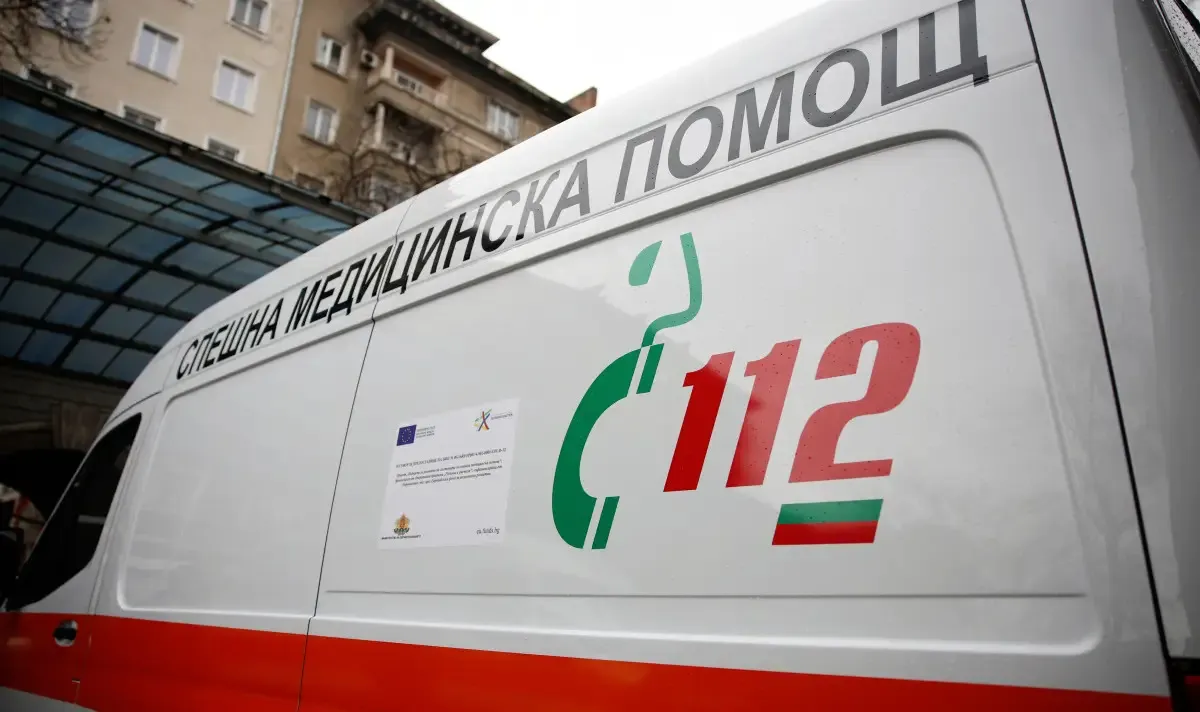

Only 22.6% of Sofia’s population can be reached by an ambulance within eight minutes under an optimistic scenario. The calculation includes only travel time, excluding response time and team organization, explained Assoc. Prof. Leonid Todorov from the Department of Geospatial Systems and Technologies at Sofia University “St. Kliment Ohridski.”
“Sofia is too large to be served effectively from just one base,” Todorov said. The main base of the capital’s emergency medical service is located in the area of Stochna Gara, while heavy traffic further complicates ambulance movement. According to him, the layout of the area itself also creates obstacles to the rapid departure of emergency vehicles.
Three satellite teams were shut down
About 12 years ago, the establishment of four satellite teams was planned, which would be deployed when necessary. One of them was subsequently transformed into a branch and continues to operate. The other three were associated with premises in polyclinics in Lyulin, Studentski Grad and Nadezhda.
In 2024, the Sofia Municipal Council decided to take back these premises. During the discussion in June 2024, one of the arguments put forward was that making them available constituted a waste of municipal resources, Assoc. Prof. Todorov said.
According to a model presented by the lecturer, restoring the three teams would increase by almost two and a half times the number of people who can be reached by an ambulance within eight minutes. The approach involves a preliminary analysis of the most suitable locations so that the teams can cover the largest possible share of the population.
The problem also affects other major cities
There are also difficulties accessing emergency care in Plovdiv, where the situation largely resembles that in Sofia. Varna has a slightly better figure, while the problem is less pronounced in most other regional centers. As a positive example, Todorov points to Veliko Tarnovo, where, according to the data presented, the entire city falls within the eight-minute travel range.
Eight minutes is the recommended response time for a life-threatening condition. For a condition that could deteriorate to a critical state, the timeframe is up to 20 minutes, while for other conditions it is up to 120 minutes.
In practice, coverage sometimes improves when a team that has left a patient at a hospital proceeds directly to a new call. However, this is difficult to predict and cannot replace the permanent deployment of a sufficient number of teams in suitable locations. Todorov also allows for administrative changes, but in his view, the resources freed up should be directed toward more teams, rather than solely toward staff reductions.
Sources: euronews.bg, btvnovinite.bg