


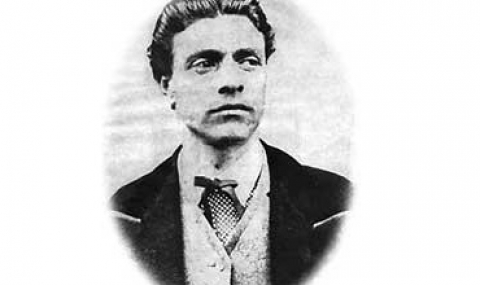

Vasil Levski was born on July 18, 1837 in Karlovo. In the church registers he was recorded under the name Vasil Ivanov Kunchev, but history will remember him with a dozen more names, two of which will remain immortal - Vasil Levski and the Apostle. Levski's childhood was not easy. His father - Ivan Kunchev died early and the 14-year-old Vasil fell under the responsibility of helping to support the family. He began his studies at the Karlovo mutual school, but under the influence of his uncle he became a novice and for three years he traveled around the villages to collect donations for the Hilendar Monastery, learning church singing and worship. For a short time he had the opportunity to continue his education in Stara Zagora, but then he accepted monasticism in the Sopot Monastery (1858) under the name Ignatius.
In the spring of 1862, Vasil Levski, at the call of Georgi Rakovski, set off for Belgrade to join the First Bulgarian Legion. In Belgrade, he received both his baptism of fire and the name Levski. After the disbandment of the legion, he returned to Bulgaria and for some time worked as a teacher in the village of Voinyagovo, Karlovo region, and later in the Dobrudja village of Eni Koi. At the beginning of 1867, attracted by the next movement of Bulgarian emigration to Romania, Levski set off for Bucharest and contacted Rakovski. On his recommendation, he was chosen as the standard-bearer of Panayot Hitov's detachment. After a three-month campaign on the Balkan Mountains, the detachment crossed into Serbia, and Levski went to Belgrade. A little later, he enrolled in the Second Bulgarian Legion, organized by the activists of the Virtuous Company. Having successfully passed all the exams, Levski expected the upcoming Serbian-Turkish war, but the disbandment of the legion thwarted plans to raise an armed uprising in the Bulgarian lands. The failure of Hadji Dimitar and Stefan Karadzha followed.
Like many of his comrades, Levski experienced with pain the death of Hadji Dimitar's detachment and the setbacks of 1867 and 1868. Unlike most émigré activists, however, already in the spring of 1868 he was considering new options for solving the Bulgarian political question. Indicative in this regard were his reflections shared in letters to Nayden Gerov and Panayot Hitov, in which he sought support for the implementation of his plans. Levski realized that the failures of the emigration were largely due to political apathy within the country. For almost a decade, the emigrant activists made plans for the liberation of Bulgaria, organized and sent detachments to the country, formed legions and volunteer detachments, but all efforts were in vain. Levski saw the main reason in the discrepancy between the ideas of the political emigration about the situation in the country and the real state of public sentiment. Levski saw the way out in the purposeful and consistent revolutionary agitation within the country and in the engagement in various forms of as many layers of the reviving Bulgarian society as possible. Therefore, it was no coincidence that, after a short stay in Bucharest, he decided to undertake a tour of the Bulgarian lands.
In December 1868, with the help of the “Bulgarian Society” and personally by Dimitar Tsenovich, he went to Constantinople and from there to Bulgaria. The purpose of this tour was to gather information about the real state of political sentiment in the country. Some researchers assume that during the first tour Levski managed to establish committees in individual settlements, but serious confirmation of this is still lacking. Returning to Bucharest in March 1869, Levski began preparing for his second tour. With the help of “Young Bulgaria” The "Proclamation on behalf of the Provisional Government in the Balkans" prepared by Ivan Kasabov was printed, which was to serve Levski as proof of the seriousness of his mission and at the same time illustrate the ideological closeness with the work of Rakovski and the Secret Committee.
Levski's second tour began on May 1, 1869 and ended on August 26. For about four months, Levski passed through a number of villages in the Danube Vilayet and in Southern Bulgaria, met with many of his old acquaintances, found like-minded people among prominent young teachers, merchants, and community center leaders. During the second tour, Levski created the first revolutionary committees in Bulgaria in Pleven, Lovech, Karlovo, Sopot and other villages in the interior of the country.
After returning to Bucharest, he rejoined the group of "young people" and took part in the construction of the Bulgarian Revolutionary Committee, but the prolonged and fruitless disputes among the emigrants prompted him to leave Romania for the third time in a row and in the spring of 1870 to move to Bulgaria. For about a year and a half, Vasil Levski managed to build a wide illegal committee network covering the entire territory of the country. At the head of the thus formed Internal Revolutionary Organization was the Lovech Committee, and the connection with the emigration in Romania was carried out through specially established conspiratorial channels. Under the leadership of Levski, the committees launched active propaganda activities among the population, and this created real prerequisites for starting the preparation of a truly nationwide revolution. In 1871, Vasil Levski also developed a Draft Statute (“Nareda”) of the VRO, in which he substantiated his basic views on the political struggles of the Bulgarian people. According to Levski, the goal of the revolutionary organization was “with a general revolution to make a radical transformation in the current despotic-tyrannical system and to replace it with a democratic republic … To erect a temple of truth and true freedom and to give place to the Turkish chorbadzhilik to consent, brotherhood and perfect equality between all nationalities”. With these ideas, Levski effectively imposed the values of European bourgeois-democratic thought of the 19th century on the Bulgarian national liberation movement and marked one of the highest ideological achievements in the political revival of the Bulgarians.
At the end of 1871, both the Bulgarian Communist Party in Bucharest, headed by Lyuben Karavelov, and the Internal Organization, headed by Levski, came to the conviction that for the success of the liberation movement it was necessary to unite the efforts of the committee organization in the country with those of the emigration. Thus, the idea of holding a General Assembly to develop new program documents and elect a unified leadership gradually crystallized. The assembly was organized in the Romanian capital from April 29 to May 4, 1872. After lengthy discussions, the delegates adopted a program and statute, and elected Lyuben Karavelov as chairman of the Bulgarian Communist Party. A little later, in accordance with the new statute, L. Karavelov appointed Kiriak Tsankov as vice-chairman of the committee, Olimpi Panov as secretary, Dimitar Tsenovich as treasurer, and Vasil Levski and Panayot Hitov as members. Levski also received a special power of attorney to represent the Central Committee “everywhere and in everything”.
After the General Assembly, Levski returned to Bulgaria and proceeded with structural changes in the Internal Revolutionary Organization, imposed by the requirements of the new statute of the Bulgarian Communist Party. The Lovech Central Committee was equated in status with the other committees. In the practice of the revolutionary organization, the conspiratorial principles, the secret mail, and the secret police finally prevailed. In the autumn of 1872, the first district centers were established, which carried out the coordination between the Bucharest Central Committee and the local committees in the country. At the same time, on the initiative of the committee activists in Teteven and Etropol regions, a plan was drawn up to attack the Turkish post office in the Arabakonak pass in the Stara Planina Mountains.
The action was carried out, under the leadership of Dimitar Obshto, on September 22, 1872, but the Turkish police took extraordinary measures to expose the participants and eventually managed to arrest them. The confessions made during the interrogations allowed the authorities to deal a crushing blow to the revolutionary organization. Dozens of committee activists, including Dimitar Obshto, were arrested and brought before an extraordinary trial organized in Sofia.
At that time, Levski was in southern Bulgaria. Initially, he began to consider a plan for the release of all those arrested, but the situation became more complicated. At the same time, contradictions arose among the members of the central leadership regarding Lyuben Karavelov's proposal to start an uprising in the country. Vasil Levski considered that in the current situation it was imperative to go to Bucharest and inform the BRCC about the real state of the committee organization after the arrests. On his way to Romania, he stopped in Lovech to collect the committee archive, but as a result of betrayal, he was captured in the inn of the village of Kakrina, Lovech region and brought before the court in Sofia. On February 6/18, 1873, Vasil Levski was hanged.