


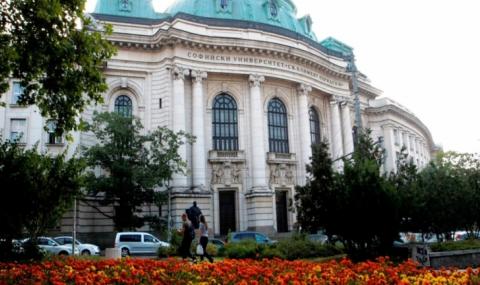

On October 1, 1888, Sofia University "St. Kliment Ohridski" was founded.
In 1880, the Ministry of Education submitted to the National Assembly a draft Basic Law for Schools in the Principality of Bulgaria.
This is recalled by the Alma Mater website.
It provides for “after completing the course of the real and classical gymnasiums, a Bulgarian higher school (university) to be opened, which will cover legal, philosophical, natural, medical and technical sciences“. In 1887, the Minister of Education T. Ivanchev issued a Regulation for the opening of a pedagogical class at the First Boys' High School in Sofia. Classes began on October 1, 1888. On December 8, 1888, the National Assembly decided to transform it into a Higher School, which came into effect on January 1, 1889, when Decree No. 159 was published in the State Gazette. Alexander Teodorov-Balan was elected the first Rector. The adopted temporary regulations provided for the functioning of only the History and Philology Department. In the academic year 1889/1890, the Physics and Mathematics Department was opened, and in 1892, the Faculty of Law was opened.
In 1894, a new law was adopted for the Higher School and by decree it was transformed into a university under the name “Bulgarian University Brothers Evlogii and Hristo Georgievi of Karlovo” with three faculties: History and Philology, Physics and Mathematics and Law. In the period from 1918 to 1923, 4 new faculties were opened - Medical, Agronomy and Forestry, Theology, Veterinary Medicine. In 1938, Sofia University already had 7 faculties, 72 institutes, clinics, seminars, a significant library fund and its own scientific journal. Sofia University “St. Kliment Ohridski“ became one of the authoritative scientific centers in the Balkans.
In the period 1947-1952, the National Assembly adopted laws separating faculties and institutes from the university structure. Some of them marked the beginning of new, independent higher schools such as the Higher Institute of Economics, the Medical Academy, the Veterinary Medical Institute, the Agricultural Academy, and others passed into the system of the Bulgarian Academy of Sciences. In recent years, some of these units have been restored to the university structure (Faculty of Theology, Faculty of Medicine). A new Faculty of Economics was also established. In 2012, the Faculty of Chemistry was transformed into the Faculty of Chemistry and Pharmacy.
In 1900, the regulations for the Library at the University were also adopted. In 1905, the University Yearbook began to be published with an official and scientific section, in which laws, regulations, lecture notes and scientific works of university lecturers were published. The University Library “St. Kliment Ohridski” is the first university and the largest scientific library in Bulgaria. In 1925, with the adoption of the Deposit Law, it became the third library in the country to receive a free copy of every publication.
Today, the University Library has a rich multidisciplinary fund, which numbers over 2,510,000 library units - scientific and educational literature, rare and valuable publications, periodicals, electronic media, etc. The collection of old printed, rare, valuable and unique publications is extremely rich. Over 20,000 library units are acquired annually and more than 30,000 readers are served with over 340,000 library materials. It offers services that combine traditions and modern technologies, which build its image as a modern library and information, cultural and educational center. Its mission is to provide library and information services to all its readers, to participate creatively in the development of Sofia University and in the formation of the information competence of its numerous users.
Since 1902, the feast of the patron saint of the university, St. Kliment Ohridski, has been established. In the University Regulations of 1905, the text was first recorded that November 25, the day of St. Kliment Ohridski, became the patron saint of the University. Since 1916, as a result of the official adoption of the Gregorian calendar in Bulgaria, the annual feast of the University began to be celebrated on December 8. Thus, over the years, the oldest and most prestigious higher education institution in Bulgaria has created and established December 8 as a symbolic date of university festivities.
Since the beginning of 1935, Sofia University officially began to bear the name of its patron. After 1968, when the Bulgarian Orthodox Church returned to the old style of the Julian calendar, the day of St. Clement of Ohrid became November 25 again and since the 1990s it has been the patronal holiday of Sofia University alone. December 8 remains a secular date and continues to unite Bulgarian students in the country with its extremely popular holiday. The teachers and students of Sofia University “St. Clement of Ohrid“ celebrate two academic holidays - the patronal and the general student holiday, containing a common origin.
Gradually, Sofia University “St. Clement of Ohrid“ became one of the authoritative scientific centers in the Balkans, a fully developed European-type university. Today, Sofia University “St. Clement of Ohrid“ is the largest and most prestigious educational and research center in the country. It encompasses 16 faculties with 119 majors.
The structure of Sofia University includes the following main units: Faculty of Slavic Philology, Faculty of Classical and Modern Philology, Faculty of History, Faculty of Philosophy, Faculty of Law, Faculty of Journalism and Mass Communication, Faculty of Pedagogy, Faculty of Educational Sciences and Arts, Faculty of Geology and Geography, Faculty of Physics, Faculty of Mathematics and Informatics, Faculty of Chemistry and Pharmacy, Faculty of Biology, Faculty of Economics, Faculty of Theology, Faculty of Medicine, Department of Information and Teacher Training, Department of Language Training and Department of Sports.
Within the framework of Sofia University “St. Cl. Ohridski“ Several independent units operate, which are: University Library, University Publishing House with Printing House, University Center for Information and Communication Technologies, Scientific Research Sector (NIS), University Botanical Gardens. Several centers have also been established: CSVP “Prof. Ivan Duychev“; Center for Educational Services; Center for Eastern Languages and Cultures; Center for Korean Studies; Career Center; Cultural Center; EURAXESS Center for Scholars' Mobility; Cisco Network Academy at Sofia University; Center for the Study of Patristic and Byzantine Spiritual Heritage; Confucius Institute in Sofia; Approved Test Center for the Oxford Test of English; University Center for the Study of Religions; Franco-German Center for Applied Research in Economics and Management; Center for Distance Learning; University Center for Quality Management; Center for Information Society Technologies; Center for Economic Theories and Economic Policies; High-Tech Business Center at Sofia University “St. Kliment Ohridski“; Center for Economics and Politics of China; Rehabilitation Centers; Center for Polar Research. In addition to the operating ones, there are radio and television "Alma Mater", theater-laboratory @alma @alter, Museum of Sofia University; Museum of Paleontology and Historical Geology; Museum of Mineralogy, Petrology and Minerals
Sofia University "St. Kliment Ohridski" is an educational and scientific institution that has chosen the path of development of a research university. The principle has been adopted that the high level of scientific research activity is a mandatory step in the implementation of effective interaction between the educational process, science, technological development and innovation policy. A large part of the best Bulgarian specialists in all fields of natural sciences and humanities work at Sofia University "St. Kliment Ohridski". The scientific research activity of the lecturers at Sofia University "St. Kliment Ohridski“ is an integral part of the learning process with the students.
Scientific activity at Sofia University “St. Kliment Ohridski“ is developed in accordance with the Strategy for the Development of Scientific Research (2009-2014) approved by the academic community. It defines the priority research areas, while at the same time respecting the tradition of Sofia University to ensure freedom for lecturers in choosing specific research goals and tasks. The Strategy for Scientific Research at Sofia University “St. Kliment Ohridski“ aims to create conditions for sustainable development of the university's scientific potential, which will guarantee its successful participation in the market of scientific products. It outlines the long-term plan for systematic actions, through which to respond to the urgent need for serious social reforms. The Strategy for Scientific Research establishes project funding as the main instrument for financing scientific research work. Today, projects are developed at Sofia University, financed by national and European programs, by ministries, national agencies, non-governmental organizations and businesses. The mission of Sofia University is to develop the educational, scientific and cultural potential of Bulgaria, with the new emphasis on creating models of social development, both by demonstrating its internal capacity for institutional change and through the social outcome of this change: a new level of scientific production, educational results, and social expertise. The realization of this specific mission is directly dependent on achieving the strategic goal of scientific development at Sofia University.
The building of Sofia University “St. Kliment Ohridski“, built with the funds of the two donors – the brothers Evlogi and Hristo Georgievi, is one of the architectural landmarks of Sofia. Today it occupies 36,000 sq. m of developed built-up area, has 324 rooms, of which 65 auditoriums with 6,000 seats.
As an independent section of the University's global strategy is the development of international activity. It significantly stimulates scientific research and supports and improves the educational process. The university has contractual relations with over 80 universities from different countries, hundreds of joint participations in international projects of various types and multilateral contacts with scientists from all over the world.
Sofia University is a leader in the country in terms of the number of participants in student and faculty mobility and the consolidation of the European Higher Education Area.