


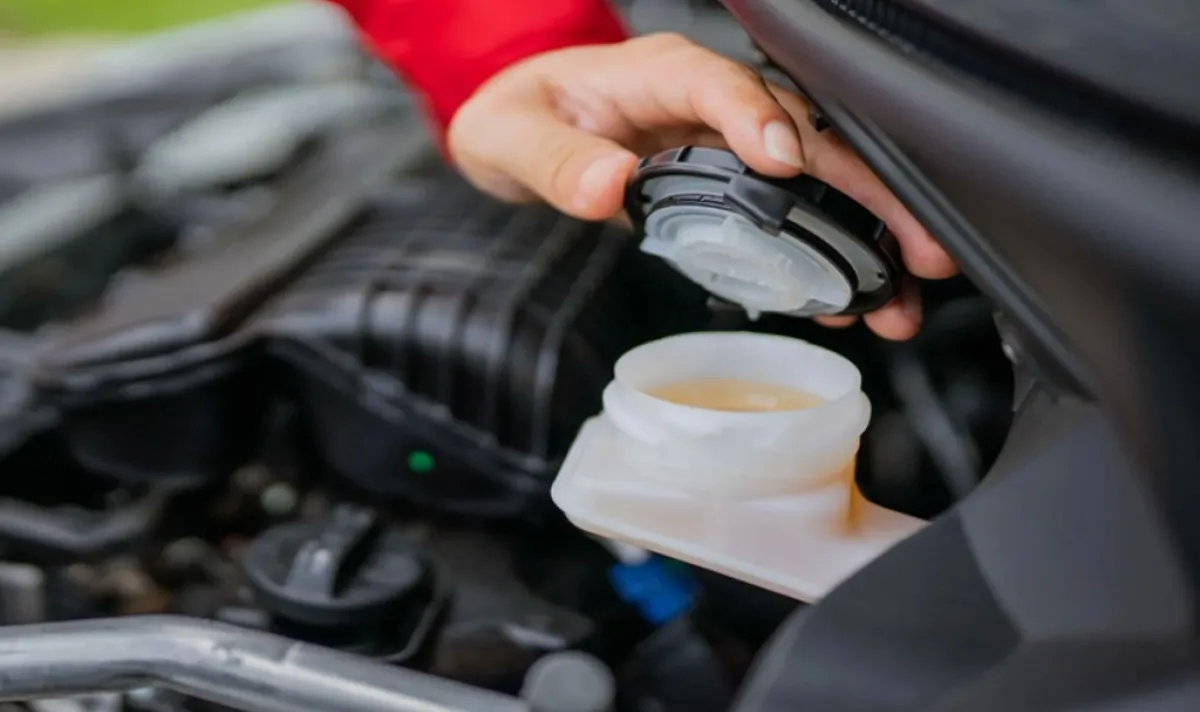

Most automotive consumables are replaced according to mileage, but brake fluid follows completely different rules. To the surprise of quite a few drivers, its service life is determined almost entirely by the passage of time, not by the figures on the odometer. Even if the car spends months parked in a dry garage, the chemical processes in the system do not stop for a moment.
The main culprit behind this degradation lies in the composition of the fluid itself. Widely used glycol-based brake fluids are highly hygroscopic – a quality that makes them literally absorb moisture from the air. Water molecules enter the sealed system imperceptibly and continuously, regardless of whether the car is actively driving on the motorway or standing still.
The most dangerous consequence of this accumulation of water is the drastic drop in the fluid’s boiling point. While completely fresh fluid can easily withstand temperatures of around 200 degrees Celsius, over time, as the water content increases, this threshold falls to a critical 150 degrees. During more dynamic driving or intensive braking, the brake pads and calipers become extremely hot, causing the absorbed moisture to boil.
The formation of gas bubbles in the lines is every driver’s nightmare. Unlike liquids, which are practically incompressible and transmit force instantaneously, steam is easily compressed. At a critical moment, this causes the brake pedal to suddenly become soft and sink, with braking force almost completely disappearing without prior warning.
In addition to the direct safety risk on the road, water in the system acts as a catalyst for corrosion. Rust gradually eats away at the inner walls of the brake cylinders, pistons and delicate seals. This natural but destructive process ultimately leads to the mechanisms seizing up and serious expenses for costly repairs.
To avoid such scenarios, car manufacturers set a strict requirement – complete replacement of the brake fluid every two years or after 30,000 to 40,000 kilometres, whichever comes first. If the vehicle is used under demanding conditions, regularly tackles steep mountain passes or is driven in a sporty manner, this interval should be shortened even further.
The condition of the fluid can be checked quickly at a service centre using a specialised tester that accurately measures the percentage of moisture or the current boiling point. Visual signs such as darkening or clouding of the fluid in the reservoir also indicate that it is time for servicing, but the safest strategy remains strict adherence to the two-year calendar cycle.