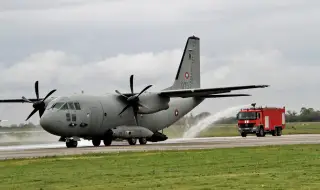
For the first time this summer, a military transport aircraft “Spartan“, equipped with a new fire extinguishing system, will be involved in extinguishing large fires in Bulgaria. However, the main burden in fighting the fire remains for the helicopters and crews of the 24th Krumovo air base, NOVA reported.
This season, the military will have four “Cougar“ helicopters and two Mi-17 helicopters. For the first time, a record number of crews have been prepared - a total of 16, of which 10 for “Cougar“ and six for Mi-17. According to military pilots, in the last three years, as many fires have broken out in the country as in an entire decade.
Among the most experienced pilots is Lieutenant Colonel Vasil Vassilev, who has participated in dozens of missions. The most difficult memory for him remains the fire in Rila last summer, when the crews struggled to protect nearby settlements. “People's houses and property, built over a lifetime, can disappear in an instant. The most difficult thing was the water supply - we had to fill water in a settlement with many obstacles - wires, trees, high temperatures and difficult mountain terrain. This puts the machine at the limit of its capabilities,“ he said.
Major Ivan Kirchev is among the newest pilots involved in firefighting missions. His first participation was in the huge fire near the village of Ilindentsi. “It's scary - fire, smoke and strong wind. Black pine burns extremely quickly. The fire was huge and if it hadn't rained, we would hardly have been able to control it. About 40,000 acres burned“, he shared.
Among the most memorable moments for the crews remains the rescue of beehives during a fire. “One of the colleagues noticed that a person's hives were burning. We made an approach and threw water. I don't know what the final result was, but his words still ring in my mind: “The approach was successful. The hives were saved.“ This is a small part of everything we do to save people's work and lives“, said Lieutenant Colonel Vassilev.
The crew of each helicopter includes two pilots and two flight engineers. During an operation, one engineer monitors the extinguishing system from the cockpit, and the other monitors the operation of the fire container from the rear of the machine.
The “Bambi Bucket“ system allows a Mi-17 helicopter to carry up to two tons of water in one release, and a “Cougar“ helicopter - about 1600 liters.
According to the commander of the 24th air base, Brigadier General Dimitar Pavlov, the most important things in firefighting are the accuracy of the maneuver and flight safety. “It is extremely important when and from where the water is released. The thick smoke above the fire poses a great risk, because the reduced amount of oxygen can lead to engine failure,“ he explained.
According to regulations, helicopters must take off within one hour of receiving a fire signal. This year, for the first time, more crews have been provided to ensure continuous readiness.
The military acknowledges that the equipment also poses challenges. Last summer, the Mi-17s were hampered by frequent technical failures and have completed only about 50 out of a total of 350 hours of firefighting flights. According to the command, the necessary spare parts are currently available to maintain the two helicopters and the season is expected to pass without such problems.
While the pilots are fighting the fire, their families are waiting for them with anxiety. Major Kirchev, who has two young children, said that his wife - also a military pilot - always tells him the same thing before each mission: "Take care and come home safe and sound."
After each operation, he first calls home to assure his loved ones that everything is okay. And the airbase commander's wish for this summer is brief: more rain, fewer forest fires, and a peaceful summer for everyone.