


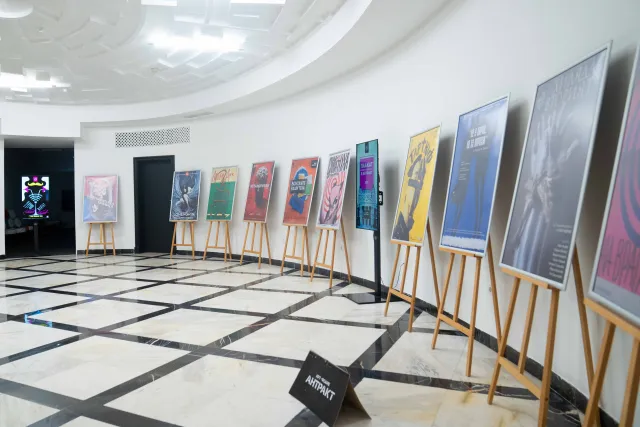
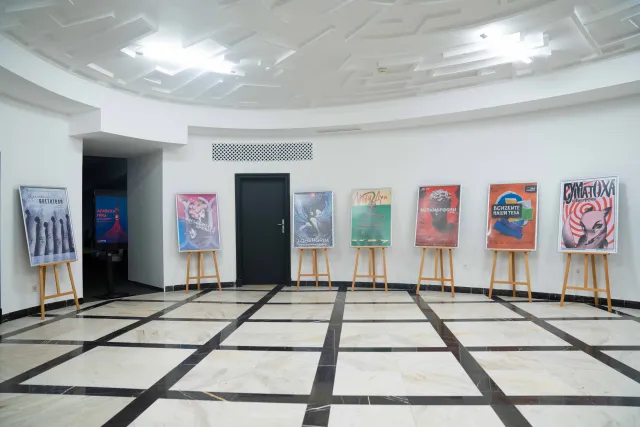
The National Theater “Ivan Vazov“ celebrates the Artist's Day with an exhibition dedicated to the contemporary Bulgarian stage poster. The exhibition features a selection of posters for performances by theaters from different cities in the country. The initiative focuses on the poster not simply as a means of presenting the production, but as an independent work of art with its own visual language. The artist and designer Nikolay Dimitrov – NAD spoke in front of FACT.
- Mr. Dimitrov, when does a theatrical poster become art and not just remain a means of advertising?
- The poster is art from its very genesis. A more correct answer would be when it stops being art and remains just advertising material.
- The poster should attract attention in seconds, but at the same time carry meaning, mood and idea. What do you think is the boundary between a good advertising image and a work of art?
- When it makes you feel the desire to hang it on your wall at home. Not only as a connection to the stage performance, but because of its own impact. Then the poster is truly not only an advertising material, but also art.
- Can a poster be impactful, even when the person looking at it knows nothing about the performance?
- I think that is the main purpose of the poster. To create interest for those viewers who are not familiar with the work and to introduce those who already know it to the specific reading. Or simply to create a provocation for the audience's interest.
- How is the idea for a theater poster born - from the text, from the director's concept or from some personal image that appears in your imagination?
- There is no exact recipe, but a theater poster is a joint work between the artist and the director to truly reflect the spirit of the performance. It is a kind of visual message of the stage realization.
- How is the balance between the clear message and the mystery found in a theater poster?
- This is perhaps the most complex task, creating an intriguing image that contains laconicism and mystery. Here the phrase “Less is more” often applies (“Less is more“) is key.
- How has the theatrical poster evolved, if we compare it to 10 or 20 years ago, for example?
- Like any art form, there are cyclicalities and trends that are constantly changing. Whether in the form of a strong emphasis on photographs and other visual images, or their complete removal and replacement with typography and graphic elements.
- How can a theatrical poster today maintain its power in a world in which we are flooded with images and advertisements?
- Posters are the vanguard of any new visual aesthetic. As an indispensable part of the “endless sea of content” that floods us daily, a poster must be well balanced and thought out in order to truly “shake” the viewer.
- What is the life of the poster after the premiere of the performance?
- Very often the poster remains as the only “time capsule” of the performance. For this reason, it has the responsible task of being the bearer of the memory of the performance.
- Your posters have been included in international selections, including the International Triennial of the Stage Poster in Sofia. How do such meetings with authors from other countries change your perception of your own work?
- It is an honor for me that my posters have been selected for participation in such high forums of our art and to be presented to a diverse audience around the world. Such encounters with the work of colleagues from other countries are extremely important for an author to refresh his or her perspective not only on his or her own work, but also to become familiar with works that achieve a different reading of a familiar text or a different synthesis of a popular theme.
- In the age of social networks, the poster is increasingly seen first on a phone screen, rather than on the theater wall. Does this change the way you create it?
- The poster is the element of the performance that, in principle, performs its “role” outside the theater building. Social media is the newest format through which viewers encounter it.
- Is there a poster of yours that you can say – this is the best?
- I would rather say that the ones I don't like are more valuable because I learn what I wouldn't repeat.
- How would you convince a young person today that making theater posters is worth working on?
- This is a passion and desire that you are born with. All I can say is that it is worth it and there is meaning in this art!