


Business cannot afford to be merely an observer of the problems in education. It is already involved in preparing future professionals through partnerships with schools and universities, practical training and the development of educational programmes. But it can play an even more active role in finding solutions to systemic problems – from supporting schools with the weakest results to using AI effectively in the classroom. What specific changes are needed and how can business contribute to them? Alexandra Mircheva, Programme Director of “Education and Skills” at the Association for Innovation, Business Services and Technology (AIBEST), spoke to FAKTI on the subject.
- Ms Mircheva, the PISA results highlighted serious deficiencies in the skills of Bulgarian students. What are the main reasons for this deterioration and why has Bulgaria failed to reverse the trend in recent years?
- The PISA results are no surprise. They continue a decade-long trend and the reasons are systemic. Since 2015, the share of students below the basic reading level has risen by 17 percentage points. I see three main reasons. The first is that schools still primarily teach us to reproduce knowledge, while PISA measures whether we can apply it in real-life situations. Curricula and exams are moving in one direction, while the skills required by the world are moving in another. The second is inequality. In our country, a child’s social background determines their results more than in most countries of the Organisation for Economic Co-operation and Development (OECD). The third is that over the years there have been many good intentions for reforms, but we have rarely seen them through to the end and almost never measured their impact.
This year, the Bulgarian Employers’ Association of Innovative Technologies (BRAIT), of which AIBEST is a member, organised a roundtable with Andreas Schleicher, OECD Director for Education and Skills and creator of PISA, and business leaders from the sector.
His message was clear – PISA is not a verdict, but a warning light.
The countries that have reversed the trend have not found one solution to all problems. They have chosen several priorities, invested in teachers and stayed the course for years, regardless of who was in power. This is the path for Bulgaria as well.
- According to the data, 58% of Bulgarian fifteen-year-olds do not reach the basic reading level, while 57% are below the minimum level in mathematics. What does this mean for the future workforce and the competitiveness of the Bulgarian economy?
- These students will enter the labour market between 2030 and 2035 and will work for around 40 years. In other words, today’s PISA results describe Bulgaria’s workforce until the middle of the century. The basic level in PISA is not a high bar. It means understanding a text and an instruction, assessing whether information is reliable, comparing two offers and choosing the more advantageous one. More than half of our students cannot do this. Everything else is built on these skills – programming, data analysis, working with AI, engineering and financial competences. Without the foundation, building further becomes costly and slow, and sometimes impossible.
This is already visible in our sector. According to AIBEST’s annual report for 2024/2025, sector revenues are growing by 7.6%, while employment is growing by 0.2%. Companies are growing through higher productivity and more complex services, and these require people with higher skills. If they cannot find them here, they will look elsewhere. The state would lose the investment, the tax revenue and the opportunity for young people to have well-paid jobs in Bulgaria. There is also a problem at the other end of the scale. Only between 1% and 3% of our students achieve the highest levels, compared with an OECD average of 6% to 8%. These are the future engineers, researchers and entrepreneurs on whom a high-value-added economy depends.
- You often point out that PISA results are directly linked to long-term economic growth. What could the cost be for Bulgaria if we fail to undertake timely education reform?
- The cost is far too high. According to Andreas Schleicher,
if all Bulgarian students reached a basic level of functional literacy, this would bring around $434 billion in long-term economic benefits to our country – approximately three times the current gross domestic product.
That is why I view the PISA results as a forecast for the economy. Every year of delay means another graduating class leaving school without the necessary skills. Catching up is expensive. We pay for it through lower productivity, less innovation and a weaker position when investors compare Bulgaria with other countries in the region. There is also an encouraging side. In the latest PISA cycle, countries such as Türkiye, Montenegro and others have shown that reversing the trend is possible when there is a clear national goal and it is pursued for more than one term in office.
- The gap between the most advantaged and the most vulnerable students in our country reaches 101 points, compared with an average of 85 points for the Organisation for Economic Co-operation and Development (OECD). What changes are needed to overcome educational inequalities and give all children a real chance to develop?
- The OECD equates approximately 20 PISA points with one year of schooling. In other words, 101 points represent a five-year gap between two 15-year-old students.
If one has ninth-grade-level skills, the other is at a fourth-grade level. You can imagine how wide the gap is.
As part of BRAIT, we advocate two key measures: Targeted support for schools with the weakest results – a recovery programme with a separate plan for each school. According to data from the Institute for Market Economics, more than 200 schools in Bulgaria have an average result below “Pass 3” in the matriculation exam in Bulgarian language and literature. And language support for children who do not have sufficient command of Bulgarian. More and more children are entering school without sufficient command of the language used in the classroom, which seriously hinders their learning and progress. The reform is currently being discussed in the National Assembly and we believe it must find an urgent and effective solution.
In this regard, we participated in the establishment of the European Literacy Coalition – an initiative of the European Commission for literacy. We are committed to ensuring that high-value-added businesses in Bulgaria participate actively, so that basic and functional literacy become a leading priority for the future of our economy.
- Bulgaria is seeking to attract investment in high-tech manufacturing, research and development, and high-value-added services. Could the shortage of well-prepared professionals become a major obstacle to this model of economic development?
- Yes, and it is already happening. When a company chooses where to open a development or complex-services centre, the first question is whether it will find the people it needs. Taxes and infrastructure are important, but the decision is also based on the available talent and human resources. Investment in a high-value-added economy and improving the quality of education must go hand in hand.
Business should not wait for qualified graduates at the university exit, but should be a partner from the training process onwards. At AIBEST, we have good examples of this. For more than seven years, we have been developing a master’s programme jointly with Sofia University’s Faculty of Economics and Business Administration “St. Kliment Ohridski”, and this autumn we launched a new master’s programme with the University of Economics – Varna. It is crucial for programmes to be developed jointly and to follow current developments and the needs of business. Lecturers from companies share the latest knowledge with students, work with them on real business cases and give them an insight into the future development of a dynamic industry like ours – something they will not find in textbooks.
- Artificial intelligence is changing the labour market and automating more and more routine activities. Is the Bulgarian education system preparing students for the professions of the future, or does it continue to train them mainly for a world that is already changing?
- Our education system is rather catching up with developments in the labour market. Artificial intelligence most easily replaces precisely what we teach our students – to reproduce information and facts.
If we continue to teach and assess them on this basis, we are preparing them for work that AI already does much better.
That is why we need to develop foundational skills – reading comprehension, mathematical thinking, scientific competences, critical thinking, problem-solving and the ability to learn. Specific tools and programming languages change quickly. Foundational skills remain and enable a person to master every subsequent technology.
- According to data presented, 41% of students in our country use AI chatbots for schoolwork at least once a week. How can schools turn this practice into a tool for developing critical thinking, rather than allowing it to encourage the mechanical reproduction of information?
- PISA analysis shows that students who use AI in the learning process with the support of their teachers and critically assess the generated content perform significantly better than those who use it to obtain, for example, a ready-made answer to their homework. Schools can start with several practical steps also recommended by the OECD and European Commission framework for AI literacy:
-- Checking generated content – the student compares the chatbot’s answer with reliable sources and decides whether to accept, correct or reject it
-- Making a conscious choice about when to use AI – and when to complete the task independently, with clear rules on how to indicate that it has been used
-- Assessing the process – the teacher looks at how the student reached the conclusion, not only at the final text
-- Shared responsibility – AI literacy is the responsibility of all teachers, not only the IT teacher
For this to happen in every school, we support the introduction of a new role – a digital transformation coordinator. The proposal is currently being developed by the Ministry of Education and Science (MON). Having such a person in every school would help ensure that technology is used meaningfully, according to the needs of the particular school. For principals and teachers, this would mean less administration and assistance with preparation and personalised teaching. For students – better and more conscious learning with technology.
- Curiosity, perseverance and a growth mindset are among the skills in which Bulgarian students lag behind their peers in the OECD. How can the education system develop these qualities and what is the role of teachers and parents in this process?
- These are skills that employers will value increasingly in the coming years. They also support better academic results – greater curiosity is associated with almost a full school year’s advantage in results.
Curiosity develops when a child has the right to ask questions, try and make mistakes. If there is only one correct answer in the classroom and mistakes are punished with a low grade, children quickly stop taking risks.
Project-based learning and real-world tasks, feedback that explains how to improve, and praise for effort build precisely this mindset. That is why we are calling for reform of curricula and assessment. As long as exams reward memorisation and the reproduction of facts, schools will teach that. When assessment begins to value thinking, reasoning and argumentation, the classroom will change along with it.
The role of parents is no less important. OECD data show that students whose parents read to them regularly in first grade perform, at age 15, an average of 25 points better in reading – more than a year of learning. Results are also better when parents regularly talk to their children about school. Sometimes it is enough to ask them what they learned today, rather than only what grade they received.
- You point out that successful education reforms can lead to improved results within two PISA cycles, or around six years. What three specific measures should be taken immediately and how can we ensure that the reform is not interrupted when the government changes?
- Six years is less than two full terms in office, but the political dynamics in our country can be serious. That is why we are proposing measures that can begin immediately:
-- Functional literacy as a national priority – with the aim of reducing the share of students below the basic level and introducing early diagnosis of reading and mathematics.
-- Support for teachers and the weakest schools.
-- A roadmap for curricula and assessment with specific deadlines – as most successful countries have done.
The most important thing, however, is for the reform to be long-term. I think three factors are important here. First, the goals must be measurable and public – when everyone can see the progress, stopping the process has a political cost. Second, funding must be multi-year. The European Union’s next multiannual financial framework for 2028–2034 gives us an opportunity to set the right priorities that will lead to real results. Third, the reform needs broad support beyond the government, with business, teachers, parents and expert organisations standing behind the same goals.
- You often call for a closer partnership between business and the Ministry of Education and Science. What specifically can business do to help schools better prepare future professionals, and how will we measure whether these efforts are actually producing results?
- Business can actively participate in the creation and implementation of education policies and programmes. A recent example is our work in sectoral councils on updating the list of professions in vocational education and training. We participated in modernising the list, creating new professions and developing curricula for them.
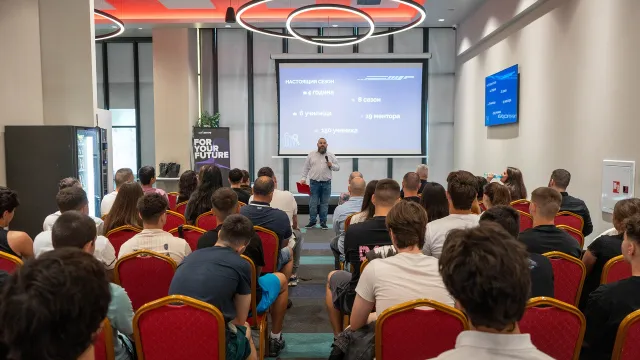
I believe that business can and must also support teachers – giving them access to the latest content, technologies and developments in the industry and bringing them closer to the classroom. In practice, we do this through the AIBEST Technical Academy. It connects schools with business. Students from grades 10 to 12 from different cities across the country work in teams on a real business case, supported by mentors from companies. Over the course of three weeks, they create a working product. There is no single correct answer – at the end, they present their solutions to a jury, which recognises the best projects and provides everyone with valuable feedback. In this way, students develop not only technical skills, but also some of the skills most valued for professional success – teamwork, communication, solving complex problems, flexibility and adaptability. We also track the results – how many participants choose technology and engineering specialisations and how many schools continue to work with us. One academy, however, cannot change the entire system. That is why we are in dialogue with MON, so that good practices can become models reaching many more schools. We believe that AIBEST and BRAIT can be a reliable partner for the state in the digital transformation of school education.