


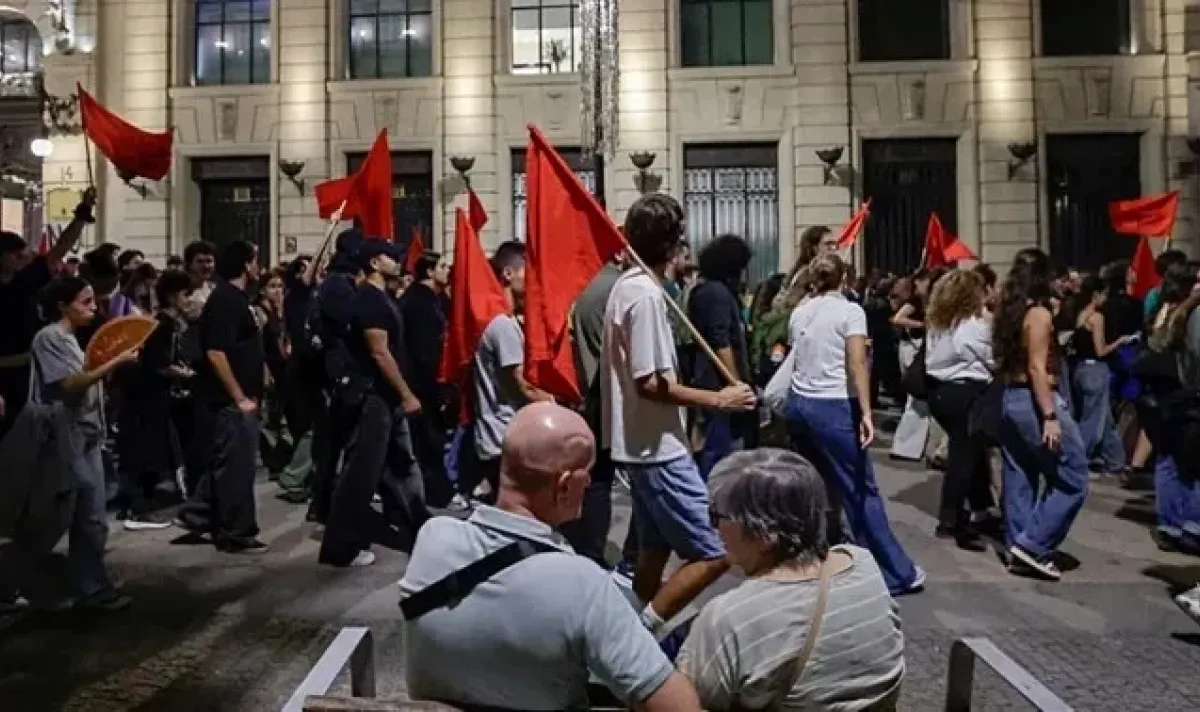

Hundreds of teachers blocked Madrid's central boulevard “Gran Vía“ for about an hour on Monday, October 26, during the ninth day of an indefinite strike in public non-university education. The National Police restricted the movement of the procession and at the end of the protest used force against some demonstrators. Traffic was restored around 2:00 p.m.
The protest began in front of the Regional Education Office on “Alcalá“ street. Shortly before 1:00 p.m., teachers unfurled a large banner on a building at the intersection with “Virgen de los Peligros“ street with the inscription „Zarsalejo, negotiate with the public education“. They then headed towards „Gran Vía“, but were stopped by police vans between „Clavel“ and „Alcalá“ streets.
During the demonstration, the protesters chanted „Public education“, „Zarsalejo, sit at the table“ and „We are teachers, not criminals“. Tensions rose at the police cordon, and some of the participants shouted „Don't hit“. The information about the force used was confirmed by „El Pais“ and „Cadena Ser“; data on serious injuries or detentions in the action of October 26 are not mentioned in these publications.
The dispute is about hours, salaries and conditions in schools
The indefinite strike began on October 14. The unions CCOO, UGT, CGT, STEM, CNT and “Solidaridad Obrera“, as well as teachers' organizations, are participating in it. They are demanding that teaching hours be reduced to 17 per week in secondary schools, vocational education and specialist forms, and to 22 hours in primary schools.
Among other demands are a reduction in the number of students per class, more specialists to support students with special educational needs, a reduction in administrative work, improvements to the building stock and a salary increase of 600 euros per month.
Regional Education Minister Mercedes Zarsalejo insists that the demands are unfeasible and that the salary increase alone would cost over 700 million euros per year. The strike committee, for its part, claims that the regional government is not fulfilling its obligation to negotiate with it and has announced its intention to go to court if talks do not begin.
Madrid and central government take different positions
The president of the Madrid autonomous community, Isabel Díaz Ayuso, described the strike as political and called the protesters aggressive. Spanish government spokeswoman Elma Sais rejected this definition.
“It is irresponsible and unacceptable not only to call them a choir, but also to call them aggressive“, Sais said.The data thus verified does not confirm the claim that the Spanish central government has condemned the protests. On the contrary, it defended the teachers and criticized the way the regional government described the demonstrations.
The strike committee said it would continue the protests and take legal action if negotiations failed. Separately, the regional education minister has scheduled a meeting with the private and charter school union, further increasing the dissatisfaction of the strike organizers in the public sector.
Sources: elpais.com, cadenaser.com, infobae.com