


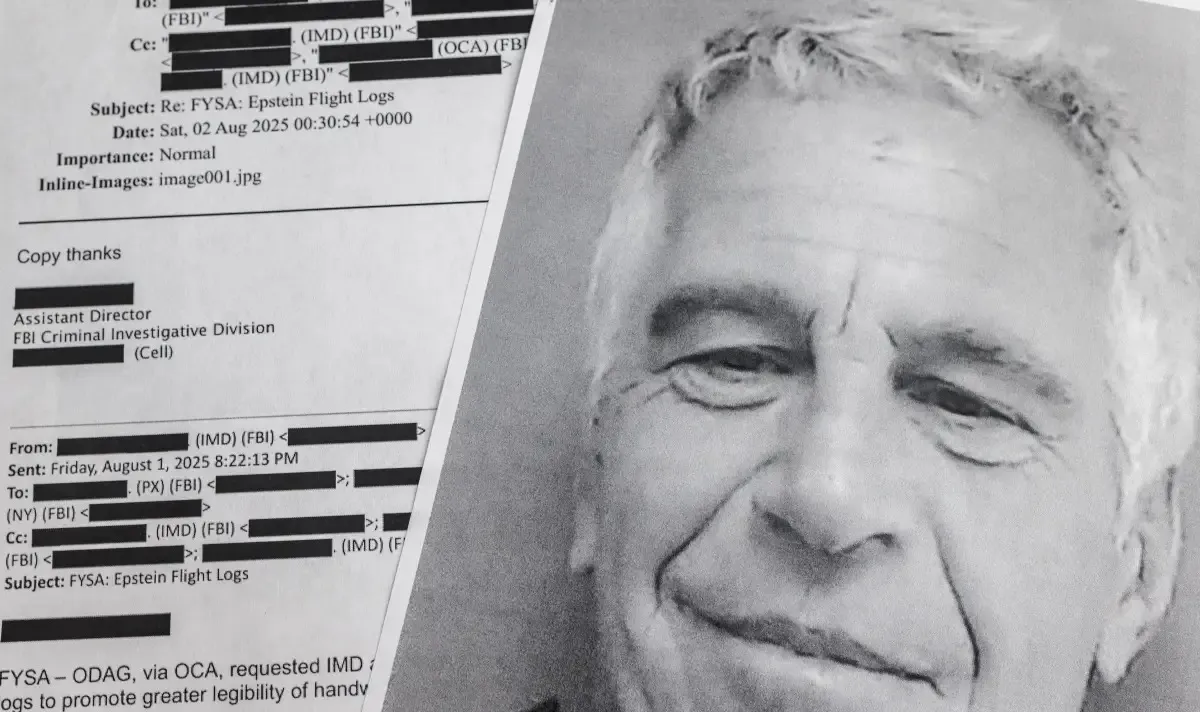

Forensic medicine professor Michael Freeman said he believes Jeffrey Epstein did not die by suicide in prison, but was the victim of a homicide. In an interview with BBC Newsnight, he said that after reviewing the autopsy file, he believed Epstein had been strangled, probably from behind.
Freeman analyzed the materials for about a year. The file, which included photographs and medical documents, was provided to him by Epstein’s brother, Mark. The expert also prepared a three-dimensional biomechanical reconstruction to assess whether the injuries described could have been sustained in a suicidal hanging.
Injuries the expert says cannot be explained by hanging
Freeman points to a second mark on the neck, located below the main ligature mark and at a different angle. He said the body also bore marks resembling fingernail scratches, as well as deep bleeding in the soft tissues of the left shoulder.
He further claims that injuries to Epstein’s face and back could have resulted from an attack and a struggle. According to the expert, some of the injuries are consistent with hanging, but the combination of all the findings cannot be explained by that theory.
“We have far too many other injuries that cannot be explained by suicidal hanging,” Freeman said. He proposes strangulation with a narrow textile loop pulled from behind as a more likely explanation.
Official conclusion remains unchanged
Epstein was found dead in his cell in Manhattan on August 10, 2019, while awaiting trial on federal charges related to sex trafficking. New York City’s chief medical examiner determined that the cause of death was hanging and the manner of death was suicide.
The US Department of Justice confirmed that conclusion following an investigation published in 2025. The report described serious failures at the jail, including lapses in checking inmates and the falsification of records by two employees. However, the investigation found no evidence of criminal wrongdoing against Epstein.
Former New York City chief medical examiner Barbara Sampson also defended her initial assessment. Thus, Freeman’s claims remain an independent expert analysis that casts doubt on the official version, but does not replace it with a new judicial or institutional finding.
Sources: cbsnews.com, the-independent.com, thedailybeast.com