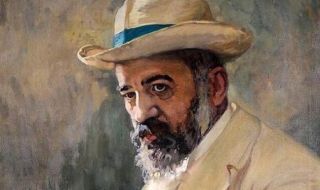
On June 10, 1912, in Lago di Camo, the great Bulgarian poet Pencho Slaveykov dies in exile.
He was born in 1866 in the town of Tryavna, in the family of Irina and Petko Slaveykov, who had 6 more children - Hristo, Ivan, Racho, Rayko, Donka, Penka. It was difficult for the father to take care of him, but he found money to send his son to school. He studied in Stara Zagora, where in 1876 his father was appointed a teacher.
He witnessed the burning of the town during the Russo-Turkish War, the memory of which remains forever in his mind. These “memories that have grown so deeply into the soul“ served Slaveykov in his work on “Bloody Song“. The Slaveykov family barely escaped the fires and gathered in Tarnovo.
After the end of the war, they moved to Sliven, and in 1879 - again to Tarnovo, where Petko Slaveykov published the newspapers “Osten“ and “Tselokopna Bulgaria“, and Pencho Slaveykov participated in their distribution. At the end of 1879, the family settled in Sofia, where Slaveykov studied until 1881. After the introduction of the Powers of Attorney, his father, one of the leaders of the Liberal Party, was arrested, after which he left for Eastern Rumelia.
Pencho Slaveykov continued his education in Plovdiv. In 1883, he was one of the leaders of the student unrest in the Plovdiv Real Gymnasium against the poor teaching of subjects, after teachers such as P. R. Slaveykov, Petko Karavelov and Trayko Kitanchev were replaced with "perfumed donkeys and mentally barefoot educators", recalls the Bulgarian National Radio.
At that time, he was under the influence not only of his father, but also of his father's friend Petko Karavelov. During these years, his love for folk art was born. The father and children wrote down folk tales, songs, legends, ancient traditions. Slaveykov often accompanied his father on his travels to different parts of Bulgaria for linguistic, ethnographic and folklore research, studying the art and language of the people from the original sources.
In January 1884, he fell asleep on the frozen Maritsa River and became seriously ill. Despite prolonged treatment in Plovdiv, Sofia, Leipzig, Berlin, Paris, he remained damaged for life - he had difficulty moving (he moved with a cane), wrote with difficulty and spoke with difficulty. After a three-month struggle with death, Slaveykov gave himself up to dark thoughts, suffered from attacks of melancholy, from which he sought a cure in books and in his work.
To get out of the severe crisis, he was helped by the books of Ivan Turgenev and V. G. Korolenko "Living Relics" and "The Blind Musician". In the fight against adversity, Slaveykov tempered his will and began to view suffering as a great teacher, elevating the spirit. This idea later found artistic expression in a number of works (“Cis moll“ and others). The view of suffering was also strengthened by his contact with the works of Henrik Ibsen, Friedrich Nietzsche, Heinrich Heine and others. After the misfortune, Slaveykov also developed a tendency to creatively comprehend loneliness. The poems he wrote at that time were influenced by Heine, whose works he read in Russian translation.
In the middle of 1884, Pencho Slaveykov's family returned to Sofia. In 1885, he became close to Aleko Konstantinov. The two collaborated on the magazine “Biblioteka Sveti Kliment“ with translations of Russian poets. This strengthens Slaveykov's critical attitude towards Stambolovism and the Bulgarian socio-political reality of the time in general, and nourishes his political democratism.
A critical-social pathos permeates many of his poems from the late 1880s and the first half of the 1890s (“Fatherland“, “Beloved Padishah“, “Smoke to God“, “Mango and the Bear“, “Tsar David“ and others). At the same time, Slaveykov also writes intimate lyrics. He collects them in his first book “Tears of Lily“, created under the unassimilated influence of Heine. Quickly realizing its immaturity, a year after its release Slaveykov confiscated the unsold copies to burn them.
In 1892, Slaveykov went to study philosophy in Leipzig. From there, he regularly collaborated with the magazines “Misul“ and “Bulgarian Collection“, created the poems “Ralitsa“, “Boyko“, “Nerazdelni“, and other classical epic songs, the first chapters of the epic “Kurvava pesen“, many of the miniatures in “San za sastesiya“. His acquaintance with Mara Belcheva, with whom they had similar interests as poets and writers and remained close friends for life, proved to be very useful for his work.
As a student, Slaveykov set himself the task of broadening his life, philosophical, and aesthetic horizons, and of studying with great artists. The lectures he attended attested to his many-sided interests: the neo-Kantian aesthetician Johannes Folkelt read about the history of new philosophy, general aesthetics, aesthetics of poetic art, and aesthetics of drama; the idealist philosopher, experimental psychologist, physiologist, and folklorist Wilhelm Wundt - psychology, ethics, and history of philosophy; E. Elster - history of German literature; Vülker - lectures on the work of William Shakespeare; Wollner - on the folk epic of the southern Slavs, etc.
Slaveykov's interest in painting and sculpture led him to the Leipzig Society of Art Lovers, of which he was a member. He was also a member of the Leipzig Literary Society. He attended numerous theatrical premieres. He immersed himself in the work of Johann Wolfgang Goethe and Heinrich Heine, read studies about them, was interested not only in their artistic work, but also in their philosophical and aesthetic views. Among the dozens of contemporary German poets who held his attention, Theodor Storm, D. Lilienkron, R. Demel, G. Falke, N. Lenau stood out. Through German translations, Slaveykov became acquainted with Scandinavian literature, studied the work of Henrik Ibsen, J. Jacobsen. He was the first in Bulgaria to become acquainted with the ideas of the Danish philosopher Søren Kierkegaard. He read the works of Georg Brandes, K. Lange, Arthur Schopenhauer, Friedrich Nietzsche.
With his versatile interests, with his inexhaustible wit, he gained authority among Bulgarian students in Leipzig. In his first year of study, he was elected chairman of the Bulgarian section of the Slavic Academic Society, and the following year he became chairman of the society. He prepared a dissertation on the topic of "Heine and Russia" but did not complete it because he was unable to work, as he had intended, in Russian libraries.
In Leipzig, Slaveykov completed (1896) book 1 of "Epic Songs", prepared book 2, and continued to create intimate lyrics, rising above his early lyrical works. The collection of poems "Dream of Happiness" is the fruit of many years of creative work in this direction. He sent his first critical texts, which were published in the newspaper “Zname“.
Slaveykov returned to Bulgaria in early 1898 and in the same year became a full member of the Bulgarian Literary Society, today the Bulgarian Academy of Sciences. He was appointed a teacher at the Sofia Boys' High School and was seconded to the National Library in Sofia. He became a close assistant to Dr. Krastyo Krastev in editing the magazine “Misl“ and was at the center of the literary circle “Misl“.
A very important aspect of his life and spiritual path was his love for the poet Mara Belcheva, widow of a deceased Bulgarian minister. He connected his life with her in 1903, but met the disapproval of Ferdinand and the court circles. Together they translated “Thus Spoke Zarathustra“ by Nietzsche. For years they worked together on his poem “Bloody Song“.
Pencho Slaveykov was deputy director (1901 – 1909) and director (1909 – 1911) of the National Library, director of the National Theater (1908 – 1909). In September 1908, he undertook a tour of Macedonia with the theater, which in Bitola, Prilep and other settlements became a cultural and public manifestation, the inspiration of which was the poet-director. During his short stay at the National Theater, Slaveykov proved to be an energetic, highly erudite and talented manager and director. Defending the independence of the theater from incompetent interference, he came into conflict with the Minister of Education Nikola Mushanov and left.
In 1909, he was sent to Moscow to participate in the celebration of the 100th anniversary of the birth of Nikolai Gogol. Together with Professor Vasil Zlatarski, he brought back to Bulgaria the bones of Marin Drinov and his library. From Russia, Slaveykov wrote several letters to Mara Belcheva, in which he appeared as a patriot and anti-monarchist, a humanist and a democrat. During the casion Slavic Council (1910), as a democrat and supporter of the idea of Slavic unity on purely cultural grounds and based on fraternal consent, Slaveykov protested in an open letter to the delegates of the council and in a speech at a public meeting.
In early March 1911, he was sent on a mission to Constantinople, Athens, Naples, Sorrento, and Rome to get acquainted with the library buildings and the development of library work. After returning to Sofia, Slaveykov devoted himself to feverish work: he completed part 2 of “Bloody Song“ (IV-VI songs), and prepared the anthology “German poets“.
On July 10, 1911, the Minister of Education Stefan Bobchev dismissed him from the post of director of the National Library and appointed him curator of the school museum at the Ministry of Education. Slaveykov did not take up the position and went abroad. Before leaving, he chaired a meeting at which a branch of the "Friends of the Russian People" society was established (with Anatole France as chairman). At the end of August, Slaveykov was in Zurich, where he was met by Mara Belcheva.
He lived in various villages - Lucerne, Hofflu, Gorat, Göschenen, Andermatt, Lugano. The strong mental oppression worsened his health. Slaveykov made heroic efforts to work. At the end of November, he arrived in Italy. He stayed in Rome for the longest time - 3 months. Later, he went to Florence, and from there to Milan. In Milan he stayed at the Hotel “Manin“, where he finished some of his last works. In May 1912 he was on the road again - through Florence, to the Engadin, to the mountains, seeking a cure for body and soul. At the end of the month he arrived in the small resort town of Brunate, located between Lake Como and the city of Como (Italy), where he died on June 10. In Bulgaria, which in less than four years would adopt the Gregorian calendar, it was still May 28. He was buried in the village cemetery, and in 1921 his bones were transferred to Bulgaria.
Due to his untimely death, the proposal of the Swedish academician Alfred Jensen, translator of “Blood Song“ and other of his works, to be awarded the Nobel Prize was not considered by the Nobel Committee.