


When Tanya Moneva took over 131. SU "Kliment Arkadievich Timiryazev" - Sofia in 2018, the school had about 270 children. Today, they are over 1200, and the change is not measured only by the number of students. New professional classes, innovative subjects, technological training and a young pedagogical team are part of the vision for a school that wants to meet the changing needs of children and parents. On the threshold of the new school year, the principal Tanya Moneva spoke to FAKTI.
– Mrs. Moneva, on September 15 you will once again cross the school threshold together with the students. What is different this year and what would you like to remember the beginning of the new school year with?
– On September 15, we do not just cross the school threshold. We are once again opening the door to the future. What is different this school year are the new members of the big family of the 131st SU. These are the first-graders, who for the first time are 157 students in six classes. And the eighth-graders, who have chosen to stay at the 131st SU, will be trained in new professions - “Administrative and office activities“ and “Management and economics“. What is different this school year is also the third innovation, which has been approved by the Ministry of Education and Science - the integrative subject “KMIT and fine arts“. We are starting with new ideas and projects that will be implemented during the school year.
I hope that the beginning will not be another official ceremony that ends with the final applause. I want it to be a moment that leaves a lasting impression on everyone.
I want this September 15th to show something very simple, but very important - in a time when there is often talk about what does not work in education, we show what is possible when there is courage, a team and faith.
I want to remember it as the beginning of another year in which we will not be afraid to be different, to seek the new and to raise the bar. Because I believe that miracles in a school do not happen alone. They are created every day by people who refuse to say “this cannot be done”. There should be emotion, smiles and that special moment when everyone says: “Yes, this is where I want to be“.
– When you took over the 131st Sofia University in 2018, about 270 children studied at the school, and today their number is over 1200. What is behind this growth – results, change in the environment, teachers or trust of parents?
– Behind this growth is not just one separate factor, but a complete transformation and a continuous chain reaction. It all started with the change in the environment – both the purely physical base and the psychological climate.
Motivated and energetic teachers were attracted, who changed not only the lessons, but also the attitudes towards teaching.
When a modern approach is combined, that every teacher is an inspiration, and every child is important, the results are not long in coming. The achievements and successes of the students have become objective proof that the direction is right. When the results are available, the trust of the parents is gained, who have become our closest partners and the strongest ambassadors of the community. This is a perfect synergy - the new environment attracted the teachers, the teachers achieved the results, and the results gained the trust. Today, 131. SU is a close-knit community, in which every parent is a friend, every child is valuable, and success is a common cause.
– The latest results from the National External Assessment (NEO) in the 4th grade are impressive - 90.98 points in English and 83.44 points in mathematics, with 11 students with 100 points in both subjects. How did you manage to achieve these results and, most importantly, how do you maintain them without exam preparation becoming an end in itself?
– Not only are the results from the 4th grade of secondary education impressive, the results from the 7th grade of secondary education are also brilliant, because 131. SU ranks sixth among municipal schools. The successes are the result of a targeted long-term strategy of the school. Preparation begins from the first lesson. With us, teachers focus on thinking, not on algorithms. They teach students to apply formulas and rules in new, non-standard situations. Errors are analyzed in detail. We organize mock exams. This helps students to build a strategy for allocating time and managing stress. Behind these results is the work of the teachers, of the team that I created and motivated to work.
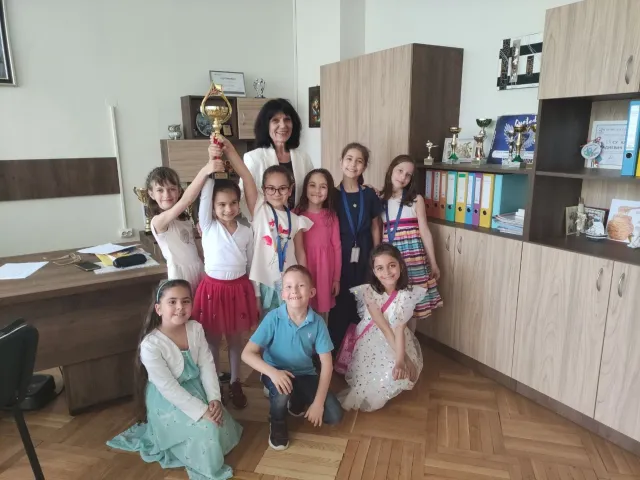
– You say that parents are the most loyal partners of the school. How has the attitude of parents towards 131. SU changed over the past seven years?
– This change is not accidental, but is the result of the purposeful development of the school. Here is how the dynamics of parent-school relations changed during this period: before, parents often perceived meetings as a formality and were involved mainly when a problem arose or around final grades.
Now, thanks to the innovative profile of the school (including its status as an innovative school with an emphasis on technology and modern methods), parents recognize each other as like-minded people. They actively participate in school life, support extracurricular initiatives, green schools and projects.
After seeing the real results - successes in national external assessments, prizes won in olympiads and competitions, parents vote full trust in the management and teachers. Parents seek out 131. SU not simply by geography (as a neighborhood school), but consciously because of its reputation as a competitive and safe environment for their children.
Communication has become much faster, more direct and effective.
The use of electronic diaries, feedback platforms and closed information channels has shortened the distance. Parents no longer learn about their children's successes or difficulties with months of delay, which has turned teachers and families into constant allies in real time. Ultimately, over the past seven years, 131. SU has managed to build a community in which parents are not just bystanders, but an active driver and support for school success.
– The school has integrative subjects such as “Mathematics and Technology“, “Pen Through the Ages“, and elements of artificial intelligence are now also used in the learning process. Where should the boundary be – how can technology help the teacher without replacing human contact?
– Yes, this is the future. Artificial intelligence is dynamically entering the educational sphere because it opens up new horizons for personalized learning. For this process to be successful, technology must play the role of a reliable assistant, not a substitute for the human factor. Artificial intelligence can process data, but not empathize. The teacher can encourage students to criticize the answers of artificial intelligence, teaching them to be independent thinkers, not blind users of ready-made solutions. The classroom must remain a space of lively dialogue, where mistakes are met with understanding, not with impartial dialogue. Artificial intelligence will never replace human contact, because after all, man is a social being.
– You talk a lot about the young pedagogical team – the average age of teachers is 33 years. How do you manage to attract young teachers and what do you give them to stay at the school?
– Young people are looking for places where technology, interactive whiteboards, STEM classrooms and modern teaching methods are not a luxury, but a standard, and 131. SU attracts with its vision of a “School of the Future“. The interviews focus on a conversation about the candidate's values, motivation, creativity and desire for development.
I give them freedom and security.
Young specialists come with new ideas and have the opportunity to try, without fear that if something doesn't happen perfectly, punishment will follow. At school, good practices are shared and we work as a real team. What I tell them is that I don't expect them to come into class as the perfect teacher from day one, but we will help them and we will succeed together.
– How does a young teacher get motivated to stay at work, how do you retain them?
– Giving young teachers the opportunity to experiment and apply innovative methods, technologies and interactive approaches in class makes them more engaged, turns work into a creative process. I hold conversations with them and give everyone the opportunity to share their ideas. Inclusion in interesting seminars, in national programs, convinces a young teacher that the profession offers dynamics and travel. The opportunity to acquire professional qualifications gives a long-term perspective.
– In which subjects are teachers most difficult to find and retain?
– Information technology and mathematics. A school cannot compete with large companies and firms. This is a problem for all schools.
– To what extent do children actually participate in making decisions about school life, and not only in organized initiatives?
– There is a working Student Parliament in the school. Students actually organize and hold their own initiatives and events. For example, the Pink Shirt Day was organized by the Student Parliament and raised a strong and categorical message: “NO to bullying!“ Students, teachers and the school management united around it.
– Like any large neighborhood school, 131. SU probably has problems with discipline and relationships between students, parents and teachers. What is the biggest challenge in this direction at the moment?
– Digital anonymity and escalation. Sometimes anonymous signals are submitted that are caused by unfounded dissatisfaction. This makes it difficult to resolve cases, if any at all. The balance between the authority of the teacher and the rights of the student or parent is disrupted. In the modern educational environment, it is important to consider complaints objectively in order to protect both the psychological comfort of children and the peace of mind of teachers.
– Some of the students after the 4th grade continue in SMG, NPMG and NGDEK, but the majority remain in 131. SU after the 7th grade. How ambitious is your school to retain more and more strong students in the high school stage?
– Yes, in my first years, a large part of the 4th grade students left the 131st Secondary School, but the introduction of innovative subjects in junior high school changed this trend and now the school is a preferred choice.
After the 7th grade, students and their parents choose the path they will continue on, according to the interests and skills of the child. They choose different professions or a foreign language. The attitude is still that students continue in language and mathematics high schools. In order to be a desirable and preferred school after the 7th grade, we offer training in professional classes with advanced study of English and Spanish.
– If you go back to 2018, when you took over the school with 270 students, what would you say to that principal who was just starting the change? And what is the next big goal for the 131st SU?
– You must know what to do. Do it as only you can and know how! A magician never reveals his secret, wait and you will see the next big goal for the school realized.