


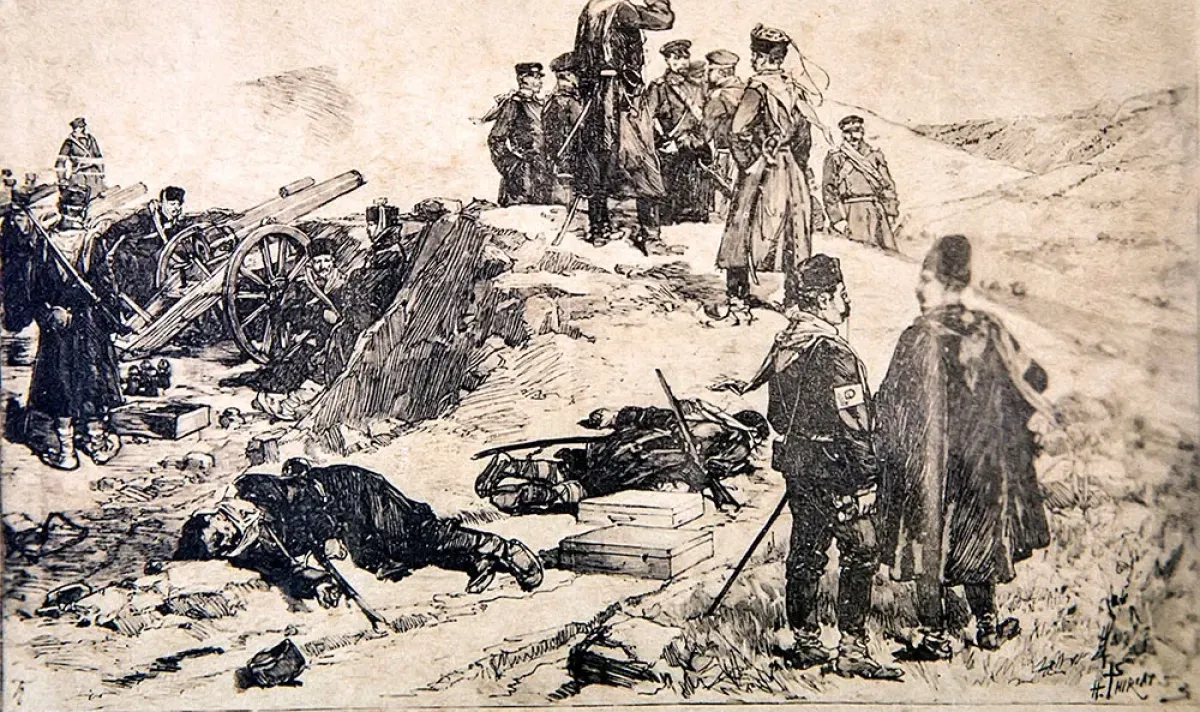

On November 5, 1885, the Battle of Slivnitsa began – the decisive engagement during the Serbo-Bulgarian War. The fighting lasted three days, from November 5 to 7, and went down in history as the baptism of fire of the young Bulgarian army. The victory at Slivnitsa defended the Unification of the Principality of Bulgaria with Eastern Rumelia, proclaimed on September 6 of the same year.
The front line was divided into three sectors. At the beginning, around 12,000 Bulgarian servicemen faced approximately 25,000 Serbian soldiers. At around 9 a.m. on November 5, the Serbian forces launched an offensive, but the battery commanded by Captain Georgi Silyanov repelled them without casualties. On the orders of Prince Alexander I of Battenberg, the Bulgarians launched a counterattack near the village of Malo Malovo, forcing the Serbian forces to retreat.
The decisive day was November 7
After reinforcements arrived, the strength of the Bulgarian forces reached around 32,000 men, while the Serbian forces numbered around 40,000. The Serbian Morava Division, delayed the previous day by Captain Stefan Kisov’s detachment of nearly 2,000 men, resumed its advance towards the Bulgarian positions.
On the right flank, at the Tri Ushi Heights, Captain Marin Marinov, commander of the Vidin Regiment, led a bayonet charge with the command “To the bayonets!”. He personally took the lead of his men and was killed in the battle. The Serbian command sent fresh forces against the heights, while Bulgarian units from the central sector also advanced towards them.
On the decisive day, the Serbs had numerical superiority – 89 companies against 64 Bulgarian ones, and 66 guns against 24. Despite this, the Bulgarian troops seized all the peaks of Tri Ushi and saved the Slivnitsa position.
The victory changed the course of the war
After the success at Slivnitsa, the Bulgarian army went on the offensive and entered Serbian territory. Thus, the defensive battle became a turning point for the entire war.
According to widely circulated Bulgarian historical references, the casualties amounted to around 1,800 Bulgarian servicemen killed and wounded and around 2,100 Serbian casualties. The National Museum of Military History describes the fighting from November 5 to 7 as the battle that created the conditions for the subsequent Bulgarian counteroffensive towards Pirot.
The significance of Slivnitsa went beyond the outcome of the specific battle. The victory showed that the young Bulgarian state could defend the Unification by force of arms and repel an army that, at the beginning of the war, had a significant numerical and artillery advantage.
Sources: bta.bg, bnr.bg, armymedia.bg