


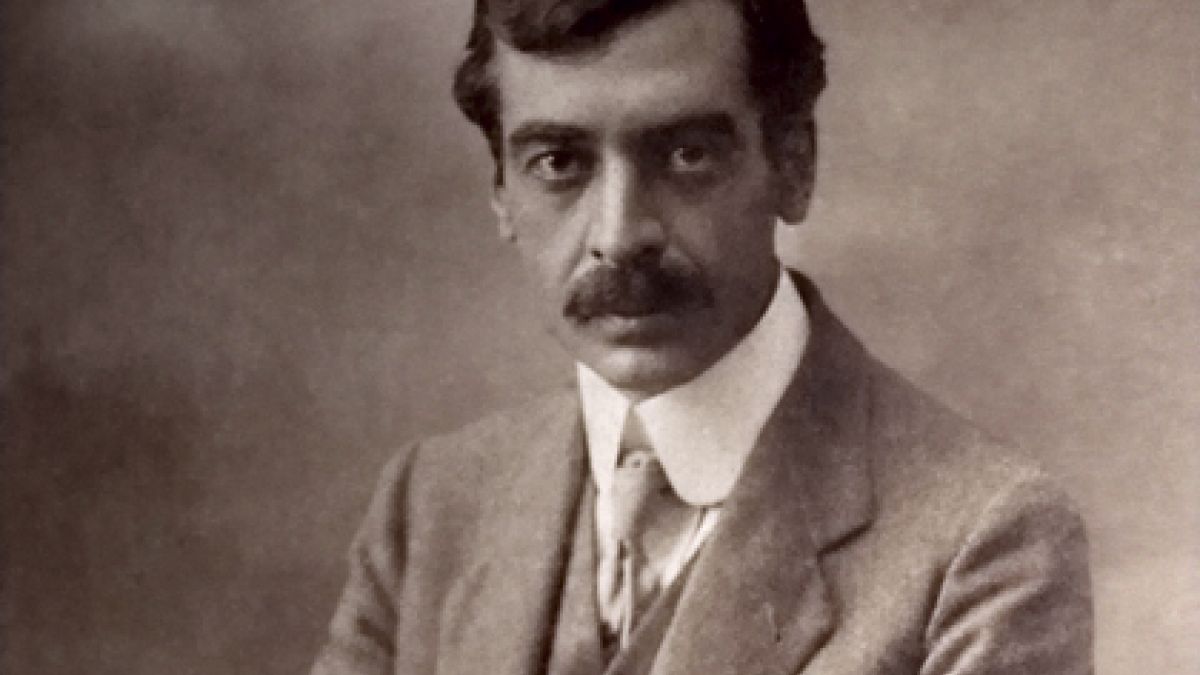

On October 29, 1914, the unfortunate Bulgarian poet drank the poison, pulled the trigger and left an entire nation orphaned, who to this day ask themselves: “Why were we silent? Why did we abandon him?”.
And he, the poet – despite the tragic impasse of his life, even at the cost of death – had found the strength to believe in the light:
You will come, the expected day.
I lost human strength
in insomnia during a long night.
You will come, savior-day.
Spreading purple and rays,
turning his eyes to eternity,
the dawn will dawn over me.
(“You will come”)
Today at 11 a.m., exactly 105 years after his untimely death, the National Literary Museum is organizing a pilgrimage to his grave.
Peyo K. Yavorov is buried in The central Sofia cemeteries, alongside his wife Lora Karavelova, recalls BGNES.
Peyo Totev Kracholov, better known as Peyo Yavorov,
is a Bulgarian symbolist poet and revolutionary, leader of the Internal Macedonian-Adriatic Revolutionary Organization, considered one of the greatest Bulgarian poets of the 20th century.
He was born in the town of Chirpan on January 14 (January 1, old style) 1878. He graduated from the 5th grade of high school in Plovdiv. From 1897 to 1900 he worked as a telegraph postman, changing different settlements – Chirpan, Stara Zagora, Sliven, Straldzha, Anhialo, Sofia.
At that time he sympathized with the Bulgarian Workers' Social Democratic Party.
After 1897 he came into contact with the Internal Macedonian-Adriatic Revolutionary Organization. From 1901 to 1902 he edited its legal organ, the newspaper “Delo“. In 1902, at the 10th Macedonian Congress, he was elected a member of the VMOK Stanishev-Karayovov. He first entered Macedonia as a Chetnik of Mihail Chakov in 1902. He was captured soon after by a Verkhovna Rada detachment and returned to Bulgaria. Initially, he was the editor of various publications related to the Macedonian-Adriatic revolutionary movement – „Delo“, „Svoboda ili smrt“, „Autonomia“, „Ilinden“.
His first published work was the poem „Napred“ in the newspaper „Glas makedonski“.
He was a Chetnik of Yane Sandanski and became one of the most active associates of Gotse Delchev and his first biographer – „Gotse Delchev“ (1904). At the Kyustendil Congress of the VMORO he was elected an additional member of the Foreign Representation of the VMORO. In 1909 he published his memoir-essay book „Hajdushki kopneniya. Spomeni ot Makedonija 1902 – 1903“. A personal friend of Peyo Yavorov was Peyo Garvalov - drama voivode of VMORO, also from Chirpan. Having settled in Sofia with the assistance of Dr. Krastyo Krastev and Pencho Slaveykov, Yavorov became a collaborator and editor of the literary magazine "Misal" published by them. His first work, which strongly impressed the aesthetes of the "Misal" circle and became an integral part of it, was the poem "Calliope".
In 1901 he published his first collection of poems "Poems", the second edition of which in 1904 had a foreword by Pencho Slaveykov. During this period, the poet worked as a librarian, and later as a playwright at the National Theater. The fruit of his work in the theater were two plays - “At the foot of Vitosha“ (1910) and “When thunder strikes, how the echo fades“ (1912). Having been sent abroad several times to improve his literature skills - in Nancy, Geneva, Vienna, Paris, Yavorov read modern French poetry extensively.
In 1905 he became close friends with Dora Gabe. In 1906 he fell in love with Mina Todorova, sister of P. Yu. Todorov, but soon after, during one of his trips (1910), he sent his beloved to her last home, who died of tuberculosis in a sanatorium and was buried in Paris, France. In 1907, his second collection of poems, "Insomniacs," was published, which finally paved the way for modern Bulgarian lyric poetry.
Yavorov's symbolist poetry, metaphysical, imbued with deep skepticism and insights into the eternal questions that no century has resolved, radically changed Bulgarian literary thinking and imposed a new way of writing. In March 1908, during the Kyustendil Congress of the Bulgarian National Library of the Republic of Bulgaria, although he was not present in person, he was unanimously elected by the delegates as an advisor (additional member) of its overseas representation.
A few days later, he left his job at the National Library in Sofia and devoted himself entirely to the problems of the Bulgarian National Library of the Republic of Bulgaria. In 1910, the poet's anthological book "After the Shadows of the Clouds" was published, the second edition of which in 1914 presented an overview of the poetic path, compared with that of Hristo Botev.
The same year, he participated in the restoration of the revolutionary organization and was elected a reserve member of its Central Committee.
At the outbreak of the Balkan War in 1912, he volunteered in the Macedonian-Adriatic Volunteers and headed partisan detachment No. 15,
composed of 9 people. He moved along the valley of the Mesta River and reached the White Sea near Kavala. He was awarded the Cross “For Bravery“. He became the first mayor of Nevrokop after its liberation in 1912, recalls “Wikipedia“.
The poet's sensitive soul had a hard time getting used to the vanity and poverty of the literary and secular customs in the capital. Lora Karavelova, daughter of the statesman Petko Karavelov, whom he married in 1912, shortly before leaving for the front in Kyustendil, was the woman whose love proved fatal for him. The preserved correspondence between them, literature in itself, testifies to a fiery and stormy love, marked by many doubts and many passions.
The tragic end came on November 29, 1913, when Laura shot herself,
and Yavorov attempted suicide (he left a one-line suicide note: “My dear Laura shot herself. I will follow her“). The shot only pierced his temple and blinded him. Devastated by the trial and the rumor that accused him of being a murderer, on October 29, 1914, the poet took a large dose of poison and shot himself.
Yavorov's creativity and poetry are imbued with tragedy, born of his dramatic life, full of disappointments. He was greatly disappointed by his father's decision to discontinue his education and start working in the telegraph service. In the circle "Misl" he found understanding and received his pseudonym Yavorov from Pencho Slaveykov, but poetry did not satisfy him - he passionately wanted to participate in the struggles for the liberation of Macedonia.
A strong emotional blow was dealt to him by the death of Gotse Delchev in 1903, when he partially separated from his revolutionary activities due to a disagreement with Yane Sandanski. The last straw for Yavorov was the death of Mina Todorova and the accusations of the murder of Lora, which led him to suicide. Until the end of his life, he was friends and corresponded with the leader of the VMORO Todor Alexandrov, and also carried out his orders. It is believed that the poison and the pistol that served for the suicide of Peyo Yavorov were given to the writer himself at the request of Todor Alexandrov. Their long-standing friendship was hidden for many years from socialist historiography.
The poet's birthplace in Chirpan was converted into a museum in 1954. His home in Sofia is also a museum, and although the building itself is in urgent need of renovation, the museum continues to receive a large number of visitors.